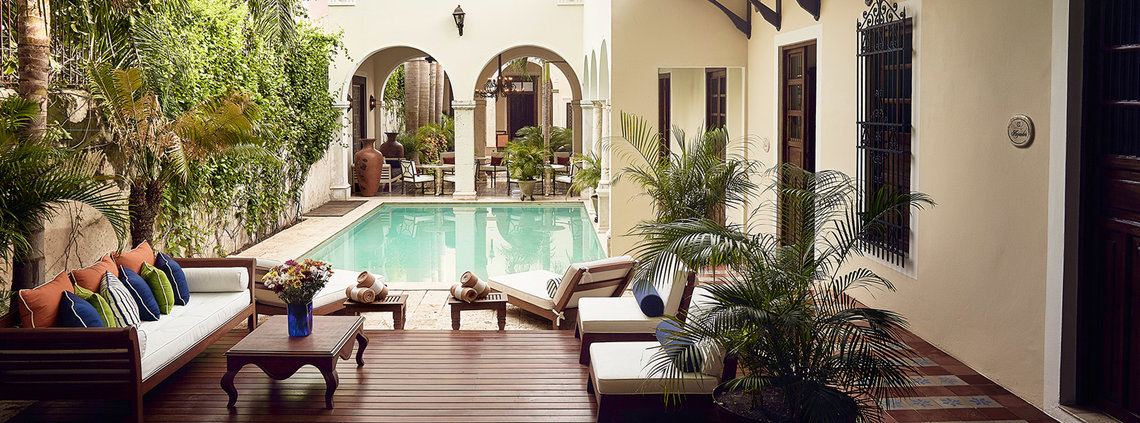
Where you stay changes how Mérida works. A hotel that looks close on a map can become inconvenient after several walks in the midday heat, while a quieter property outside the historic center may leave you taking a car for every meal.
For most first visits, the simplest answer is to stay in Centro Histórico and then choose the part of Centro that suits you. Santa Lucía is strong for restaurants and evenings. Santa Ana is the most balanced central base. Santiago is calmer and often better value. The Plaza Grande core gives you the shortest walks but also the greatest chance of noise.
This guide compares the areas travelers are most likely to book. It focuses on practical differences: walking, dinner options, parking, day-trip access, family suitability, noise, and how much you will depend on taxis or rideshare.
Use it alongside the best hotels in Mérida, Centro hotels guide, boutique hotels guide, and Mérida transport guide.
Quick answer: where should you stay in Mérida?
| Traveler type | Best area | Main reason | Main drawback |
|---|---|---|---|
| First-time visitor | Santa Ana or central Centro | Easy walking, restaurants, simple city layout | Heat, traffic, and possible street noise |
| Food-focused trip | Santa Lucía and the Calle 47 area | Strong dinner choice and evening atmosphere | Busy nights and awkward parking |
| Couple wanting a boutique stay | Santa Ana or lower Paseo de Montejo | Attractive hotels, architecture, central location | Some properties are farther from Plaza Grande than they appear |
| Family with children | Santa Ana or a quiet Centro hotel with a pool | Shorter journeys and easy taxi fallback | Uneven sidewalks and limited shade |
| Budget traveler | Santiago or wider Centro | Markets, simple meals, less taxi spending | Fewer polished restaurants on the doorstep |
| Longer stay or remote work | García Ginerés or Itzimná | Quieter residential rhythm and more space | You will use rideshare or a car more often |
| Frequent trips to Progreso or the north coast | North Mérida or the Paseo area | Easier access toward the northern highway | Poor base for walking Centro |
| Mostly city sightseeing without a car | Centro, Santa Lucía, Santa Ana, or Santiago | Most daily needs can be reached on foot | Central parking can be difficult |
| Late airport arrival | Centro, Santiago, or the western side of the center | More direct than crossing the city to the north | Check reception hours before booking |
For a normal three- or four-night first trip, Santa Ana is the safest all-round choice. Stay closer to Plaza Grande if you want maximum convenience, or choose Santiago if you prefer a calmer neighborhood feel.
Understand Mérida's geography before booking
Centro Histórico is not one small district around Plaza Grande. It is a broad historic grid containing several traditional barrios, including Santa Lucía, Santa Ana, Santiago, Mejorada, San Sebastián, and La Ermita.
Hotel listings do not always use these names consistently. A property may describe itself as “Centro” while sitting a 25-minute walk from Plaza Grande. That can still be a good location, but it is not the same experience as staying beside the cathedral.
Always check the exact pin and ask three questions:
- How long is the walk to Plaza Grande?
- Are there restaurants open nearby after dark?
- Will you need to move the car every time you enter Centro?
Walking times below are approximate. In Mérida, a 20-minute walk at 8:00 am feels different from the same walk at 2:00 pm.
Neighborhood comparison
| Area | Plaza Grande access | Evening food | Typical noise | Parking | Best for |
|---|---|---|---|---|---|
| Plaza Grande core | 0–10 minutes on foot | Excellent | Medium to high | Difficult | First visits and short stays |
| Santa Lucía | About 8–15 minutes on foot | Excellent | Medium to high | Difficult | Food, couples, lively evenings |
| Santa Ana | About 15–25 minutes on foot | Very good | Medium | Mixed | Families, couples, boutique stays |
| Santiago | About 15–25 minutes on foot | Good but more local | Low to medium | Usually easier | Budget and repeat visitors |
| La Ermita / San Sebastián | Usually 15–30 minutes on foot | Limited to moderate | Low to medium | Mixed | Atmospheric hotels and slower stays |
| Lower Paseo de Montejo | About 20–30 minutes on foot | Very good | Medium | Mixed | Architecture and boutique hotels |
| Itzimná | Usually a short ride | Good in pockets | Low to medium | Easier | Longer stays and residential calm |
| García Ginerés | Usually a short ride | Good in pockets | Low | Easier | Families, remote work, longer stays |
| North Mérida | Usually 20–40 minutes by car | Strong but dispersed | Low to medium | Usually easy | Business, malls, coast access |
Traffic, rain, roadworks, and the time of day can change driving times considerably.
Plaza Grande and the central core
The blocks around Plaza Grande are the easiest base for a short first visit. The cathedral, Palacio de Gobierno, museums, Calle 60, markets, restaurants, and evening events are close enough that you can return to the hotel between outings.
This is particularly useful when you only have two or three nights. You spend less time working out transport and can start sightseeing early before the heat builds.
The main drawback is noise. Rooms facing busy streets, plazas, hotel courtyards, or ground-floor common areas may hear traffic, music, church bells, arriving guests, and early cleaning. Colonial buildings can also carry sound differently from modern hotels.
Choose the central core if:
- this is your first visit
- you have a short stay
- you do not want a rental car in the city
- museums, markets, and evening events are priorities
- you prefer convenience over quiet
Think twice if:
- you are a light sleeper
- your hotel has no pool or shaded courtyard
- you plan to drive out of the city every morning
- you need easy, guaranteed parking
Read recent room-specific reviews rather than relying on the hotel's overall location score. The Mérida Centro visiting guide has a practical walking route and a clearer sense of how the central sights fit together.
GuideMérida Centro Visiting Guide: Plaza Grande, Markets, Museums & Walking RouteMérida Centro Histórico is the old grid around Plaza Grande in the heart of Mérida, Yucatán, encompassing the Cathedral, Casa de Montejo, Palacio de Gobierno, markets such as Lucas de Gálvez and San Benito, and the streets of Santa Lucía, Santa Ana, Santiago and La Mejorada. No admission fee is required to walk the area; individual sites may have separate opening hours, so check each building before planning a visit. The guide recommends arriving before 11 am or after the afternoon heat, and suggests a half‑day minimum, a full day for a relaxed itinerary, or two days if museums and food are a priority. Getting there is easiest on foot, by Uber/DiDi, taxi, Va‑y‑Ven bus or private transfer; a rental car is not needed and can be cumbersome in the narrow streets. A typical walking route from Plaza Grande north along Calle 60 to Santa Lucía and Santa Ana takes about two hours at a quick pace, but most visitors spread it over a half‑day with frequent pauses. Visitors can expect a lively mix of locals and tourists, uneven sidewalks, heat, and occasional traffic, balanced by shaded plazas, colonial façades and vibrant market stalls. Practical tips include wearing a hat, comfortable shoes, carrying water and cash, and being patient at crossings. Early mornings are best for markets; afternoons are suited to museums or cafés, and evenings offer pleasant plaza ambience with music and street food.Open
Santa Lucía and Calle 47
Santa Lucía sits inside Centro, north of Plaza Grande. The park and surrounding streets have one of Mérida's strongest concentrations of restaurants, boutique hotels, bars, galleries, and evening activity.
This works well for travelers who want to walk out for dinner without planning transport. Calle 47, sometimes promoted as a gastronomic corridor, extends the dining choice toward Paseo de Montejo.
The area can feel more polished and visitor-oriented than Santiago or the market districts. That is useful for a first trip, though repeat visitors may prefer somewhere more residential.
Best for: couples, food-focused trips, first-time visitors, travelers who like active evenings.
Main drawbacks: weekend noise, higher restaurant prices in some blocks, limited street parking, and more delivery or service traffic around popular venues.
Ask whether the room faces the street, the restaurant, the courtyard, or the back of the property. That detail can matter more than the hotel brand.
Use the Mérida restaurants guide to see whether the places you actually want to eat are within a comfortable evening walk.
Santa Ana
Santa Ana is the most balanced central base for many visitors. It sits between the deeper historic center and Paseo de Montejo, with a market, park, church, cafés, galleries, restaurants, and a good range of small hotels.
You can walk south toward Santa Lucía and Plaza Grande or north toward Paseo. When the heat becomes uncomfortable, rideshare journeys are usually short.
 Santa Ana church and neighborhood center in Mérida
Santa Ana is particularly useful for couples and families who want to remain central without staying directly beside Plaza Grande. It also has more mid-range and boutique options than some residential areas.
Best for: first visits, families, couples, boutique hotels, travelers splitting time between Centro and Paseo.
Main drawbacks: busy roads on some edges, uneven sidewalks, and noise around popular restaurants or public events.
Do not assume every “Santa Ana” hotel is on a quiet side street. Check the precise block, traffic direction, and recent comments about sound.
Santiago
Santiago is on the western side of Centro around Parque de Santiago and Mercado Santiago. It has a more residential rhythm than Santa Lucía, with local food, small shops, long-established homes, guesthouses, and restored colonial properties.
It remains walkable to Plaza Grande, but the trip is long enough that some travelers will use a taxi back after dinner or during the hottest part of the day.
Santiago can be a good-value choice if you want Centro access without paying for the most polished restaurant blocks. Its western position can also be practical for journeys toward the airport, Celestún, and western routes, although the exact advantage depends on traffic and your hotel's street.
Best for: budget travelers, repeat visitors, market food, longer Centro stays, travelers who prefer a neighborhood atmosphere.
Main drawbacks: fewer destination restaurants immediately outside the hotel, less visual polish in some blocks, and longer walks to Paseo de Montejo.
A hotel with a pool can make Santiago especially effective: explore early, return during the hottest hours, then go out again in the evening.
La Ermita, San Sebastián, and Mejorada
These historic barrios appear increasingly often in hotel and rental searches. They can offer beautiful streets, restored homes, churches, small parks, and a slower atmosphere than the busiest central blocks.
They are not interchangeable. La Ermita and San Sebastián sit south and southwest of the core, while Mejorada lies to the east. The important question is not only the barrio name but the exact street and what remains open nearby after dark.
These areas can work well when the property itself is part of the reason for booking: a characterful hotel, a private courtyard, a good pool, or a spacious house for a group.
Best for: repeat visitors, design-led stays, groups renting a house, travelers comfortable using rideshare.
Main drawbacks: thinner restaurant choice on some streets, uneven nighttime activity, and greater variation from one block to the next.
This is not the best option for a very short first visit unless the hotel is exceptional and you are comfortable taking short rides.
Paseo de Montejo
Paseo de Montejo is Mérida's historic mansion boulevard. It offers architecture, museums, cafés, restaurants, wider pavements in places, and several of the city's most polished boutique stays.
The location needs closer inspection than the label suggests. A hotel near El Remate and the southern end of Paseo can still feel connected to Santa Ana and Centro. A property near Monumento a la Patria is better treated as a short rideshare from Plaza Grande rather than a central walking base.
 Monumento a la Patria on Paseo de Montejo
Best for: architecture, museums, couples, boutique hotels, Sunday morning walks, travelers who prefer a more open boulevard setting.
Main drawbacks: distance from markets and Plaza Grande, traffic noise on the avenue, and hotel descriptions that use “Paseo” for properties several blocks away.
Paseo is convenient for driving north, but it does not remove the need for a car or rideshare if you are staying near the upper end. See the boutique hotels guide for specific properties.
GuidePaseo de Montejo: A Complete Guide to Mérida’s Grand AvenuePlan a thoughtful walk along Paseo de Montejo in Mérida, from the historic mansions and Palacio Cantón to Monumento a la Patria, Sunday Biciruta, museums, transport, and nearby stays.Open
Itzimná
Itzimná begins beyond the northern edge of Centro and extends around the traditional neighborhood center, Avenida Rómulo Rozo, and the eastern side of the Paseo corridor.
It is quieter than Centro and has restaurants, cafés, specialist shops, and larger residential properties. It works better as a lived-in base than as a sightseeing base.
You can walk locally, but most visitors will use a car or rideshare for Plaza Grande, the markets, and evening events. This is not a problem on a week-long stay, but it becomes inefficient when you only have two nights.
Best for: remote work, longer stays, repeat visitors, travelers with a car, people who want quiet evenings.
Main drawbacks: scattered dining, limited sightseeing on foot, and greater dependence on transport.
Itzimná is a better choice when you already know Mérida or have a particular hotel, rental, or restaurant drawing you there.
García Ginerés
García Ginerés is a broad residential colonia west of Paseo, best known to visitors for Parque de las Américas. It feels local, spacious, and less tourism-driven than Centro.
 Parque de las Américas in García Ginerés
The area can work well for families, remote workers, and travelers staying a week or more. There are cafés, local restaurants, bakeries, parks, and useful everyday services, but they are spread across a larger area.
Best for: longer stays, families wanting parks and more space, remote work, residential rentals.
Main drawbacks: no simple tourist walking circuit, inconsistent pavement quality, and regular reliance on rideshare or a car.
Choose García Ginerés for the neighborhood itself, not as a cheaper substitute for Centro. The experience is different.
North Mérida
“North Mérida” covers a large suburban area of newer hotels, malls, hospitals, restaurants, gated developments, and business districts. It is useful for specific trips, but it should not be the default recommendation for a first-time visitor.
The north works well when your priorities are:
- business meetings
- medical appointments
- shopping and modern restaurants
- easy parking
- frequent trips toward Progreso, Chicxulub, or the northern coast
- a newer hotel with larger rooms and predictable facilities
It works poorly when your priorities are:
- walking to Plaza Grande
- visiting markets and museums every day
- returning to the hotel between Centro activities
- using the airport repeatedly
- driving toward Uxmal, Ruta Puuc, or Celestún
Mérida Airport is southwest of the city center. A hotel in the north usually means crossing more of the city, not less. North Mérida should not be sold as an airport-convenience district.
Allow roughly 20–40 minutes for trips between the north and Centro in ordinary conditions, with longer journeys possible during busy periods or roadworks.
Best for: business travelers, visitors with a car, longer suburban stays, frequent north-coast trips.
Main drawbacks: traffic, taxi dependence, dispersed restaurants, and little sense of historic Mérida.
Which neighborhood works best with a rental car?
A rental car does not automatically make north Mérida the best base. Choose according to the direction of your main journeys.
| Main plan | Practical base |
|---|---|
| Mostly walking and city sightseeing | Centro hotel with confirmed parking |
| Progreso and northern coast on several days | Paseo area or north Mérida |
| Uxmal and Ruta Puuc | Centro, Santiago, or a western base can be more practical |
| Celestún | Santiago or western Centro can reduce some cross-city driving |
| Izamal, Valladolid, or Chichén Itzá | Any central hotel with good parking; road access matters less than your daily city plans |
| Mixed city stay and two day trips | Santa Ana or Centro with on-site parking |
| Airport night before an early flight | Centro, Santiago, or the west/southwest side rather than north Mérida |
Parking in Centro varies from secure on-site courtyards to paid lots several blocks away. “Parking available” does not always mean free, on-site, or accessible at all hours. Ask before booking.
If you are only renting a car for one or two excursions, it can be easier to stay centrally and collect the car on the morning you leave the city.
Best areas for families
Santa Ana is usually the strongest compromise for families. It keeps journeys short, offers easy access to food, and gives you a quick taxi fallback when children are tired.
A central hotel can also work well, especially when it has:
- a pool
- reliable air conditioning
- family rooms
- quiet rooms away from the street
- breakfast or food nearby
- a staffed reception
- space for a pushchair
Mérida's sidewalks can be narrow, broken, uneven, or interrupted by high curbs. Pushchairs are usable, but not always comfortably. Families with babies, older relatives, or limited mobility should prioritize the exact block, ground-floor access, elevators, and short rides over a romantic description of the neighborhood.
North Mérida may offer larger modern rooms and elevators, but the daily transport burden often outweighs those advantages on a sightseeing trip.
Heat, walking, and accessibility
Do not judge a Mérida location only by distance. Shade is inconsistent, pavements vary, and midday heat can make a modest walk feel much longer.
A practical daily pattern is:
- walk early
- return to the hotel during the hottest hours
- use a pool, courtyard, or air-conditioned room
- go out again toward late afternoon
- take rideshare back when the heat or pavement becomes tiring
This is one reason a slightly more expensive central hotel can be better value than a cheaper room far away. You may recover the difference through fewer rides and easier breaks.
For accessibility needs, contact the hotel directly. Colonial properties may have steps, narrow doors, uneven internal floors, or rooms reached only by stairs.
Safety and getting around at night
Mérida is widely considered manageable for visitors, but neighborhood choice does not remove the need for normal urban awareness.
Walk on active, well-lit streets after dark. Use Uber, DiDi, a registered taxi, or a pre-arranged driver when a route feels too quiet or the distance is uncomfortable. Keep valuables out of sight in parked cars and confirm where a driver can collect you, especially around pedestrianized events or closed streets.
The main practical problems for most visitors are heat, traffic, uneven pavements, and underestimating distance rather than navigating an especially complicated city.
See the Mérida transport guide and airport guide for more detailed arrival and journey planning.
What to check before booking
Before paying for a hotel or rental, check:
- the exact map pin rather than the neighborhood label
- walking time to Plaza Grande and the nearest evening restaurants
- recent comments about street, bar, church, or courtyard noise
- whether air conditioning is in every room
- whether the pool is large enough to be useful
- whether parking is on-site, secure, free, and available overnight
- whether breakfast is included or easy to find nearby
- whether reception is staffed for a late arrival
- whether stairs, curbs, or uneven floors will be a problem
- whether day-trip operators will collect from the property
- the final price, taxes, cancellation terms, and room category
A beautiful courtyard does not compensate for weak air conditioning, and a “central” label does not guarantee an easy walk.
FAQ
What is the best area to stay in Mérida for a first visit?
Santa Ana is the best all-round answer for many first-time visitors. It is central, close to Paseo de Montejo, within reach of Plaza Grande, and well supplied with hotels and restaurants. Stay closer to Plaza Grande when maximum walkability matters more than quiet.
Is Centro Histórico walkable?
Yes, but Centro is larger than many visitors expect. The central core, Santa Lucía, Santa Ana, and Santiago are all walkable for reasonably active travelers. Heat and uneven pavements often matter more than the raw distance.
Is Santa Lucía or Santa Ana better?
Choose Santa Lucía for restaurants and lively evenings. Choose Santa Ana for a more balanced position between Centro and Paseo, with slightly more breathing room. Both work well without a car.
Is north Mérida close to the airport?
No. The airport is southwest of the historic center, while north Mérida is on the opposite side of the city. Stay in the north for business, malls, modern hotels, or repeated coast trips—not for airport convenience.
Do I need a car in Mérida?
Not for normal sightseeing in Centro. Walk and use rideshare for city days. A car becomes useful for cenotes, beaches, haciendas, Uxmal, Ruta Puuc, and flexible regional trips.
Final recommendation
For a first visit, book Santa Ana or central Centro. Choose Santa Lucía when food and evening atmosphere are the priority. Pick Santiago for a calmer, more local base with good value. Stay near Paseo de Montejo for architecture and boutique hotels. Use Itzimná or García Ginerés for longer residential stays, and choose north Mérida only when its suburban conveniences or coast access genuinely match your plans.
Once you know the area, compare actual properties in the best hotels in Mérida and best hotels in Centro guides. Check pools, parking, noise, room position, and recent reviews rather than booking on photographs alone.
For the next step, compare the Stay guides with the relevant destination guide.