

Parque Santa Lucía is the plaza Mérida sets its most romantic scenes in: an elongated garden square on Calle 60, framed on one long side by arcaded portales full of restaurant tables, and faced across the street by a modest red-and-pink 16th-century church. It sits three short blocks north of Plaza Grande, close enough to the cathedral that most visitors arrive on foot without planning to, and just far enough out that the blocks around it keep a calmer, more residential rhythm than the main square.
This is also the most musical corner of the centro. Since 1965 the plaza has hosted the Serenata de Santa Lucía nearly every Thursday night — tríos and trovadores playing the Yucatecan songbook while couples dance jarana between the trees — and the tradition has made Santa Lucía the symbolic home of trova yucateca, the guitar-and-voice music the city considers part of its soul. On any other evening the plaza simply works as the city intended: shade, benches, the curved "tú y yo" love seats built for conversation, and some of the best restaurant tables in Mérida under the arches.
This guide covers what there is to see around the park, how the barrio grew out of a roadside hermitage, what actually happens at the Thursday serenata, where to eat under the portales, what is going on with the great theater next door, and how to fold the plaza into a wider day in central Mérida. It is written for travelers deciding whether Santa Lucía deserves a dedicated evening — or whether it should anchor a full loop of the centro's quieter northern blocks.
Quick answer
Parque Santa Lucía is a free public plaza in the northern Centro Histórico, best visited twice: once in passing during a morning walk along Calle 60, and once in the evening for dinner under the portales or, ideally, for the Thursday-night serenata. There is no ticket booth and no fixed itinerary — the value is in the ensemble of plaza, church, arcades, and nearby buildings.
| Question | Practical answer |
|---|---|
| Where is it? | Calle 60 between Calles 55 and 57, about three blocks north of Plaza Grande |
| How much time? | 20 minutes for the plaza alone; an easy half-day with the church, theater block, and museums; a full evening if you stay for the serenata |
| What does it cost? | Nothing — the park is a free public space; the serenata is free; museums nearby charge modest fees (verify locally) |
| Best time of day | Morning for quiet photos; Thursday from about 20:00 for the serenata; any warm evening for the portales |
| Do you need a tour? | No. The plaza works well independently; centro walking tours usually pass close by |
| Wheelchair access | Flat and paved throughout; curb cuts are inconsistent on surrounding sidewalks |
Three things make Santa Lucía worth more than a walk-through. First, the setting: it is the most architecturally complete plaza in the centro, where 16th-century church, 19th-century arcades, and early-20th-century theater sit within a block of each other. Second, the music: the Thursday serenata is the longest-running cultural appointment in the city calendar and costs nothing. Third, the food: the portales hold one of Mérida's densest clusters of serious kitchens, from regional classics to vegan tasting menus.
If your trip is limited to a single day in Mérida, you will likely pass through anyway — the walk from Plaza Grande toward Paseo de Montejo runs right past it. Give the plaza a deliberate visit instead if you have an evening free, care about live music, or want one memorable dinner without leaving the historic center.
Where Santa Lucía sits in Mérida
Santa Lucía occupies the block bounded by Calle 60 on the east, with Calles 55 and 57 closing off its north and south ends. The long axis runs north–south along Calle 60, which is one of the centro's two great pedestrian spines: from Plaza Grande at the cathedral, Calle 60 climbs due north through the university block, past the theater, alongside this plaza, and onward to Parque Santa Ana and eventually the southern tip of Paseo de Montejo. In practice, everything between the main square and Paseo de Montejo happens on or one block off this street.
The walk from Plaza Grande takes about ten unhurried minutes. Leave the cathedral's north corner, pass the Museo de Arte Contemporáneo Ateneo de Yucatán (MACAY) and the Casa de Montejo, and continue up Calle 60 past the university's Edificio Central and the Teatro José Peón Contreras — the plaza opens on your right just beyond. From Parque Santa Ana, with its small market and church, the walk south is barely five minutes, so the two plazas combine naturally into one northern-centro circuit.
Geography matters here for one practical reason: Santa Lucía is inland Mérida, roughly thirty kilometers from the Gulf coast, and it gets the same heavy interior heat as the rest of the peninsula. There is no sea breeze to soften a midday visit. From about 11:00 to 16:00 for much of the year the open center of the plaza is unforgiving, though the portales keep their tables in deep shade all day. Plan plaza time for the morning or the evening, and spend the middle of the day somewhere with air conditioning — the Palacio de la Música behind the park is exactly that kind of refuge.
The city has been steadily upgrading this corridor under its Corazón de Mérida program, which closes Calle 60 to car traffic between Plaza Grande and Calle 55 on certain evenings, filling the street with outdoor tables, music, and strollers rather than cars (the schedule shifts with the seasons — check locally for current nights). Combined with the plaza's own activity, that means the area is at its liveliest after sunset and completely manageable on foot.
A short history of the plaza
Santa Lucía began as a chapel at the edge of town. According to the 1579 account of Mérida resident Martín de Palomar, the hermitage was built in 1575 by a conquistador named Pedro García, in what were then the northern limits of the city — open country beyond the street grid. The bishop of the day, Fray Gregorio de Montalvo, described it unglamorously in a letter to Spain as a stone vault with walls of thatch. Around it grew one of the city's indigenous pueblos, the organized Maya neighborhoods that serviced the Spanish center; research by the historian Jorge Victoria Ojeda traces the pueblo of Santa Lucía to 1577.
An older popular story holds that Santa Lucía was the quarter where Black and mulato residents were made to live, barred from worship at the cathedral. Modern scholarship has complicated that picture: Victoria Ojeda's work finds no record of such classification for this indigenous pueblo, and locates the colonial parish dedicated to Black and mulato parishioners instead at the church of Santo Nombre de Jesús, established near the center in 1686. The truth seems less segregated and more ordinary — a Maya village on the city's doorstep — though the Afro-Yucatecan legend persists in guidebooks and is worth knowing about as a story rather than a fact.
For roughly two and a half centuries the church atrium doubled as the barrio's cemetery, which is why the plaza you see today sits where graves once did. Burials inside parish grounds were banned for public-health reasons in the early 1820s, after the new Cementerio General opened south of the center in October 1821, and the old atrium gradually shed its funerary role. The square itself had been an unsanitary dumping ground well into the 1800s; in 1804 the provincial governor had it cleaned, leveled, and planted into something resembling a proper plaza.
The arcades came next. The portales lining the plaza have no precisely documented birth year, but historians place them in the first decades of the 19th century, and by the 1870s they were commercial infrastructure: records from 1872 describe the grain market occupying the portales while fish sellers briefly took over the garden itself. Under the arcades' vaults, vendors shaded produce, carriages waited, and the barrio did its shopping — a working arcade long before anyone thought of serving dinner there.
The plaza also saw war. During the final campaign against the Second Mexican Empire, republican forces besieged Mérida for fifty-five days between April and June 1867, and Santa Lucía — one street from the imperial commissariat, whose building survives today as the university's Edificio Central — became frontline territory. Residents watched besiegers and besieged alike tunnel through the party walls of their houses.
Civic polish followed the fighting. Between 1870 and 1872 the state government re-landscaped the garden with a steam-powered fountain at its center, cast-iron benches, iron railings, and twenty public lamps, finishing early in 1872. In 1877 the city renamed the square Plaza de la Unión Federal, part of a wave of secular renaming; the religious name eventually won back. On February 1, 1878, a truncated obelisk was inaugurated at the plaza in memory of Coronel Sebastián Molas, a Tizimín-born officer who had fought in the Caste War and was executed in 1853 for rising against the government of the day — the monument still anchors the garden, and its engineer, Olegario G. Cantón, is the same man who drew the plans for the Palacio de Gobierno facing Plaza Grande.
The 20th century gave the plaza its musical identity. From 1965 onward the Thursday serenata turned Santa Lucía into the stage of trova yucateca, and over time busts of the genre's founding figures — Cirilo Baqueiro, Ricardo Palmerín, Guti Cárdenas, and Pepe Domínguez among nine honored in total — were placed around the garden. A remodel in the early 2010s freshened the paving and gardens, though it also handed several of the old portales over to upscale restaurants, a trade-off locals still debate: the arcades have never looked better or eaten more expensively.
The Iglesia de Santa Lucía
Across Calle 60 from the portales stands the church that named the barrio. Its origins go back to that 1575 hermitage; the temple you see now took shape from the end of the 16th century and was completed by around 1620, making it one of the oldest standing churches in Mérida after the cathedral itself. The architecture is deliberately sober Franciscan work — thick stone walls, a plain rectangular facade framed in pale cantera stone, and a simple bell gable rather than towers. Against the pastel red-and-pink paint, the restraint reads as elegance rather than austerity, which is why the facade appears in so many of the city's postcards.
Two details reward a closer look. Inside, look for the mural depicting the martyrdom of Santa Lucía — the fourth-century saint of Syracuse — painted by the Yucatecan artist Torre Gamboa in the 1950s. Outside, the raised atrio in front of the church is the ghost of the old cemetery: the low platform you cross to reach the door is where generations of barrio residents were buried before the 1820s reform.
 Portico entrance of the Iglesia de Santa Lucía in Mérida, Yucatán
The church remains a working parish rather than a museum. It is generally open during the day outside mass times, admission is free, and visitors are welcome — but people come here to pray, so dress modestly, keep voices low, and skip photography during services. Mass schedules change often enough that planning tightly around published times is not wise; check the notice at the door (verify locally). There are a few steps up to the entrance, so wheelchair users may prefer to view the facade from the plaza side, which is arguably the better angle anyway.
For travelers collecting Mérida's sacred architecture, Santa Lucía pairs naturally with the cathedral on Plaza Grande and the small Iglesia de Jesús further south. It lacks their scale; what it offers instead is intimacy — a 16th-century parish still doing its job while the best-looking restaurant tables in the centro face its door.
The park today
The modern plaza is a long rectangle of trees, benches, and paths with the Molas obelisk at its heart. What distinguishes it from Mérida's other squares is furniture built for lingering: the famous sillas confidentes, the S-curved double seats that park two people face to face, scattered through the garden alongside giant white sculptural versions that have become the plaza's signature photo prop. They were designed exactly as advertised — for conversation — and they suit a plaza whose evening business is dinner and serenades.
The rhythm of the day is easy to read. Mornings belong to dog walkers, coffee lines spilling out of the cafés on Calle 60, and photographers catching raking light on the church facade. Afternoons thin out in the heat. From late afternoon the portales fill, the giant chairs acquire queues of couples waiting for portraits, and by nightfall the plaza becomes what it has been for sixty years: the centro's open-air concert hall. If you want the garden to yourself, arrive before nine in the morning; if you want it at its best, come when the lights come on.
Photographers should plan two windows. Early morning gives empty benches, soft light on the church across the street, and clean shots of the arches before the tables fill. Evening gives blue-hour shots of the illuminated facade, string lights under the portales, and — on Thursdays — dancers between the trees. Midday is harsh and busy with tour groups passing through; if you must shoot then, stay under the arcades.
Thursday night: the Serenata de Santa Lucía
If you can time your Mérida visit around one free event, make it this one. Every Thursday at 21:00, Santa Lucía hosts the Serenata de Santa Lucía, a tradition running continuously since 1965 — longer than most of the city's cultural calendar has existed. Tríos and trovadores set up a modest stage and play the Yucatecan romantic repertoire: boleros, clave songs, and jaranas, with folkloric dancers in embroidered huipiles turning between numbers. Between songs come the bombas — shouted comic rhymes that the audience answers in kind — and visitors are welcome to attempt one, though locals will set a high bar.
The atmosphere is family-friendly and unpretentious. Folding chairs appear for older residents, couples claim the sillas confidentes, and restaurant tables under the portales become premium seating; if you want a table with a view of the stage on a Thursday night, book ahead or arrive by 20:00. Everything is free. Bring small bills if you want to tip the waiters or buy a marquesita from the carts that gather at the edges (lineup and start time are set by the city's cultural program and occasionally shift — verify locally).
One clarification that saves confusion: the Monday-night vaquería — the folkloric dance showcase you may also have read about — no longer happens here. It takes place at Plaza Grande, in front of or below the Palacio Municipal, as part of the same weekly program. Santa Lucía's night is Thursday. If your trip runs Wednesday to Sunday, plan your centro evening around Thursday; if not, the plaza is still worth an ordinary evening for dinner alone.
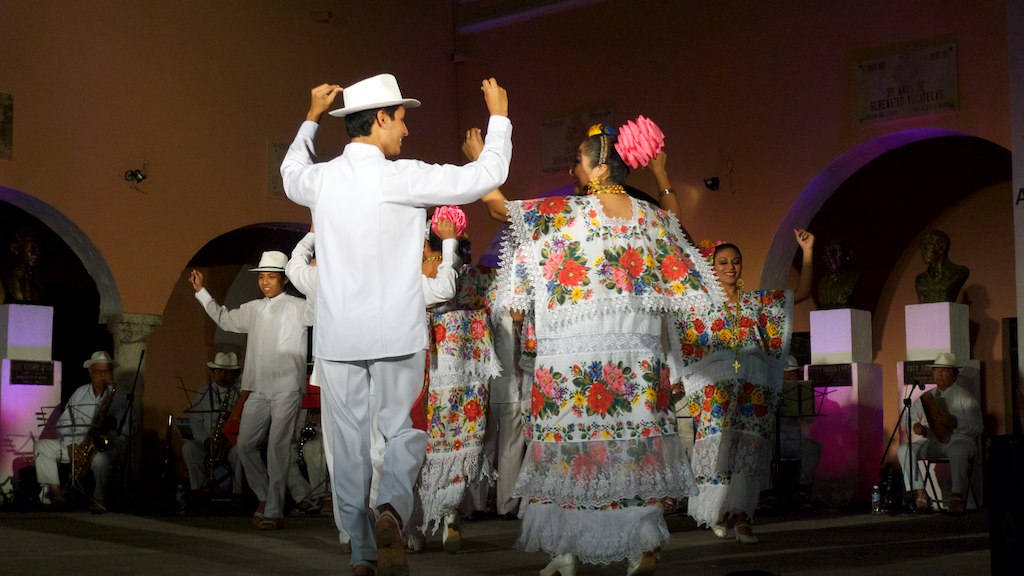 Jaranero dancers performing at the Plaza de Santa Lucía in Mérida, Yucatán
Eating and drinking under the portales
Food is half the reason to point an evening at Santa Lucía. The arcades along the plaza hold one of the densest fine-dining clusters in the centro, a consequence of the 2010s restoration that handed the old vendor arches to restaurants. The line-up changes often enough that you should treat any list as a snapshot, but several names have held their ground for years and give a fair picture of the range.
 Arcaded portales with restaurant tables beside Parque de Santa Lucía in Mérida, Yucatán
Apoala, in the portales on the Calle 60 side, pairs Yucatecan ingredients with Oaxacan technique — tlayudas and mole alongside relleno negro — and has been the plaza's marquee table since it opened. Teya Santa Lucía, run by the Hacienda Teya group, covers the classic Yucatecan canon — cochinita pibil, sopa de lima, poc chuc — in a more formal dining room and terrace facing the garden. La Tratto Santa Lucía is the long-running Italian option, popular for its terrace position directly on the park. Avec Amour adds a French-Mexican bistro note a few steps along, and Crush, on the Calle 60 flank, was Mérida's first vegan restaurant-bar and doubles as a cultural space. For mornings and laptop hours, Márago Coffee across from the university building does proper specialty coffee with all the brew methods (hours shift frequently in this row — several kitchens close one weekday each, so check before planning a specific dinner).
Budget travelers are not excluded. The streets immediately around the plaza keep cheaper options: tortas and coffee shops toward Santa Ana three blocks north, the market stalls there for breakfast, and evening street carts — marquesitas, elotes, churros — along Calle 60 when the pedestrian closures are on. Our guides to where to eat panuchos in Mérida and marquesitas cover the cheap classics in detail.
Timing advice: lunch service in this row starts early and thins mid-afternoon; dinner tables fill from about 20:30, later still on Thursday serenata nights. If a specific restaurant matters to you, reserve. If it doesn't, walk the arcade at 19:00, see what looks busy, and sit down — this is one corner of the city where wandering works.
Around the plaza: theater, university, music museum
Santa Lucía's block sits inside a cluster of cultural buildings unusual even by Mérida standards, and two of them deserve places in the same visit.
Directly south across Calle 57 rises the Teatro José Peón Contreras, Mérida's grand early-20th-century opera house, inaugurated in December 1908 to designs associated with the Italian architect Pío Piacentini. Its French-neoclassical facade, monumental marble staircase, frescoed dome, and iridescent cut-glass chandelier were meant to announce that this remote capital had arrived culturally — and they still do. The theater spent decades as a cinema before its careful 1981 restoration returned it to live performance. Note for current planning: a fire in November 2022 damaged the dome and the theater has been under INAH-supervised restoration since, with full performances relocated and only the vestibule reopened so far for exhibitions and a crafts shop; the reopening timeline has slipped repeatedly, so check the status before building plans around attending a show (verify locally). The facade alone justifies walking the extra half-block — it is the most photographed building frontage in the centro after the cathedral.
Facing the theater across Calle 60 stands the Edificio Central of the Universidad Autónoma de Yucatán, the university's historic main building. Its role in the 1867 siege — as the imperial commissariat one street from the fighting at Santa Lucía — makes it part of the plaza's war story, and today it operates as the university's cultural center, hosting exhibitions and events. You cannot always wander deep inside, but the arcaded courtyard entrance is usually visible from the street and the building's scale explains why the barrio grew up in its shadow.
Behind the plaza's portales on Calle 58 sits the Palacio de la Música, opened in 2018 as part of Mexico's national network of music museums. Eight halls trace Mexican popular music — mariachi, son jarocho, and trova yucateca among them — with interactive sound rooms and recordings, plus concerts in its auditorium. Since the theater fire it has also served as the temporary home of the Orquesta Sinfónica de Yucatán, which makes it doubly useful: a serious museum in the morning, and quite possibly a symphony concert in the evening, steps from where you ate dinner. Admission runs to roughly 200 pesos for foreign adults, with discounts for residents and students, and it closes two days a week (fees and days change — verify locally before going).
 Neoclassical facade of the Teatro José Peón Contreras near Parque Santa Lucía in Mérida, Yucatán
Santa Lucía as part of a day in the centro
The plaza rarely deserves a dedicated trip in isolation — its real value is how naturally it anchors the northern half of the Centro Histórico. A loop that works for most first-time visitors runs like this: start early at Plaza Grande with the cathedral and Palacio de Gobierno murals, walk north up Calle 60 past MACAY's galleries and Casa de Montejo, stop for coffee around the university block, and reach Santa Lucía before the tour groups thicken. Continue three blocks north to Parque Santa Ana for its church and small market lunch, and finish the morning at the southern remate of Paseo de Montejo, five blocks from where you started — all flat, all shaded by ten in the morning, barely four kilometers in total.
Evening rewrites the same map. From about 19:00 onward the portales take over: aperitifs under the arches, dinner facing the garden, and on Thursdays the serenata afterwards. If you want guided context rather than self-navigation, several operators run evening and food-focused walks through this part of the centro, and comparing what is currently running beats guessing:
Compare Mérida walking tours on GetYourGuide · See Mérida tours on Viator
Listings change seasonally, so check meeting points against your plan rather than assuming any fixed route passes through the plaza — though given its position on Calle 60, most centro walks come close.
Getting there
Walking is the right way. From Plaza Grande, head north along Calle 60 for three blocks — about eight minutes past galleries and coffee shops — and the portales appear on your left just beyond the theater. From Paseo de Montejo, walk south down Calle 56 or 58 for roughly twenty minutes; the route is flat the whole way, which sounds trivial until you do it at midday in May.
By taxi or rideshare, give "Parque Santa Lucía" or "Calle 60 por 55" as the destination — every driver knows it — and expect a short hop from anywhere in the centro. Local buses run along the surrounding avenues, but stops and routes add friction without saving meaningful time from the center. If you have a rental car, know that street parking around the plaza is scarce and the one-way grid around Calle 60 punishes circling; leave the car at your hotel and walk. On Sunday mornings the BiciRuta closes central streets to traffic and loaner bikes often appear near the main squares, making the ride between Plaza Grande, Santa Lucía, and Paseo de Montejo the most pleasant hour of the week (route and schedule shift — verify locally).
Accessibility is good by centro standards: the plaza and both flanking sidewalks are flat and paved, curb cuts exist but are inconsistent, and the church entrance has steps. Wheelchair users will find the portales restaurants reachable from Calle 60, though individual doorways vary.
Staying near Santa Lucía
The blocks between Plaza Grande and Santa Ana have become one of the centro's better places to sleep: quieter than the zócalo frontage, walkable to everything, and dense with restored casonas turned boutique hotels plus a growing set of vacation rentals. Staying near Santa Lucía means stepping out to coffee under the arches, walking three minutes to dinner options most visitors plan evenings around, and still reaching the cathedral in ten minutes on foot.
The trade-offs are honest ones. Weekend nights bring amplified sound from the plaza and the pedestrian corridor until late, so light sleepers should favor rooms off Calle 60 itself or ask for interior-facing rooms when booking. Properties here occupy old buildings, which makes air-conditioning quality, water pressure, and street noise the three things worth checking in recent reviews before committing:
Check current Mérida accommodation rates on Booking.com · Compare Mérida hotels on Trip.com
Filter for Centro Histórico and check map positions relative to Calles 55–60 to find stays within a couple of blocks of the plaza. Inventory changes hands quickly in this barrio, so treat published amenities as claims to verify rather than facts.
Practical details
| Detail | What to know |
|---|---|
| Location | Parque Santa Lucía, Calle 60 between Calles 55 and 57, Centro Histórico, Mérida |
| Park access | Public square, free, open at all hours |
| Iglesia de Santa Lucía | Working parish; generally open outside mass times (verify schedule locally) |
| Serenata | Thursdays around 21:00, free, since 1965 (confirm current program) |
| Monday vaquería | Now at Plaza Grande / Palacio Municipal, 21:00, free |
| Teatro José Peón Contreras | Facade always viewable; fire restoration ongoing, vestibule exhibitions only (check status) |
| Palacio de la Música | Calle 58 behind the portales; closed two days weekly; modest admission (verify locally) |
| Time needed | 20 minutes for the plaza; half a day with church, museums, and theater block; an evening for dinner or serenata |
| Combine with | Plaza Grande, MACAY, Santa Ana market, Paseo de Montejo |
FAQ
Is Parque Santa Lucía worth visiting? Yes — and unlike some of Mérida's plazas, it earns a deliberate visit rather than a drive-by. The combination of the 16th-century church, the restaurant arcades, and the Thursday serenata gives it more concentrated atmosphere per square meter than anywhere else in the centro. If you only have one evening free in Mérida, spend it here.
How far is Santa Lucía from the main square? Three short blocks north of Plaza Grande up Calle 60 — about an eight-to-ten-minute walk. From Paseo de Montejo it is closer to twenty minutes on foot.
What is the Thursday serenata and how much does it cost? It is a live trova yucateca concert series held in the plaza every Thursday night, running since 1965. Tríos play, dancers perform jarana, and the audience shouts bombas between songs. It is completely free; arrive by 20:00 for seating, or reserve a restaurant table under the portales if you want dinner with the show (times can shift — verify locally).
When is the best time to visit? Early morning for quiet photographs, Thursday evening for the serenata, or any evening for dinner. Avoid the middle of the day if you dislike heat — the open plaza bakes from late morning, while the arcades stay shaded.
Is the area safe at night? The plaza is busy and well-lit into the night, especially Thursday through Sunday, and it is considered one of the centro's safer corners for evening strolls. Normal city precautions apply: watch belongings in crowds, use licensed taxis or rideshares late, and stick to lit streets when walking back to your hotel.
Is Santa Lucía good for families with children? Yes, particularly on serenata nights, where the dancing and bombas hold kids' attention better than most museum visits. The plaza is car-free on event evenings, benches make snack breaks easy, and ice cream and marquesita carts work in your favor. Midday heat remains the main obstacle — aim for mornings or after about 17:00.
Do I need a tour to see Santa Lucía? No. The plaza, church, and surrounding buildings are all viewable independently, and signage plus this kind of guide covers the context. A guided walk adds value mainly for the barrio's history layers, and many centro tours pass within a block anyway.
The bottom line
Give Santa Lucía one full evening of your Mérida trip. Walk up Calle 60 from Plaza Grande as the heat breaks, sit in one of the curved love seats while the light turns gold on the church across the street, eat dinner under the arches at whatever table looks best, and if the calendar cooperates, stay for the Thursday serenata — sixty years of trova under the trees, costing nothing, in the plaza where Mérida goes to be romantic. Then finish the night with a slow stroll back down the pedestrianized avenue toward the cathedral, and you will have seen why this barrio, more than any postcard monument, is where the city keeps its heart.


