
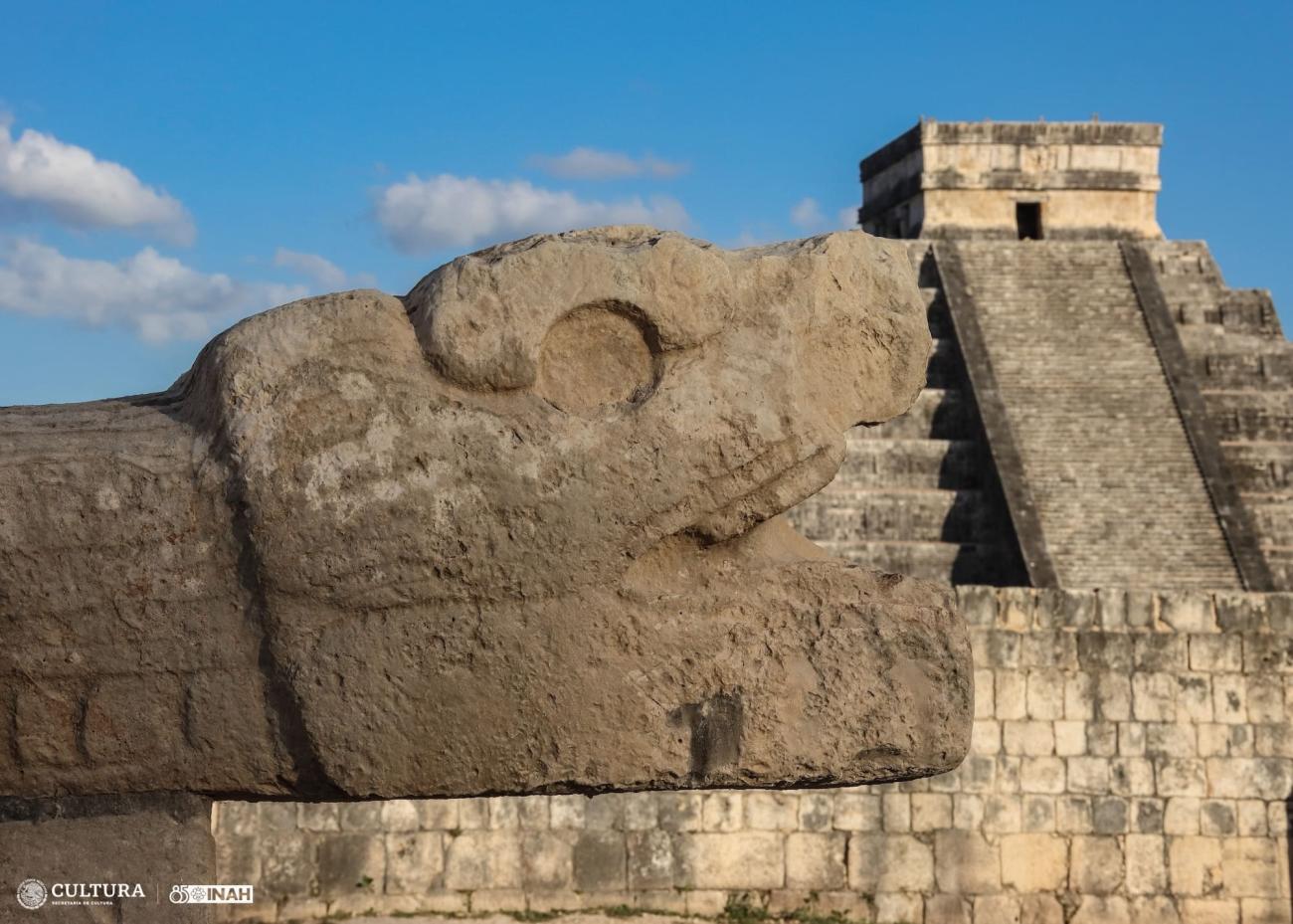
The Chichén Itzá equinox is a light-and-shadow event, not a theatrical show. In the afternoon, angled sunlight creates a sequence of triangular shadows along the northern balustrade of El Castillo, the pyramid also known as the Temple of Kukulcán. When the triangles meet the carved serpent head at the foot of the stairway, the stone architecture appears to form a descending feathered serpent.
It is one of the most memorable things to see in Yucatán, but it is also one of the most demanding days to plan. The best-known dates attract exceptional crowds. The effect depends on the sun, the geometry of the building, and the clouds. Access rules and operating arrangements can change for the official event. If you want the phenomenon itself, plan around the date and accept the uncertainty. If you want to understand Chichén Itzá without spending an afternoon in a tightly packed plaza, a normal visit outside the equinox window may be the better choice.
This guide explains what the shadow means, when it appears, how to choose between spring and autumn, how to approach the site from Mérida or Valladolid, and how to spend the rest of the day without treating the archaeological zone as a single pyramid.
Quick answer: is the Chichén Itzá equinox worth planning around?
Yes, if you are interested in Maya architecture, astronomy, photography, or the way a built landscape can produce a seasonal visual effect. No, if you are visiting Yucatán on a tight schedule and would be disappointed by clouds, restricted circulation, or a view dominated by other visitors.
The most sensible choices are:
| Your priority | Best approach |
|---|---|
| See the phenomenon on its most famous date | Plan for the official spring or autumn event, confirm the current INAH announcement, and expect crowds. |
| See a recognizable serpent shape with less pressure | Visit a few days before or after the equinox window, subject to sunlight and access conditions. |
| Explore the whole archaeological zone comfortably | Visit in a regular week, preferably early in the day, and skip the equinox date. |
| Photograph architecture rather than crowds | Choose a normal opening period and give yourself time for El Castillo, the Great Ball Court, the Temple of the Warriors, and the Observatory. |
| Avoid organizing transport yourself | Compare a small-group or private excursion from Mérida or Valladolid, checking exactly how long it allows at the site. |
There is no guaranteed minute when the serpent will look perfect. The effect changes gradually in the afternoon and is strongest only when the northern staircase is illuminated clearly. Published times are useful planning estimates, not a promise.
For a guided day trip, compare the current Chichén Itzá inventory on GetYourGuide and Viator. Read the inclusions carefully: a tour that combines the ruins with a cenote or Valladolid may be convenient, but it can leave less time for the equinox viewing period.
What the serpent shadow actually is
The visible pattern is produced by sunlight and the stepped geometry of El Castillo. The northern staircase has sloping side surfaces, or alfardas, that frame the stairway. Near the equinoxes, the changing angle of afternoon sunlight creates several bright and dark triangular forms across the side of the staircase. The pattern appears to descend toward the carved serpent head at the base.
INAH describes the effect as seven triangles of light and shadow projected on the northern alfarda. The triangles are the part visitors often call the serpent's body; the stone head completes the image. The pattern is therefore not a solid shadow serpent moving down the steps. It is an optical reading of separate geometric forms, aligned with a carved sculptural element.
That distinction makes the experience more interesting, not less. You are watching a relationship between the sun and a building. The pyramid is not being illuminated by a modern projector, and the shape is not visible in the same way throughout the day. It develops as the sun moves and the balance of light changes.
Clouds can soften or erase the contrast. A bright overcast sky may leave enough light to see the pyramid but not enough sharp sunlight to produce clear triangles. Thin clouds can make the effect appear and disappear. This is why photographs from one year should not be treated as a guarantee for the next.
The event is often described as the descent of Kukulcán, the feathered serpent. Kukulcán is the Yucatec Maya form of a feathered-serpent deity associated with the broader Mesoamerican tradition. Visitors will often hear comparisons with Quetzalcóatl, but it is better to keep the local name and the Chichén Itzá setting in view rather than flattening different traditions into one character.
The effect is also a reminder that the ancient city was designed as a connected ceremonial landscape. El Castillo is the most recognizable structure, but the astronomical and architectural story is not contained in one staircase. The Great Ball Court, the Temple of the Warriors, the Platform of Venus, the Sacred Cenote, and the Observatory all make more sense when you give yourself time to look beyond the central pyramid.
When does the Chichén Itzá equinox happen?
There are two astronomical equinoxes each year: one in March and one in September. The exact astronomical date can vary slightly by year and by time zone, while the visitor program may cover several days rather than only the exact instant of the equinox.
For 2026, INAH announced a spring equinox operation at Chichén Itzá for Friday March 20, Saturday March 21, and Sunday March 22. Its announcement said the light-and-shadow phenomenon is observable approximately from 15:00 to 17:00. That is the kind of official notice you should look for before a future visit. It also reported that the previous year's phenomenon drew 32,872 people, which gives a more useful sense of event-day pressure than generic descriptions of the site as “busy.”
The autumn equinox generally falls around September 22 or September 23. Dates, entry arrangements, crowd controls, and any special programming should be checked with INAH for the year of your trip. Do not assume that the spring operating plan automatically applies to autumn.
The shadow can be visible on days around the equinox because the sun's position changes continuously rather than jumping from one alignment to another. The farther you move from the exact date, the more the shape and contrast can change. A visit a few days away may still show recognizable triangles, but the result depends on the weather, the angle of the light, and what the site permits that day.
If your trip is in a future year, use the dates below only as a planning framework:
- Spring: usually around March 20, with the official visitor operation potentially spread across several days.
- Autumn: usually around September 22 or 23, with the exact public arrangements requiring confirmation.
- Viewing period: commonly described as mid-to-late afternoon, with the clearest development often between about 15:00 and 17:00.
- Best weather question: spring is usually the simpler bet for dry-season planning, while September brings a greater chance of tropical showers and cloud cover.
The practical conclusion is simple: treat the date as a seasonal target, then verify the official announcement close to travel. The web pages of tours and blogs often preserve old schedules after public rules have changed.
What happened at the 2026 spring event?
The 2026 spring announcement is a useful example of why equinox planning needs current information. INAH identified a three-day operation rather than a single afternoon, described the approximate observation window, and noted changes affecting the wider visit. The Great Museum of Chichén Itzá was listed as open from 08:00 to 15:00 during the operation, with access and re-entry arrangements connected to the archaeological zone. The announcement also said that visits to the Serie Inicial area would be suspended during the operation.
Those details may not be repeated in the same form in another year. They do show the kind of logistical change that can matter more than a travel blog's suggested arrival time. A special event can alter entrances, circulation, re-entry, transport unloading, group movement, and the amount of the site available to explore.
Before booking an equinox day, check:
- The current INAH notice for the archaeological zone.
- Whether the normal ticket process applies or a special schedule is in force.
- Which entrance is used by your transport or tour.
- Whether re-entry is allowed and where it takes place.
- Whether the museum and any peripheral groups are open.
- Whether the viewing area has a capacity or a controlled circulation system.
- The latest weather forecast, especially cloud and rain probability.
You do not need to memorize the Spanish administrative wording. You do need to read the current announcement rather than relying on a page written for a previous equinox.
The best time of day to see the effect
The serpent shadow is an afternoon phenomenon. That creates a planning conflict: early morning is usually more comfortable for exploring a large archaeological zone, while the equinox effect develops later, after heat has built up and many visitors have gathered.
A practical day has three phases. First, arrive early enough to deal with entry and walk through the site before the main viewing period. Second, explore the structures that are not the main focus of the event. Third, move toward the permitted viewing area with water, sun protection, and realistic expectations about waiting.
Do not plan to arrive at the last possible minute and step straight into a perfect spectacle. Traffic, parking, ticket lines, security checks, and walking distances can all consume time. A tour schedule that leaves the hotel late in the morning may work for a normal Chichén Itzá visit but be poorly matched to an afternoon equinox observation.
The effect is gradual. Early triangles may be faint. Later, contrast can improve, but low sun, clouds, neighboring visitors, or an altered viewing boundary may interfere with what you can see. If you are photographing, take a few reference images early and then watch the pattern rather than staring at a screen for the entire period.
The site is hot, with limited shade in major plazas. A hat, water, light clothing, sunscreen, and comfortable closed walking shoes are more useful than elaborate camera equipment. If rain is possible, protect your phone and camera in a simple waterproof bag. A small umbrella may be inconvenient in a crowd and can block someone else's view.
Where the serpent appears
The pattern forms on the northern side of El Castillo, along the staircase associated with the carved serpent head. The exact viewing position can be controlled during a special event. Do not assume that you can walk freely around the pyramid or choose any angle you have seen in a photograph.
The most useful position is one from which you can see the northern balustrade and the base of the staircase at the same time. Standing too close makes it harder to read the whole pattern. Standing too far away may make the triangles small, especially through a phone camera. On a crowded day, your position may be determined by the visitor flow rather than by ideal photography.
Climbing El Castillo is not an option for ordinary visitors. The pyramid is protected and should be treated as a monument to observe from the permitted ground-level areas. Do not touch the stone, cross barriers, or push toward the front for a photograph. Conservation is part of the reason the event is managed closely.
A clear view is not the only measure of success. You may see the triangles but not a perfect, uninterrupted serpent. You may see the shape for only a short period between clouds. You may understand the geometry better by moving later to another structure and returning to your photograph. The place is ancient architecture first and a visual event second.
What else to see at Chichén Itzá
A common mistake is to treat the equinox as a reason to ignore the rest of the archaeological zone. That is especially unfortunate because the site is large enough to reward a slower route.
 The Great Ball Court at Chichén Itzá, Yucatán
The Great Ball Court
The Great Ball Court is one of the most imposing spaces in Chichén Itzá. Its long walls and elevated stone rings make the scale of the ceremonial complex clear. The ancient ballgame had religious, political, and social dimensions, and its meaning cannot be reduced to a simple sport played for entertainment.
Look at the acoustics and the relationship between the court, its reliefs, and the surrounding structures. Even when interpretation is careful and avoids claiming a single fixed meaning, the court shows how architecture could organize movement, audience, ritual, and authority. It is also a place where the heat can feel intense because the broad stone surfaces offer little shade.
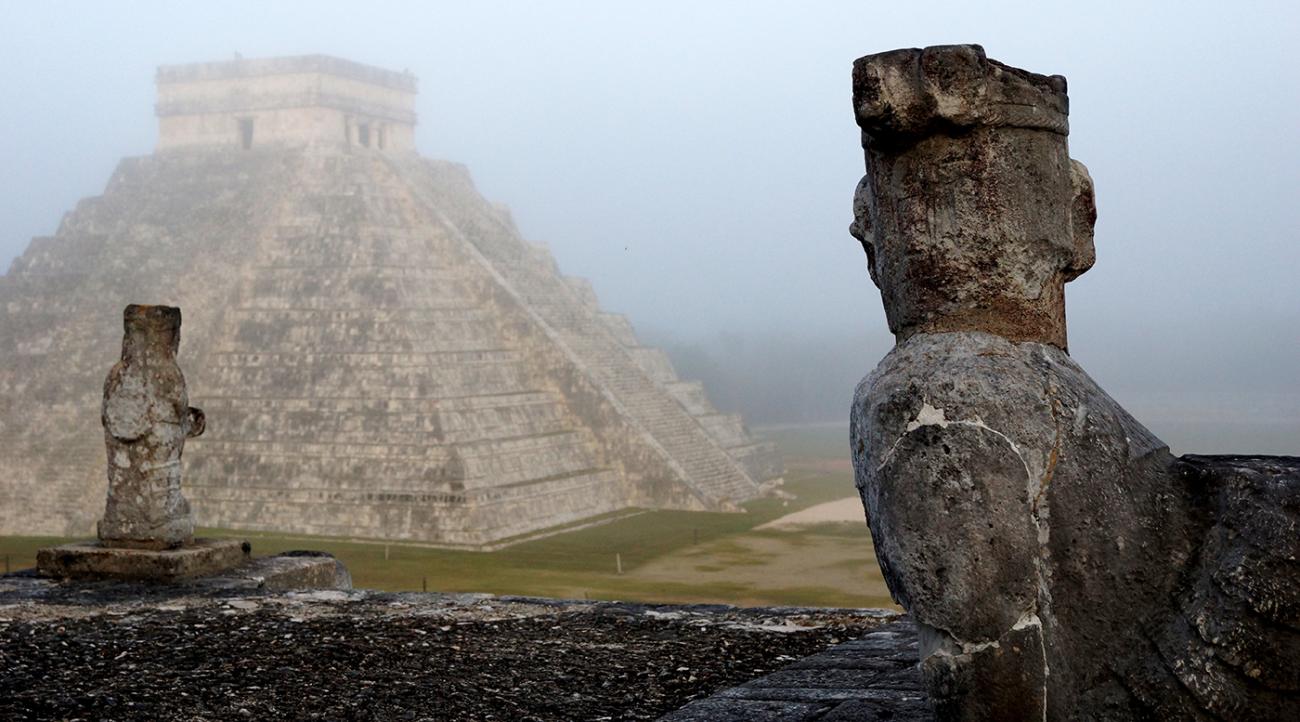
The Temple of the Warriors and the colonnades
 The Temple of the Warriors at Chichén Itzá
The Temple of the Warriors stands within a group of columns and sculpted architectural elements. The area gives you a different experience from the clean silhouette of El Castillo: more layered, more crowded with details, and better suited to a slow look at carving, supports, and repeated forms.
Go here before the afternoon becomes exhausting if the equinox crowd allows it. A guide can help distinguish what is directly visible from what is interpretation, particularly when discussing cultural exchange and the site's relationships with other Mesoamerican traditions.
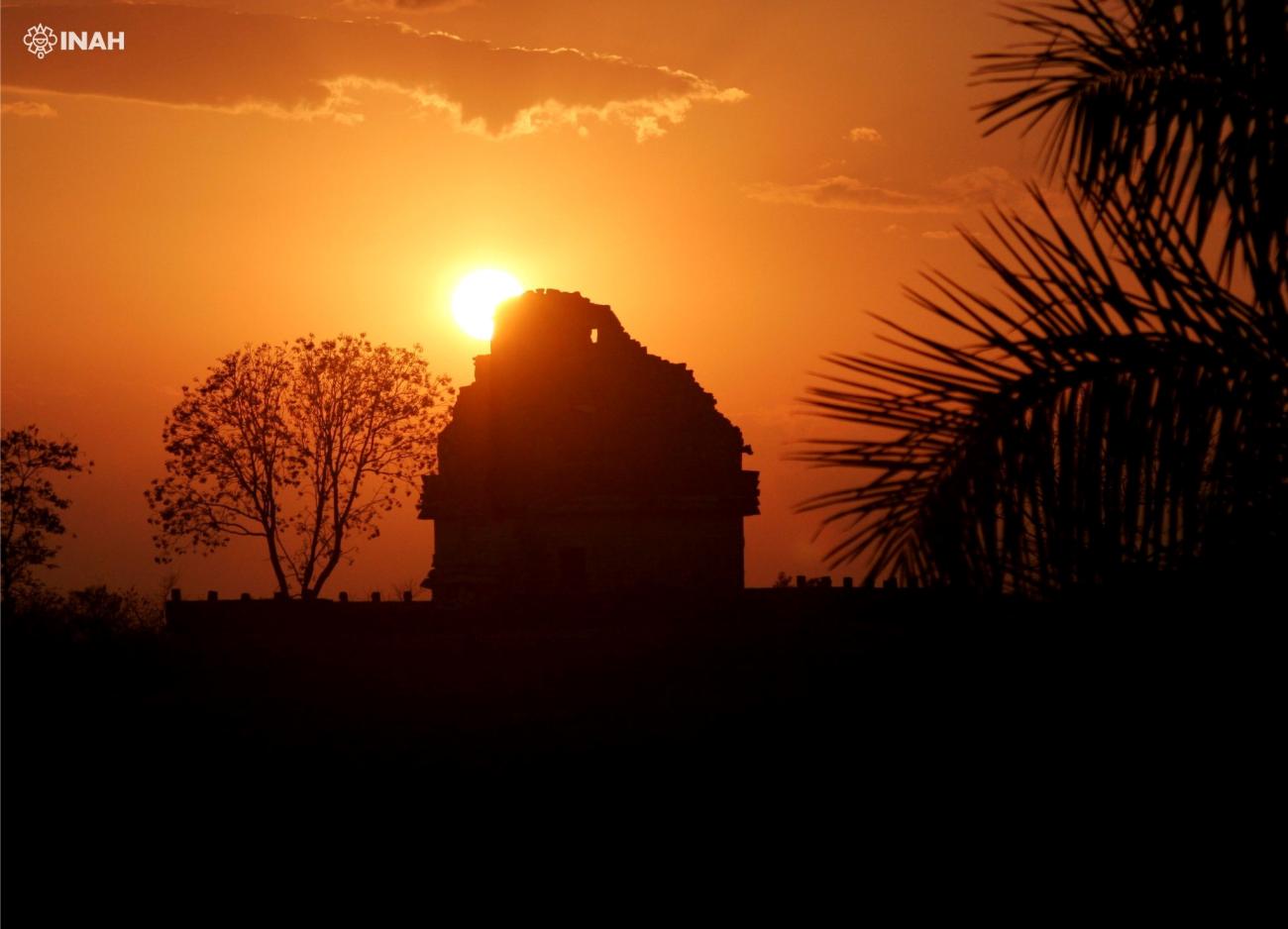
The Observatory, or El Caracol
 El Castillo and the central plaza at Chichén Itzá
The Observatory is often called El Caracol because of the spiral form associated with its interior staircase. It is one of the structures most frequently connected with Maya observations of the sky, but avoid turning that association into a claim that every opening was a precise modern telescope. The building's form, orientation, and astronomical interest are important; the details are best explained by a qualified guide and current scholarship.
 The Observatory, or El Caracol, at Chichén Itzá
The Observatory is a good reason to keep the equinox in context. The event is a visible seasonal alignment, but Chichén Itzá's relationship with the sky is expressed through a larger architectural complex. Allowing time for El Caracol can make the afternoon feel like a study of the city rather than a wait for one photograph.
The Sacred Cenote and the wider site
The Sacred Cenote is not a swimming cenote. It is a natural sinkhole associated with the ancient city's ceremonial landscape. Visitors should follow the current path and restrictions rather than looking for access to the water.
Other structures, platforms, and plazas help convey the size of Chichén Itzá. Some areas may be closed or rerouted during special operations. That is not a reason to trespass or to treat a restricted monument as a missed photo opportunity. A responsible visit accepts that conservation and safety take precedence over a complete checklist.
Spring or autumn: which equinox is better?
Spring is the famous choice. It falls in the generally drier part of the Yucatán year and is easier to pair with a wider road trip if you prefer lower rain risk. It is also the season most associated with huge crowds, particularly around the official event dates.
Autumn can be a more comfortable choice for people who want the same basic astronomical idea with a less intense public atmosphere. The trade-off is weather. September is hot and humid, and afternoon showers or cloud cover can interfere with the shadow. Hurricane-season conditions also deserve attention, even when a storm is not expected to make landfall.
Choose spring if your priority is:
- a higher chance of a dry travel day;
- the largest event atmosphere;
- fitting the visit into a spring Yucatán itinerary;
- accepting that crowd levels may be exceptional.
Choose autumn if your priority is:
- a potentially quieter event period;
- flexible travel dates and a willingness to watch the forecast;
- avoiding the most famous spring weekend;
- seeing the broader site without assuming the event will look perfect.
Choose neither if your priority is a calm archaeological visit. A normal morning at Chichén Itzá, outside the equinox period, gives you more control over pace, photography, and the order of the route.
Getting to Chichén Itzá from Mérida
Chichén Itzá is east of Mérida in Yucatán's interior. Mérida is inland, so this is a road trip to an archaeological site, not a coastal excursion. A rental car gives the most control over arrival time and over whether you add Valladolid or another stop. Leave substantial margin around the equinox because highway traffic and event-day arrivals can be less predictable than a normal weekday.
A bus can be workable for a regular visit if its timetable matches the site schedule. It is less flexible for a late-afternoon viewing event, particularly if you need to return to Mérida the same day. Check the current ADO or operator schedule rather than relying on an old timetable copied into a guide.
A private driver is useful when a group wants a long site visit without driving after a hot day. Ask whether the quoted service is hourly or fixed-route, how long the vehicle waits, and whether the driver knows the event entrance arrangements. Do not assume a driver can bypass public access controls.
An organized tour is the simplest option for many visitors. The important question is not only whether the tour goes to Chichén Itzá, but whether its timing leaves you at the pyramid during the shadow window. Some tours prioritize an early arrival, a cenote swim, lunch, or Valladolid and may depart before the equinox phenomenon develops.
For current transport and tour inventory, start with Chichén Itzá tours on GetYourGuide and Chichén Itzá options on Viator. Confirm the departure city, date, return time, site duration, entry inclusions, and whether the experience is actually scheduled for the equinox operation.
GuidePrivate Transfer from Mérida to Chichén Itzá: Comfortable, Door-to-Door ServiceLearn everything you need to know about booking a private transfer from Mérida to Chichén Itzá, including vehicle options, pricing, booking process, and tips for a smooth journey.Open
Getting to Chichén Itzá from Valladolid
Valladolid is the more natural base if the equinox is the main purpose of your trip. The town is closer to the archaeological zone than Mérida, so an overnight stay can reduce the pressure of a long morning drive. It also lets you explore Valladolid's colonial center, markets, and surrounding cenotes separately from the ruin visit.
A car or private transfer is convenient for a timed afternoon event. Public transport may be possible, but the return leg and the special operating schedule need careful checking. On an event day, ask about the last realistic departure rather than planning around a normal timetable.
Staying in Valladolid does not guarantee a quiet visit. It simply gives you more room to handle an early start, a delayed exit, or a return after the afternoon viewing period. Compare Valladolid hotels on Booking.com and Valladolid stays on Trip.com while checking the cancellation terms and location in the town.
If you prefer a tour from Valladolid, look for a product that states its time at Chichén Itzá and whether it is designed around the equinox. A broad “ruins and cenote” description is not enough evidence that you will still be at El Castillo in the afternoon.
Guide5 Days in Yucatán: Mérida, Uxmal, Izamal, Chichén Itzá and ValladolidA practical five-day Yucatán itinerary using Mérida and Valladolid as bases, with Uxmal, Kabah, Izamal, Chichén Itzá, Ek Balam and realistic drive times.Open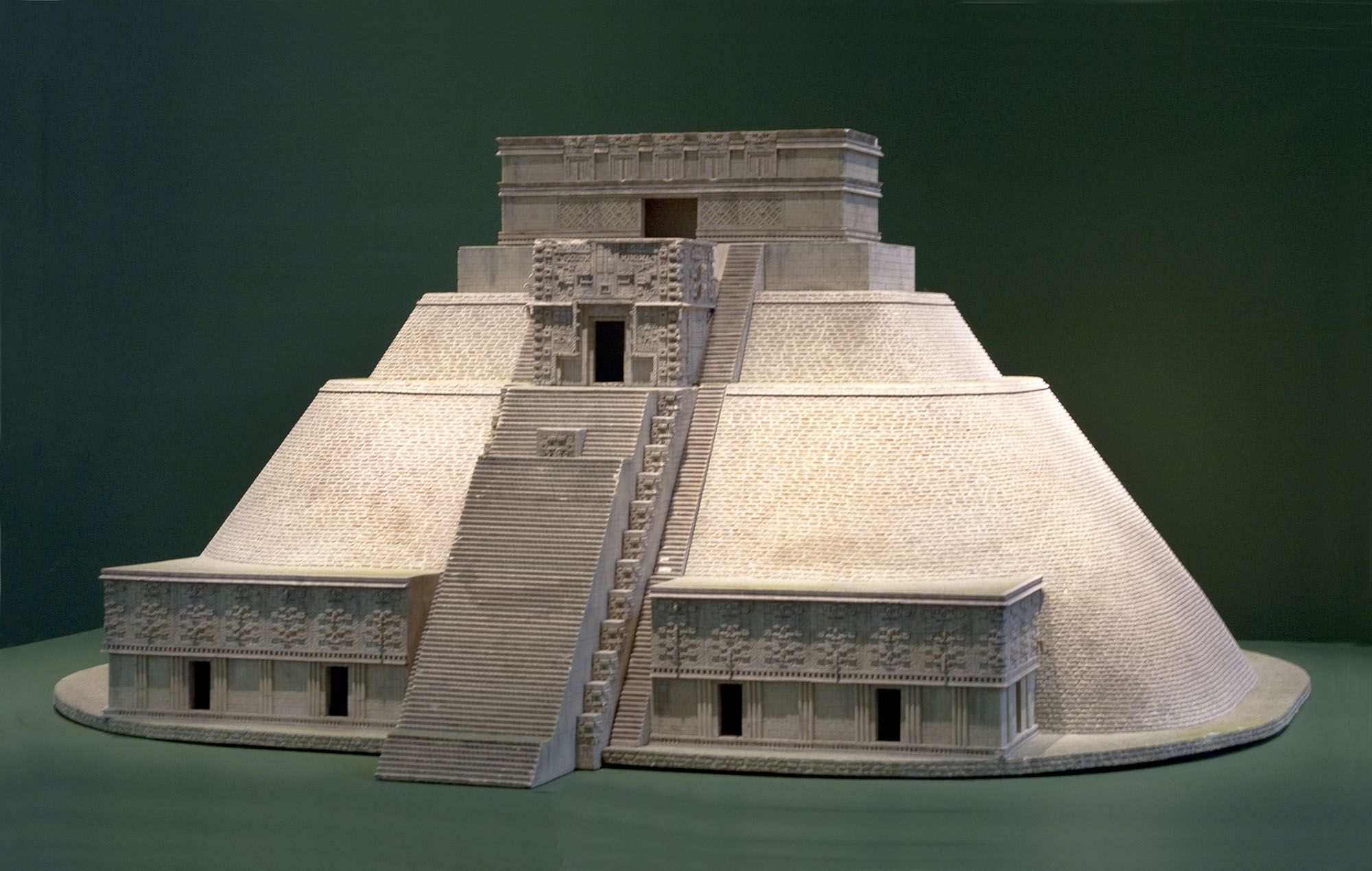
Should you combine the equinox with a cenote or Valladolid?
On a normal day, combining Chichén Itzá with a cenote and Valladolid can be an efficient itinerary. On the equinox, it can become an overpacked one. The main issue is not distance alone; it is that the phenomenon occupies an afternoon window and event-day movement may be slow.
If the serpent shadow is your priority, put Chichén Itzá first in the decision. Add a cenote only if the timing leaves a comfortable margin. A rushed swim followed by a late arrival at the viewing area is a poor trade.
If the shadow is a bonus rather than the main goal, a morning ruin visit followed by a cenote may be more enjoyable. You can then treat any visible afternoon pattern as a fortunate extra rather than the success condition for the whole day.
Valladolid works best as an overnight base or a separate half-day, not as a box to tick in the same schedule at any cost. The town has enough character to deserve time without being used as decorative filler around a ruin tour.
What to bring and what to wear
The equinox involves waiting outside in a hot climate. Bring refillable water if permitted under the current rules, a hat with a secure fit, sunscreen, sunglasses, and light clothing that covers your shoulders if that makes sun exposure easier. Wear shoes that handle uneven paths and long periods of standing.
A small camera or phone is sufficient for most visitors. A telephoto lens can help if you are positioned far from the pyramid, but it will not solve clouds, blocked sightlines, or a crowd. Keep spare batteries and a power bank protected from heat.
Bring cash only if you have confirmed that you need it for the parts of the day outside the archaeological zone. Avoid assuming that every vendor, transport stop, or attraction accepts cards. At the same time, do not carry valuables openly in a dense crowd.
Food and drink rules can change by area and event. INAH's site information should take priority. Do not plan on eating inside a restricted plaza, and do not leave wrappers, fruit peels, or plastic near the monuments. Arrange a meal before or after the main visit with enough time to avoid turning the viewing window into a race.
Photography and respectful viewing
The best equinox photograph is not always the one with the largest crowd or the darkest shadow. A wide image can show the relationship between El Castillo, the staircase, the plaza, and the people waiting. A tighter image can record the triangles and serpent head. Take both if conditions allow, but do not hold a phone above other people's faces for an extended period.
Avoid flash. It does not improve a sunlit stone monument and can distract visitors. Do not use a drone unless you have explicit authorization; archaeological zones generally have strict rules for aerial equipment. Never climb, lean against, or touch the structures for a better angle.
If you are photographing other visitors, be considerate. The event attracts people who may have saved for the trip or travelled a long way. A clear view matters, but it is not a contest. Move back when possible, keep walkways open, and follow staff instructions when the crowd is reorganized.
Photography can also distract from the phenomenon. Watch the light change with your own eyes. The shape is not a single instant that must be captured perfectly. It is a slow conversation between sun, stone, and shadow.
Common mistakes to avoid
Believing every online date. Old event pages remain visible in search results. Check INAH for the year you will travel.
Assuming a normal site schedule applies. Special operations may modify entrances, circulation, re-entry, museum access, and restricted areas.
Arriving only for the final minutes. Traffic and walking distances can erase your margin. Arrive early enough to handle the site calmly.
Expecting a guaranteed full serpent. Clouds and light conditions matter. The event is not a daily projection.
Planning too many attractions. Chichén Itzá is large, and the equinox adds waiting. A cenote, Valladolid, and a long return journey may be too much in one day.
Treating El Castillo as the whole site. The Great Ball Court, Temple of the Warriors, Observatory, Sacred Cenote, and other groups provide essential context.
Using “Maya calendar” as a complete explanation. The architecture has astronomical significance, but precise claims should be grounded in current interpretation rather than repeated as slogans.
Expecting to climb the pyramid. Visitors cannot use the structure as a lookout. View it from the permitted areas.
Booking a tour without checking the site duration. A tour may advertise Chichén Itzá but allocate only a short stop before another activity. Ask what the schedule actually allows.
A realistic equinox day plan
For a visitor staying in Valladolid, a sensible outline is to leave with enough time for entry, walk through the principal groups in the morning, pause for food and water outside the busiest movement period, and reach the permitted north-side viewing area well before the shadow develops. Afterward, return without adding a distant attraction.
From Mérida, the same structure requires an earlier departure and more tolerance for traffic. If the event is the central reason for the trip, consider sleeping in Valladolid the night before or using a private transfer. A same-day Mérida return is possible in principle but should not be planned with a narrow final connection or an evening reservation you cannot miss.
If the official operating plan offers several event days, choose the one that gives you weather flexibility. A spare day is more valuable than an elaborate chain of bookings. If the forecast is poor, a normal visit on a clearer day may deliver more understanding and better photographs than insisting on the exact astronomical date.
The meaning of the event without overclaiming
The serpent image is powerful because it joins a natural cycle to a built ceremonial space. It is reasonable to discuss the display as evidence of careful observation of the sun and the seasonal year. It is also reasonable to describe Kukulcán as a feathered serpent figure represented through the site's sculpture and architecture.
It is less responsible to claim that every detail of the modern popular story is proven in exactly the same way, or that the event carries one simple meaning for all ancient Maya people. Chichén Itzá was a complex city with a long history, changing political relationships, and multiple architectural traditions. The modern spectacle is an interpretation of a real light-and-shadow alignment in a place whose original users lived in a different social and religious world.
That nuance does not take away from the visit. It gives the stones room to speak without forcing them into a single tourism slogan. Look at the geometry, listen to the guide's explanation, notice the way the crowd responds, and keep the difference between direct observation and interpretation clear.
Final recommendation
Plan the Chichén Itzá equinox only if you are willing to make the shadow the organizing priority of the day. Confirm the current INAH schedule, arrive with time to spare, prepare for heat and crowds, and accept that clouds may change the result. If your real goal is to appreciate Chichén Itzá as an ancient city, choose a regular morning visit and use the equinox season as a bonus rather than a deadline.
The most balanced version is usually an overnight in Valladolid, a current official check, one carefully timed archaeological visit, and enough room to see more than the northern staircase. The serpent shadow is memorable, but the city that produces it is the reason to travel there.
Frequently asked questions
Does the serpent shadow happen only on the exact equinox?
No. The pattern can be visible on days around the equinox, but its shape and clarity change as the sun's position changes. The exact public viewing arrangements and the effect on a particular day should be treated as uncertain until you see the weather and current site notice.
Is the autumn equinox less crowded?
It can be less crowded than the famous spring event, but crowd levels vary by year and by the official program. September also brings more rain and cloud risk. Check both the forecast and the current INAH announcement.
Can I climb El Castillo during the equinox?
No. Visitors should remain in the permitted viewing areas and follow staff instructions. Do not cross barriers or attempt to climb the pyramid.
Can I swim in the Sacred Cenote at Chichén Itzá?
No. The Sacred Cenote is an archaeological and ceremonial feature, not a swimming stop. If you want to swim, plan a separate cenote that is currently open to visitors and fits your route.
Is Chichén Itzá closer to Mérida or Valladolid?
It is generally easier to reach from Valladolid, which is why Valladolid is often the more practical overnight base for an afternoon-focused equinox visit. Mérida remains a workable base with a car, driver, or appropriately timed tour.
What if clouds hide the shadow?
Enjoy the rest of the archaeological zone and do not treat the day as wasted. The effect depends on direct sunlight. If the phenomenon is the sole purpose of your trip, build in a spare day or choose a regular visit with a broader goal.
Do I need a guide?
You can walk the site independently if the current access rules allow it, but a qualified guide can explain the architecture, chronology, and limits of what is known. On an equinox day, a guide is most useful when they also explain the schedule honestly rather than promising a perfect spectacle.
How long should I allow for the visit?
Allow most of a day when travelling from Mérida, and at least several hours at the archaeological zone itself if the equinox is your priority. Add more time for entry, walking, waiting, weather delays, and the possibility of altered circulation. Avoid booking a tight onward connection.
Is the event suitable for children?
Older children who enjoy history, astronomy, and outdoor waiting can find it fascinating. Younger children may struggle with heat, crowds, and a slow afternoon. Bring water and sun protection, and consider a regular early visit if the event schedule would be uncomfortable for your family.
Where should I stay?
Valladolid is the most practical town base for reducing the drive. Some visitors prefer lodging closer to the archaeological zone, while others choose Mérida for a longer cultural stay. Compare current availability rather than assuming that a hotel listed in an old guide still operates or has the same access arrangements.
Is the serpent shadow a modern light show?
No. It is a naturally occurring light-and-shadow effect created by sunlight interacting with the architecture and the carved serpent head. Special event management controls visitors, but the shadow itself is not a projected production.
What is the most important thing to verify?
Verify the current INAH announcement for the exact year and date of your visit. It should take precedence over tour descriptions, social-media posts, and old travel articles.
A final way to think about the visit
The equinox is best approached as a chance to notice how Chichén Itzá works: a city where architecture, landscape, seasonal light, ritual memory, and modern conservation meet. Watch for the serpent, but stay long enough to see the court, columns, observatory, and plazas around it. That broader attention turns a crowded event into a meaningful visit.


