If you have time for only one Maya archaeological site in Yucatán, the choice is usually straightforward: visit Chichén Itzá if you want the landmark everyone recognizes, the largest monumental complex, and the strongest sense of a major regional capital. Choose Ek Balam if you care more about preserved stucco decoration, a quieter jungle setting, and—when the authorities allow it—the possibility of climbing the Acropolis.
They are not interchangeable stops. Chichén Itzá is a broad, highly visited ceremonial and political centre with famous monuments spread across a large archaeological zone. Ek Balam is smaller and more intimate, but its Acropolis is an unusually complex royal palace with important sculptures, murals and architectural details. One gives you scale and iconic architecture; the other rewards patient looking.
For many travellers based in Valladolid, the best answer is not “either/or.” If your schedule, budget and energy allow it, visit both on separate mornings or as part of a carefully planned long day. If you are staying in Mérida, Chichén Itzá is the easier first choice for a single ruin day, while Ek Balam becomes more appealing when you want to pair archaeology with Valladolid, a cenote or a less hurried route through the east of the state.
Quick answer: Ek Balam or Chichén Itzá?
| Choose… | If you want… | Main drawback |
|---|---|---|
| Chichén Itzá | The best-known Maya site in Yucatán, monumental scale, El Castillo, the Great Ball Court and a deep concentration of major structures | More visitors, more walking in exposed areas and stricter restrictions on touching or climbing monuments |
| Ek Balam | A smaller site, exceptional stucco reliefs, a royal palace, jungle atmosphere and a possible Acropolis ascent | Fewer services and less certainty that every climbable area will be open on your day |
| Both | A useful contrast between two powerful Maya centres and two different archaeological landscapes | A same-day visit can be long, hot and too rushed without an early start and private transport |
The sites also differ in what “worth it” means. Chichén Itzá is worth the effort even if you are not an archaeology specialist because its central monuments are immediately legible: a huge pyramid, a monumental ball court, columned halls, platforms and an observatory. Ek Balam asks you to slow down. Its most important details are not always visible from a distance, and a good guide can make the painted and stucco remains much easier to understand.
The essential difference in atmosphere
Chichén Itzá feels like a major public centre. Its monumental core is laid out around broad plazas and imposing structures, and the route between them gives you a strong sense of civic scale. The Great Ball Court, Temple of the Warriors, Platform of Venus, El Castillo and the surrounding platforms are designed to be read as a large ceremonial landscape. Even with crowds, the architecture dominates the visit.
Ek Balam feels more enclosed by vegetation. Paths move between plazas and buildings, and the Acropolis rises as a long, layered mass rather than as one clean pyramid. The site’s defensive walls and sacbeob, or raised Maya roads, help explain that this was a substantial city, not merely a small ceremonial outpost. Yet the visitor experience is more concentrated. You can spend time examining a façade or climbing a terrace without feeling that you have missed half a city.
That contrast matters in the middle of the day. Chichén Itzá has more shade in some sections than visitors expect, but its principal plazas are open and the walking distance adds up. Ek Balam also gets hot, and the Acropolis ascent can be physically demanding, but its smaller footprint makes it easier to retreat, pause and continue. Neither site should be treated as a quick air-conditioned excursion.
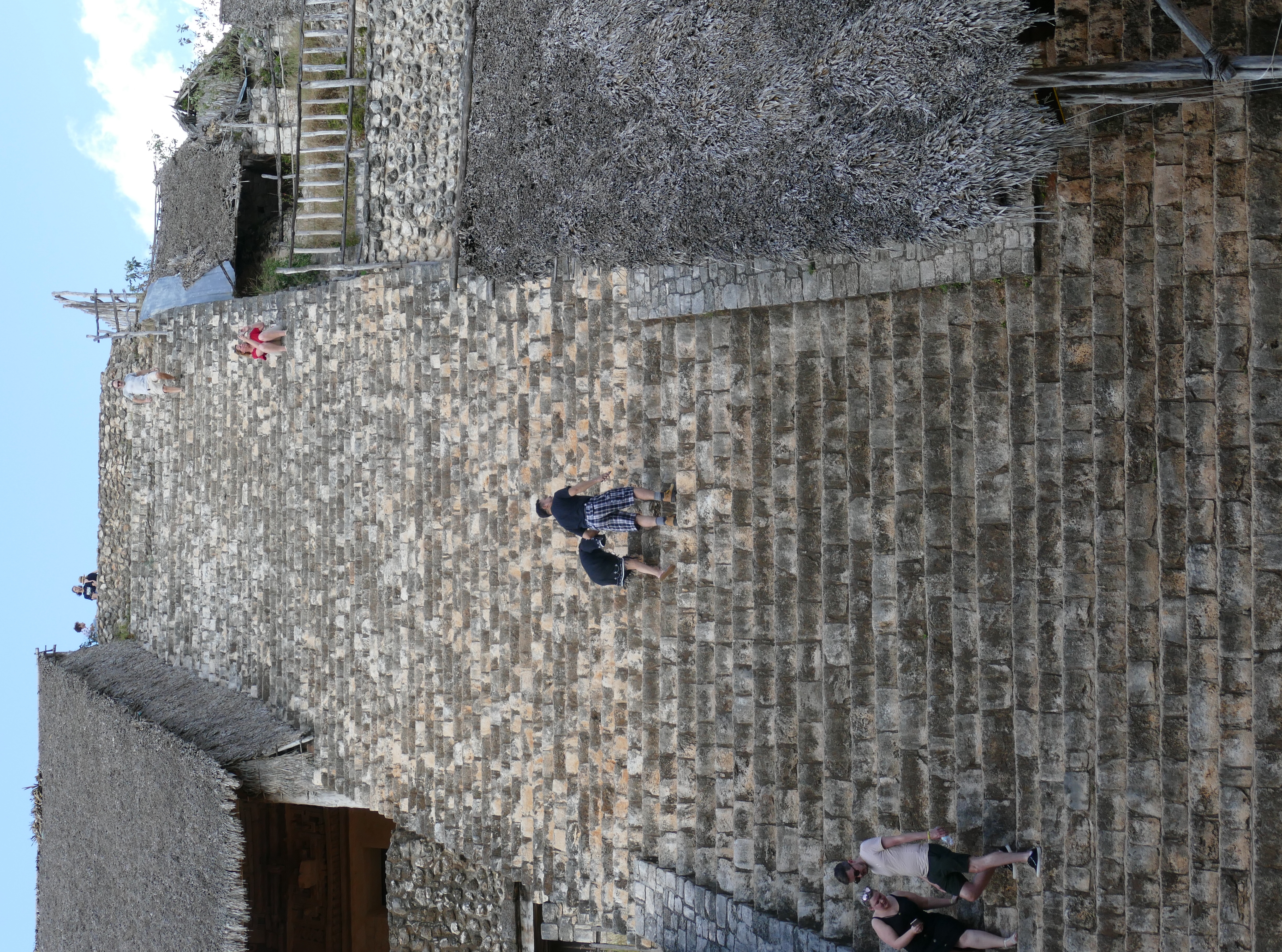 Steep stairway of the Acropolis at Ek Balam
What you see at Ek Balam
Ek Balam was established in the Middle Preclassic, around 300 BC to AD 300, and remained occupied until the arrival of the Spanish. INAH identifies its peak as the Late Classic period, approximately AD 770–896. The city was the centre of the kingdom of Talol, and its political importance is reflected in the size and complexity of the Acropolis.
The site’s most important structure is the Acropolis, a palace and funerary complex associated with the ruler Ukit Kan Lek Tok’. INAH describes it as approximately 160 metres long, 68 metres wide and 32 metres high, with six levels, many rooms, corridors, stairways and subterranean spaces. It is less like a simple pyramid than a massive architectural history book built in stages.
The famous entrance decoration is often described as a jaguar mouth or the entrance to the underworld. The relief includes fanged forms and elaborate stucco figures. Some travel descriptions turn this into a single easy symbol, but the practical point for visitors is simpler: the decoration is unusually three-dimensional and survives in a way that lets you appreciate the skill of Maya sculptors and plaster workers. Look carefully rather than rushing straight to the highest accessible terrace.
Other parts of Ek Balam deserve time too. The South Plaza contains the Oval Palace, the Platform of the Stelae and the structure known as the Twins. The North Plaza holds the Acropolis and other large buildings. There are remains of walls, a ballcourt, stelae and several sacbeob. A visit that consists only of climbing the Acropolis misses the political and urban setting that made the palace meaningful.
The site museum is included in the official visitor information and can help you connect the architecture with the discoveries made there. Whether all galleries, displays or interpretation areas are operating can change, so treat the museum as a useful addition rather than the sole reason to make the trip.
Can you climb Ek Balam?
This is the question most people ask, and the honest answer is conditional. Ek Balam has traditionally been one of the Yucatán sites where visitors could climb portions of the Acropolis. Access can change because of conservation work, rain, slippery surfaces, safety decisions and site-management rules. Do not build a non-refundable itinerary around a guaranteed summit view. Confirm the current condition close to your visit and follow staff instructions on the day.
Even when climbing is permitted, it is not a casual staircase. The steps are steep, uneven and exposed. Use the handrails or ropes where provided, keep both hands available, and do not climb in sandals that slide on stone. People who dislike heights, have knee problems or are travelling with very young children may enjoy Ek Balam without ascending the highest section. The reliefs and palace terraces are the main event, not a fitness test.
Current practical information for Ek Balam
INAH’s English site lists Ek Balam as open Monday to Sunday from 08:00 to 17:00, with last entry at 16:00. Fees, additional state charges, parking arrangements and exemptions can change; check the official INAH Ek Balam visitor page and ticket information before travelling. The site rules include no smoking, no food and no pets. Bring water for the journey and use the facilities before beginning the archaeological walk.
From Valladolid, Ek Balam is a practical half-day outing by rental car, taxi or private driver. The site is north of the city in the municipality of Temozón. Public transport arrangements can be less direct than the main Valladolid–Mérida or Valladolid–Cancún corridors, so independent travellers should confirm the return plan before setting out. A taxi that drops you at the gate without waiting is not automatically a reliable way home.
If you prefer an organised day, compare the live Ek Balam and Chichén Itzá options on GetYourGuide with Valladolid excursions on Viator. Read the current itinerary carefully: some products include a cenote or lunch, some are private, and some list archaeological entrance tickets separately.
What you see at Chichén Itzá
Chichén Itzá was an extensive Maya city and a major political, religious and economic centre. INAH’s interpretation presents it as a warrior capital as well as a place of palaces, temples, craft production, government and ritual. The city developed over centuries and incorporates several architectural traditions, including Maya forms and influences often described as Maya-Toltec.
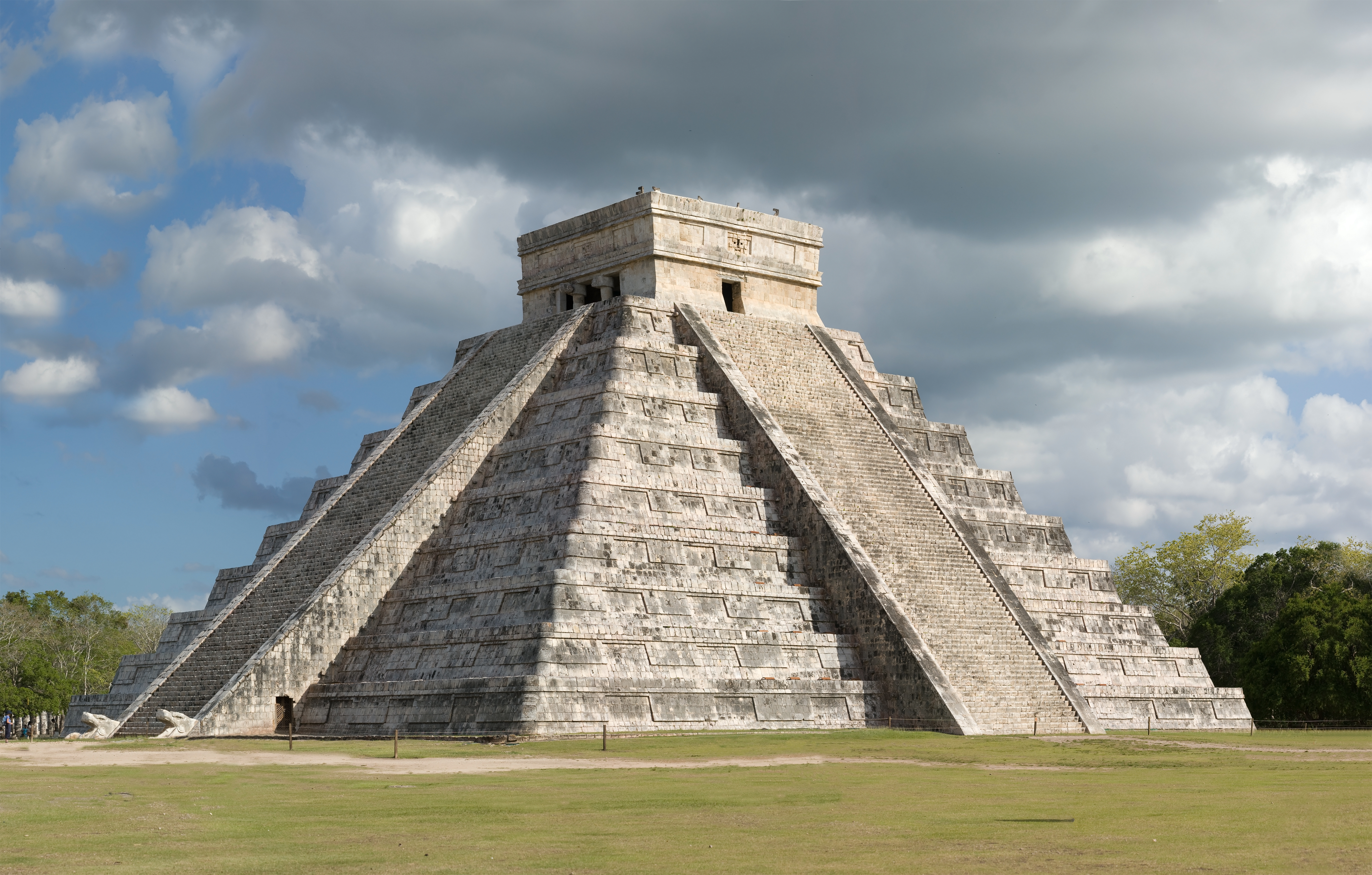
The most recognisable structure is El Castillo, also called the Pyramid of Kukulkán. Its nine stepped bodies, four stairways and serpent imagery make it the monument most visitors picture when they think of Chichén Itzá. You cannot climb it. That restriction protects the structure and changes the way you experience it: the pyramid is a visual centrepiece viewed from ground level, not a lookout.
The Great Ball Court is another reason Chichén Itzá feels larger and more civic than Ek Balam. Its parallel walls, stone rings and carved imagery create an unmistakable sense of a formal arena. The Temple of the Warriors and its surrounding columns are equally important for understanding the site’s public architecture. The Observatory, often called El Caracol, adds a different kind of interest, especially for visitors curious about astronomy and the way Maya builders used architecture to observe the sky.
The Sacred Cenote lies beyond the main monumental area, connected by a sacbé. It is not a swimming cenote, and it should not be confused with the recreational cenotes that can be added to a day trip. The site also has a museum and visitor services, but the exact operating arrangements can change with conservation, crowd management and official policy.
 El Castillo at Chichén Itzá, the Maya pyramid of Kukulkán in Yucatán
Current practical information for Chichén Itzá
INAH currently lists Chichén Itzá as open daily from 08:00 to 16:00, with last access at 15:00. The site has official services including parking, toilets, lockers, a shop, an information module and guided tours. Admission is made up of the INAH component plus an additional Yucatán state charge for many visitors. Fees and ticket procedures are particularly important here because a low advertised headline price may not represent the complete amount payable.
Use the official INAH Chichén Itzá page for the current notice and ticket links. Arrive as close to opening as your transport allows, especially during hotter months, weekends and holiday periods. A 08:00 entry is not a guarantee of solitude, but it gives you a better chance of seeing El Castillo before the busiest part of the day and reduces the heat during the longest walk.
For a guided day from Mérida, compare the current Chichén Itzá inventory on GetYourGuide with Viator’s Chichén Itzá listings. Check whether the option includes a certified guide inside the archaeological zone, transport, admission, a cenote, lunch and the pickup area. “Chichén Itzá tour” can describe very different products.
History: related cities, different stories
It is tempting to rank the sites by age or importance, but that flattens the history. Ek Balam and Chichén Itzá were not identical versions of the same city. Ek Balam gives you an unusually clear view of a royal centre in northeastern Yucatán, especially through the Acropolis and its sculpted decoration. Chichén Itzá reveals a much larger urban and political project with monumental public spaces and a long, complex history.
INAH notes that Ek Balam influenced neighbouring sites, including early Chichén Itzá, through mural-painting methods, stucco sculpture techniques and ceramic traditions. That does not mean Chichén Itzá is simply an expanded Ek Balam, nor that influence moved in only one direction. It does mean the two sites can make more sense together. Visiting Ek Balam first may help you notice how Maya power was expressed through palace architecture, elite tombs and highly worked surfaces; Chichén Itzá then shows how monumental urbanism and public ceremony operated on a much larger scale.
Chichén Itzá is also a UNESCO World Heritage site, a status that contributes to its international profile and visitor numbers. Ek Balam is protected and managed by INAH but is not listed as a UNESCO World Heritage site. UNESCO status is not a quality ranking. It is one reason Chichén Itzá has a larger global audience, not proof that Ek Balam is historically unimportant.
Crowds, photography and comfort
Choose Ek Balam if crowd levels strongly affect your enjoyment. It is usually the calmer visit, particularly when you arrive early and avoid the busiest shared-tour windows. “Quiet” does not mean empty: tour groups, school groups and seasonal visitors can still be present. The advantage is that the site feels less dominated by a single queue or viewing platform.
Choose Chichén Itzá if you are willing to accept more people in exchange for monuments that are immediately impressive. The central plaza around El Castillo can be busy, and vendors may be present in the wider visitor experience outside the protected route. Set your expectations correctly. You are visiting a globally famous archaeological site, not a private ruin.
For photographs, Ek Balam offers layered vegetation, stairways and close architectural details. Chichén Itzá offers stronger wide compositions and more recognisable silhouettes. At both sites, do not step onto restricted structures, touch carved or stucco surfaces, or use a drone without the required permission. The best light is generally earlier in the day, and early arrival is useful for comfort even if photography is not your main goal.
Which site is better for different travellers?
First-time visitors to Yucatán
Chichén Itzá is the safer single-site recommendation. It is the place friends and family are likely to recognise, and the main monuments justify the travel time. A guide is especially useful because the site is large enough that first-time visitors can walk past important structures without understanding their role.
Add Ek Balam if your trip already includes Valladolid or if the Acropolis, stucco reliefs and smaller-scale archaeology sound more interesting than a checklist of famous landmarks.
Travellers who want to climb
Ek Balam is the obvious choice, subject to current access rules. Chichén Itzá’s major pyramids are not open for climbing. Do not assume that a product description, old photograph or travel video reflects today’s rules. Verify directly and respect temporary closures.
Families
Chichén Itzá has more formal services and a straightforward headline attraction, but the size, heat and walking can tire younger children. Ek Balam can be easier to grasp as a shorter visit, though steep steps make the Acropolis unsuitable for some children. For either site, schedule water, shade and a realistic stopping point rather than promising a full archaeological lecture.
Serious history and archaeology readers
Visit both if possible. Ek Balam’s Acropolis and stucco work reward close observation; Chichén Itzá offers more monumental variety and a broader discussion of regional power, ritual and architectural change. A knowledgeable guide matters more than squeezing in a third attraction.
Travellers with limited mobility
Ask specific questions before booking. Chichén Itzá has listed accessibility services, but the archaeological route is large and surfaces can be uneven. Ek Balam’s terrain and any open climbing route present additional challenges. An accessible vehicle does not make every monument accessible. Contact the site or tour operator about drop-off points, walking distances, rest areas and whether the guide can adapt the route.
Photographers
Ek Balam is better for close details, vegetation and sculptural surfaces. Chichén Itzá is better for iconic architecture, broad plazas and recognizable compositions. Go early to both. Midday light is harsh, and heat affects patience more than camera settings do.
Transport and time from the main bases
From Valladolid
Valladolid is the best base for comparing the two sites. Ek Balam is close enough for a half-day, while Chichén Itzá is also a manageable excursion. A rental car gives the most control, especially if you want to add a cenote or return to Valladolid for lunch. A private driver helps if you do not want to navigate or manage parking, but confirm exactly how long the driver waits.
Public transport is more practical to Chichén Itzá via the main highway and nearby Pisté than to the Ek Balam entrance. The final connection to Ek Balam needs advance planning. Do not treat a “cheap taxi out” as a complete itinerary until you know how you will return.
Valladolid works well as an overnight base because you can begin early without making a long round trip from Mérida. For current availability, check Valladolid stays on Booking.com and compare Valladolid hotels on Trip.com.
 A street scene in Valladolid, Yucatán, a practical base for visiting Ek Balam
From Mérida
Chichén Itzá is the more conventional day trip from Mérida. It is a long day, but the route is straightforward by car, bus or organised tour. Ek Balam is possible from Mérida, but the distance and less direct final connection make it a better fit for a driver-led day or a multi-stop itinerary that includes Valladolid.
If you are staying in Mérida and have only one archaeological day, choose Chichén Itzá unless your priorities clearly point to Ek Balam. If you have two days, consider one early Chichén Itzá visit and a separate east-of-Yucatán day rather than forcing both sites into a single exhausting schedule.
From Cancún or the Riviera Maya
Chichén Itzá is frequently sold as a very long day trip from Cancún and nearby destinations. Ek Balam can be added to private itineraries, but doing both from the coast makes the day especially demanding. Since this guide focuses on Yucatán State, consider moving your overnight base to Valladolid if both sites are central to your plan. You will spend more time at the ruins and less time sitting in traffic.
Should you visit both in one day?
You can, but it is not automatically the best plan. A same-day combination requires an early departure, private or highly coordinated transport, enough time at each entrance and a willingness to skip other stops. The sites have different official schedules, and an unplanned delay at the first one can reduce the second visit to a rushed walk.
The strongest version is usually Ek Balam first, then Chichén Itzá only if your transport and ticket plan are confirmed, or a private itinerary that states the time allocated at each site. Some travellers prefer the reverse order so they see Chichén Itzá while fresh and use Ek Balam as the quieter second stop. There is no universal order; the right choice depends on opening times, heat, ticketing and whether climbing access is important.
A better two-day pattern from Valladolid is:
- Day one: Chichén Itzá at opening, then a slow afternoon in Valladolid or a nearby swimming cenote.
- Day two: Ek Balam in the morning, followed by lunch and a relaxed Valladolid afternoon.
That plan gives each site enough attention and leaves room for the practical realities of Yucatán travel: heat, traffic, hydration and the occasional delay.
Guides, tours and independent visits
A guide is most valuable at Ek Balam because its architecture can look like a sequence of terraces unless someone explains the Acropolis, ruler, tomb, reliefs and city layout. At Chichén Itzá, a guide helps you connect the monuments and avoid treating the site as a series of famous photo stops.
Independent visits work well for travellers who have read ahead, can manage transport and are comfortable checking official information. They are less attractive if you are trying to see both sites, a cenote and Valladolid in one day. Tour descriptions vary widely, so inspect inclusions rather than trusting a title. Confirm whether tickets, meals, swimming stops, hotel pickup and guide services are included.
The verified GetYourGuide private listing for Chichén Itzá, Ek Balam and a cenote describes a 12-hour private excursion with archaeological visits, a cenote and lunch. Details such as availability, language, pickup and current price require checking for your dates. For alternatives, browse Viator’s Valladolid archaeological and day-trip inventory and compare the actual itinerary, not just the headline.
What to bring and what not to assume
Bring water, sun protection, comfortable shoes with grip, insect repellent for shaded areas, and a small amount of cash for situations where card payments are not available. Wear clothing that dries quickly. A hat is useful, but secure it before climbing or walking in wind.
Do not assume you can swim at the Sacred Cenote at Chichén Itzá. You cannot treat the site as a water park. If swimming matters, book or plan a separate cenote stop with its own rules and changing arrangements.
Do not assume a pyramid can be climbed because an old blog says it can. At Ek Balam, access is conditional; at Chichén Itzá, major monument climbing is prohibited. Do not assume every tour includes entry. Do not assume a return taxi will be waiting. These small checks prevent the most common frustrations.
A simple decision by trip length
If you have one free morning from Valladolid, the decision depends on what you want to remember. Choose Chichén Itzá for the broadest introduction to Maya monumental architecture. You will spend more time walking and managing other visitors, but you will see a concentration of structures that cannot be replicated elsewhere in the state. Choose Ek Balam if you have already seen a major ruin, prefer details to spectacle, or want your archaeological visit to feel connected to the surrounding landscape.
With one full day, resist the urge to attach every possible stop. A ruin, a swimming cenote, lunch and Valladolid can already make a satisfying route. Adding two ruins to that list may sound efficient but often means arriving at the second site tired, close to the hottest part of the afternoon, or too late for the official last-entry time. If both ruins matter, divide them across mornings whenever your accommodation allows it.
A three-night Valladolid stay gives you the most flexibility. Use the first morning for Chichén Itzá, return to town during the warmer hours, and keep the next morning for Ek Balam. This leaves space for a cenote or town walk without making every activity dependent on a perfect transport connection. It also lets you change the order if rain, maintenance or a temporary access restriction affects one site.
Travellers who are not especially interested in archaeology should still consider one site, but choose based on patience. Chichén Itzá is easier to appreciate quickly because its visual landmarks explain themselves. Ek Balam is more rewarding when you are willing to read signs, listen to a guide and look at surfaces rather than only taking a summit photograph. A short visit to either site is better than skipping both, but neither deserves to be treated as a roadside photo stop. Allow time to notice the setting.
The verdict
Choose Chichén Itzá for your one essential Maya-ruin visit: it has the larger monumental story, the most recognisable architecture and the strongest infrastructure for first-time visitors. Choose Ek Balam when you want a quieter, more detailed and more physically involved visit, especially if you are staying in Valladolid and can confirm current Acropolis access.
If your itinerary can support two archaeological mornings, visit both. Treat them as complementary rather than competitors: Ek Balam brings you close to the royal palace, stucco art and layered history of Talol, while Chichén Itzá shows the scale of a famous regional capital. That contrast is more useful than trying to decide which one is universally “better.”
For most travellers, the practical decision is simple: base yourself in Valladolid, start early, verify official site information, and leave enough time to look carefully. The ruins are not improved by racing between them for the sake of a longer checklist.