
 Acropolis pyramid at Ek Balam, Yucatán
Ek Balam is one of the few remaining Mayan sites in Yucatán where you can still climb the pyramids. Located about 25 kilometres north of Valladolid in the municipality of Temozón, this compact archaeological site sees a fraction of the visitors that Chichén Itzá draws, yet it holds some of the finest stucco carvings ever found in the northern Maya lowlands. The name translates from Yucatec Maya as "dark jaguar" or "star jaguar" — a fitting title for a site that feels wilder and less polished than its famous neighbours.
The excavated area is small enough to explore in two to three hours, which makes it straightforward to combine with a swim at the nearby Cenote Xcanché on the same day. If you are based in Valladolid or passing between Mérida and the coast, it is a worthwhile detour.
A Brief History
Ek Balam was occupied from around 300 BC through the Postclassic period, reaching its peak between roughly 770 and 840 CE. At its height, the city may have supported a population of around 18,000 people and served as the capital of a regional polity. The first known king, Ukit Kan Lek Tok, is credited with constructing the Acropolis — the massive pyramid that dominates the site today. His tomb lies within it, marked by an entrance carved in the shape of a jaguar's mouth.
After 840 CE, the population declined sharply. Within a generation or two, the city was largely abandoned. The reasons remain unclear. Some researchers point to evidence of defensive walls and a hasty departure, suggesting conflict or threat, but no consensus has been reached. The site sat hidden in the jungle until French explorer Désiré Charnay visited in 1886, and systematic excavation by INAH (Instituto Nacional de Antropología e Historia) did not begin until the late 1980s. It opened to the public in 1992.
Only a small portion of the original city has been excavated — about 45 structures within a walled enclosure of roughly one square kilometre. The rest remains under the jungle.
Climbing the Acropolis
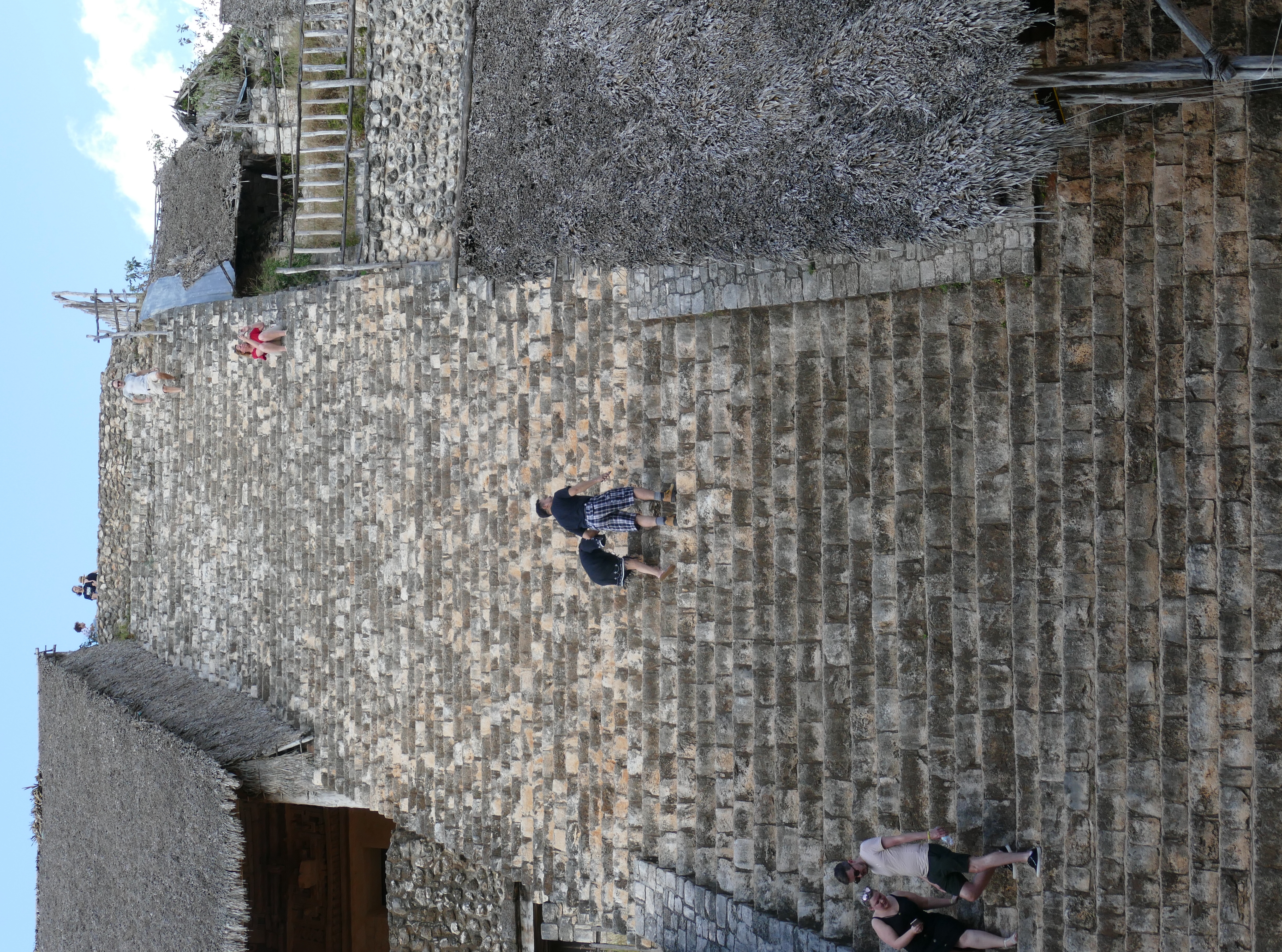 Steep stairway of the Acropolis at Ek Balam
The Acropolis is the centrepiece of Ek Balam. Measuring approximately 160 metres long, 70 metres wide, and rising 32 metres above the surrounding plaza, it is the largest structure at the site. The climb is steep — the steps are narrow and uneven, and there is no railing for much of the ascent. You do not need to be an experienced hiker, but a reasonable level of fitness and a head for heights are helpful. Wear trainers or hiking sandals with good grip; the limestone steps can be slippery after rain.
From the top, the view extends across the tree canopy in every direction. On a clear day, you can see the outline of Cobá's pyramid roughly 48 kilometres to the southeast. The sense of space and quiet up there is the main reason people make the climb. At Chichén Itzá, you stand on the ground and look up. At Ek Balam, you stand on top and look out.
The descent is steeper than the ascent. Take it slowly and use the rope handrail where it is provided. If you have young children, assess their comfort with heights before committing — there is no shortcut back down.
The Stucco Carvings of the Sak Xok Naah
 Preserved stucco carvings at Ek Balam
Near the top of the Acropolis, under a thatched protective roof, you will find the entrance to the tomb of Ukit Kan Lek Tok. The doorway is carved in the form of a monstrous jaguar or serpent mouth — the entrance to the underworld, or Xibalba, in Maya cosmology. The surrounding stucco façade is remarkably well preserved, with intricate carvings depicting warriors, rulers, and mythological scenes.
This is one of the most significant features of Ek Balam. The plasterwork survived because it was buried behind a wall for centuries, protected from rain and sun. What you see today is a combination of original stucco and careful restoration, but the detail is extraordinary. The craftsmanship on display here rivals anything at Uxmal or Kabah, and you can get close enough to see individual tool marks.
Photography is allowed, but the thatched roof creates uneven lighting. A polarising filter helps if you are carrying one, but a phone camera will capture the essentials without difficulty.
Other Structures Worth Seeing
Beyond the Acropolis, the site contains several other structures that reward a slow walk-through:
- The Entrance Arch — a vaulted passageway that once marked the ceremonial entry to the city. It stands on four legs and is one of the better-preserved examples of its kind in the northern lowlands.
- The Oval Palace — a smaller structure with cosmological alignments, believed to have been used for burial rituals. Its rounded shape is unusual for Maya architecture in this region.
- Structure 17 (Las Gemelas / The Twins) — a pair of mirroring temples on a shared platform, located on the west side of the South Plaza. The architectural details here are among the best preserved at the site.
- The Ball Court — a standard I-shaped playing field, smaller than the one at Chichén Itzá but still clearly defined.
The defensive walls that encircle the ceremonial centre are also worth noting. Three concentric walls, each about three metres wide, once restricted access to the inner city. Five gateways and five sacbeob (raised white roads) radiate outward from the walls toward the cardinal points.
Cenote Xcanché
 Acropolis at Ek Balam, Yucatán
About 1.5 kilometres from the archaeological site entrance, Cenote Xcanché is a large open sinkhole set in dense jungle. It is operated by a local Maya community cooperative, and visiting it supports the local economy directly. The cenote is roughly 30 metres deep, with clear turquoise water and steep limestone walls draped in roots and a small waterfall.
Access is via a long, steep wooden staircase that descends into the pit. The water is calm and suitable for swimmers of all levels; life jackets are available free of charge. You can jump from platforms at different heights, swing in on a Tarzan rope (free), or pay extra for zip lines (100–170 MXN) and rappelling (150 MXN). There are basic changing rooms and restrooms on site. Lockers are free but bring your own padlock.
Entrance fee: 170 MXN per person. Hours: 8 AM to 5 PM daily. The cenote closes at 4 PM, so plan accordingly if you are visiting both the ruins and the cenote in one day.
To reach the cenote from the ruins, you can walk along a shaded jungle path (about 20 minutes), rent a bicycle at the site entrance, or drive directly to the cenote's parking area (100 MXN parking fee). If you arrive by colectivo, you will need to arrange transport between the ruins and the cenote — the free bicycles provided with cenote entry are the most practical option.
GuideCenote Xcanché Guide: Swim Near Ek Balam from ValladolidCenote Xcanché is a semi‑open limestone pool set in the forest near the Ek Balam archaeological zone, north of Valladolid in the municipality of Temozón. The cenote is about a 30‑minute drive from Valladolid, 2.25–2.75 hours from Mérida and 2–2.5 hours from Cancún; visitors usually reach it by rental car, taxi, private driver or an organized tour, and the walk from the Ek Balam entrance to the water is roughly 1.5 km, often done on foot, bike or a local tricycle‑style transport. Entry to the cenote costs a few hundred pesos; the exact amount varies with season and any extra activities such as zip‑line, rappel or biking, and cash in pesos is required because cards are not reliably accepted. The site is open only during daylight hours, with no specific closing time given, so arriving late after the ruins is discouraged. A typical visit lasts 1.5 to 2 hours, longer if adventure options are added. Visitors can expect a rustic setting with wooden stairs, platforms, changing areas, bathrooms, life jackets and basic food or drinks. The water may appear dark blue, green or almost black depending on light. Bring swimwear, a towel, water, a hat, sandals or water shoes with grip, and a dry bag for wet clothes. Life jackets are advisable for children and less confident swimmers, and sunscreen, oils or insect repellent should not be worn in the water. The cenote is best visited after touring Ek Balam in the early morning, then swimming around late morning or midday, followed by lunch in Valladolid. Weekdays are quieter; the path can be slippery in the rainy season and the stairs may be challenging for those with limited mobility.Open
Getting There
Ek Balam is located 25 kilometres north of Valladolid on Highway 295 toward Tizimín. The drive takes about 30 minutes from the centre of Valladolid.
By colectivo: Shared vans depart from the corner of Calle 44 and Calle 37 in Valladolid, a short walk from the ADO bus terminal. The one-way fare is approximately 70 MXN per person if the van fills up, or around 280 MXN for the trip if you are the only passenger. The colectivo drops you at the Ek Balam parking lot. Return colectivos leave from the same spot, but frequency drops in the afternoon — confirm the last departure time with the driver.
By rental car: The drive from Valladolid takes about 30 minutes on a well-signed, paved road. From Mérida, allow approximately 2 hours and 25 minutes via the Valladolid highway. From Cancún airport, the drive is about 2 hours and 15 minutes. Parking at the site costs around 30–50 MXN.
By taxi: A round-trip taxi from Valladolid, including waiting time, costs approximately 600–800 MXN. Negotiate the price and wait time before departing.
By tour: Several operators in Valladolid offer half-day tours that combine Ek Balam with Cenote Xcanché and sometimes a stop in the town of Temozón. Prices range from 450 to 900 MXN per person.
Entrance Fees and Opening Hours
Archaeological site entrance: The fee for foreign visitors is approximately 531 MXN per person. Mexican nationals pay a reduced rate. Children under 13, seniors, teachers, and people with disabilities may be exempt from the state portion of the fee. The ticket office accepts cash only — there is no ATM on site. Bring enough cash to cover entrance, parking, and any additional costs.
Hours: Open daily from 8 AM to 5 PM. Last admission is at 4 PM.
Guide service: Official guides are available at the entrance for approximately 600 MXN in Spanish or 800 MXN in English or French. Their knowledge varies, but a good guide can add meaningful context to the stucco carvings and the site's history.
GuideChichén Itzá Opening Hours and Tickets: 2026 Prices, Last Entry and TipsCurrent Chichén Itzá opening hours, 2026 ticket prices, last-entry time, parking costs, Sunday rules, night-show tickets, and practical advice for an easier visit.Open
Practical Tips
- Go early. The site opens at 8 AM, and arriving within the first hour gives you the best chance of having the Acropolis almost to yourself. By mid-morning, tour groups begin arriving.
- Bring water. There is no food or drink allowed inside the archaeological zone, and the heat on the exposed pyramid steps can be intense. Vendors at the entrance sell water and snacks.
- Wear sunscreen and a hat. Most of the site is in full sun. The jungle shade is limited to the perimeter paths.
- Bring cash. The ticket office, parking, and cenote entrance are all cash-only. The nearest ATM is in Valladolid.
- Combine with Cenote Xcanché. Visiting the ruins first and then cooling off in the cenote is the most logical order. Allow two to three hours for the ruins and one to two hours for the cenote.
- Combine with Valladolid. Ek Balam works well as a half-day trip from Valladolid. You can visit the ruins in the morning, swim at the cenote, and be back in Valladolid by early afternoon for lunch.
- Footwear matters. The Acropolis steps are steep and can be slippery. Avoid flip-flops.
Who This Suits
Ek Balam is a good fit for travellers who want a more hands-on archaeological experience than Chichén Itzá allows. The ability to climb the pyramid and stand at the top, looking out over uninterrupted jungle, is the main draw. It suits history enthusiasts, photographers, and anyone who prefers a quieter site without the souvenir-stall atmosphere of larger ruins.
Families with older children will find it manageable — the climb is doable for active kids, though parents should assess the steep steps carefully. The cenote adds a swimming element that appeals to families.
It is less suitable for travellers with limited mobility, as the Acropolis climb is strenuous and there are no alternative routes to the top. The Oval Palace and ground-level structures are accessible, but the main attraction requires climbing.
If you are short on time in Yucatán and can only visit one or two ruin sites, Ek Balam pairs well with either Uxmal (for Puuc architecture) or Chichén Itzá (for scale). It is not a replacement for either, but it offers something they do not: the chance to climb.

