Cenote Hubiku is a large underground cenote near Temozón, north of Valladolid. Its broad cavern, deep blue water and opening in the roof make it one of the most dramatic swimming stops on the route between Valladolid and Ek Balam.
Hubiku is more developed than many rural cenotes. There is a large parking area, changing facilities, showers, a buffet restaurant, a gift shop, a small tequila attraction and a reconstructed Maya village area.
That infrastructure makes the visit straightforward for families, tour groups and first-time cenote swimmers. The trade-off is that Hubiku can feel busy and commercial when excursion buses arrive.
Visit close to opening time if you want a calmer swim. Visit nearer midday if seeing the shaft of sunlight entering through the roof matters more than avoiding crowds.
Cenote Hubiku at a glance
- Location: Near Temozón, north of Valladolid
- Type: Underground or semi-open cave cenote
- Published hours: 9:00 AM to 5:00 PM daily
- Time needed: Around 1.5 to 2.5 hours
- Water depth: Approximately 27 metres
- Cavern width: Approximately 50 metres
- Access: Around 115 stone steps
- Facilities: Parking, toilets, showers, changing areas, lockers, restaurant and gift shop
- Best for: Families, first-time cenote visitors and Ek Balam day trips
- Less suitable for: Wheelchair users, travelers avoiding stairs and people looking for a quiet community cenote
- Easiest transport: Rental car, private driver or organized tour
Published hours and ticket packages can change. Check the official Cenote Hubiku website or call +52 998 195 6537 before making a tightly timed journey.
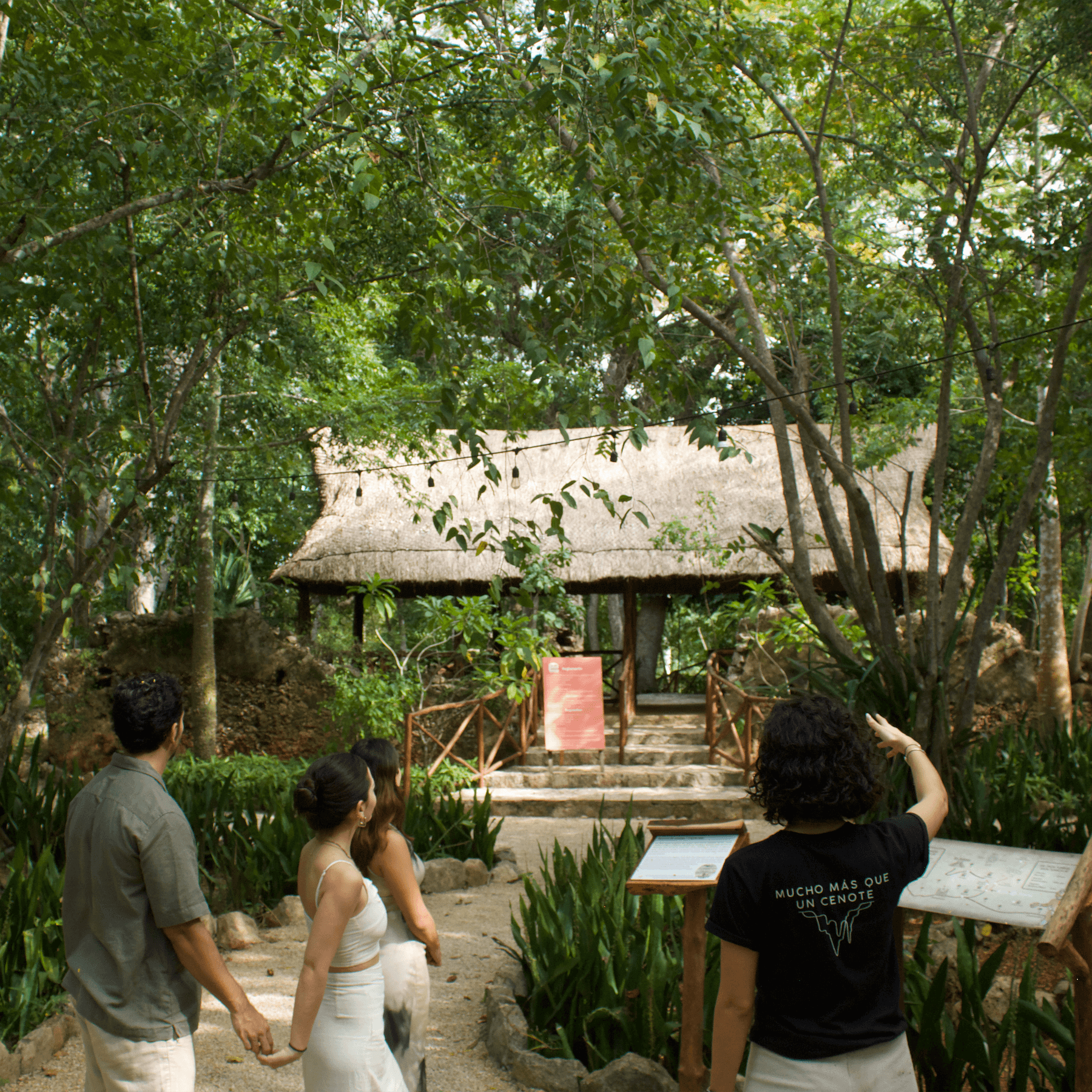
 Colorful Hubiku entrance sign beside the cenote pool
Is Cenote Hubiku worth visiting?
Hubiku is worth visiting if you want a large cave cenote with easy parking, on-site facilities and enough space for a proper swim.
It works particularly well after a morning at Ek Balam. The ruins can be hot, exposed and physically demanding. Hubiku gives you a convenient place to cool down, change clothes and have lunch before returning to Valladolid.
Choose Hubiku if you want:
- A large underground swimming area
- Changing rooms and showers
- Easy access by car or tour van
- Food available without another journey
- A family-friendly stop with staff and established facilities
- A cenote that fits naturally into an Ek Balam route
You may prefer another cenote if you want:
- A small, quiet or community-run experience
- Minimal commercial development
- Easy access without a long staircase
- A shallow swimming area for very young children
- Photography without tour groups in the background
Hubiku is not untouched or remote. It is a visitor complex built to handle substantial numbers of people. That is either its main strength or its main weakness, depending on the kind of cenote day you want.
What is Cenote Hubiku like?
Hubiku is an almost circular cavern with a broad pool beneath a limestone roof. A natural opening in the ceiling allows daylight, roots and rainwater to enter the chamber.
Around midday, sunlight can fall through the opening and illuminate part of the water. The strength and position of the light depend on the season, weather and time of day, so do not plan the visit around one exact photograph.
The water is fresh, clear and cool. Published venue information places its temperature at roughly 20°C, which can feel cold when you first enter, especially after walking outside in the heat.
The pool is deep rather than beach-like. There is no gradual sandy entrance or shallow children’s area. Swimmers enter from the developed platform and steps at the water’s edge.
Ropes across sections of the pool provide somewhere to rest, but visitors should still treat Hubiku as deep open water.
 Hammocks and a shaded rest area in the Hubiku complex
Swimming at Cenote Hubiku
Hubiku is a good swimming cenote rather than only a photography stop. The chamber is wide enough to move around, and the cool water is welcome after visiting ruins.
Life jackets are available on site. Whether they are included in your particular ticket or charged separately can change, so check at the entrance.
Less confident swimmers should use one. The water reaches considerable depth, and the cavern can feel darker once you move away from the opening in the roof.
Follow the posted instructions before entering. Most cenotes require visitors to shower and remove sunscreen, insect repellent, oils and heavy skin products before swimming.
Do not jump from rocks, walls or platforms unless staff have clearly marked an area as safe and permitted. Water depth alone does not make an improvised jump safe.
Small fish may be visible in the water. They are part of the cenote environment and should not be fed or handled.
GuideCenote Hool Kosom Guide: Swimming, Prices and the Homún Cenote RouteA practical guide to Cenote Hool Kosom near Mérida, including swimming, current price guidance, opening hours, transport and nearby Homún cenotes.Open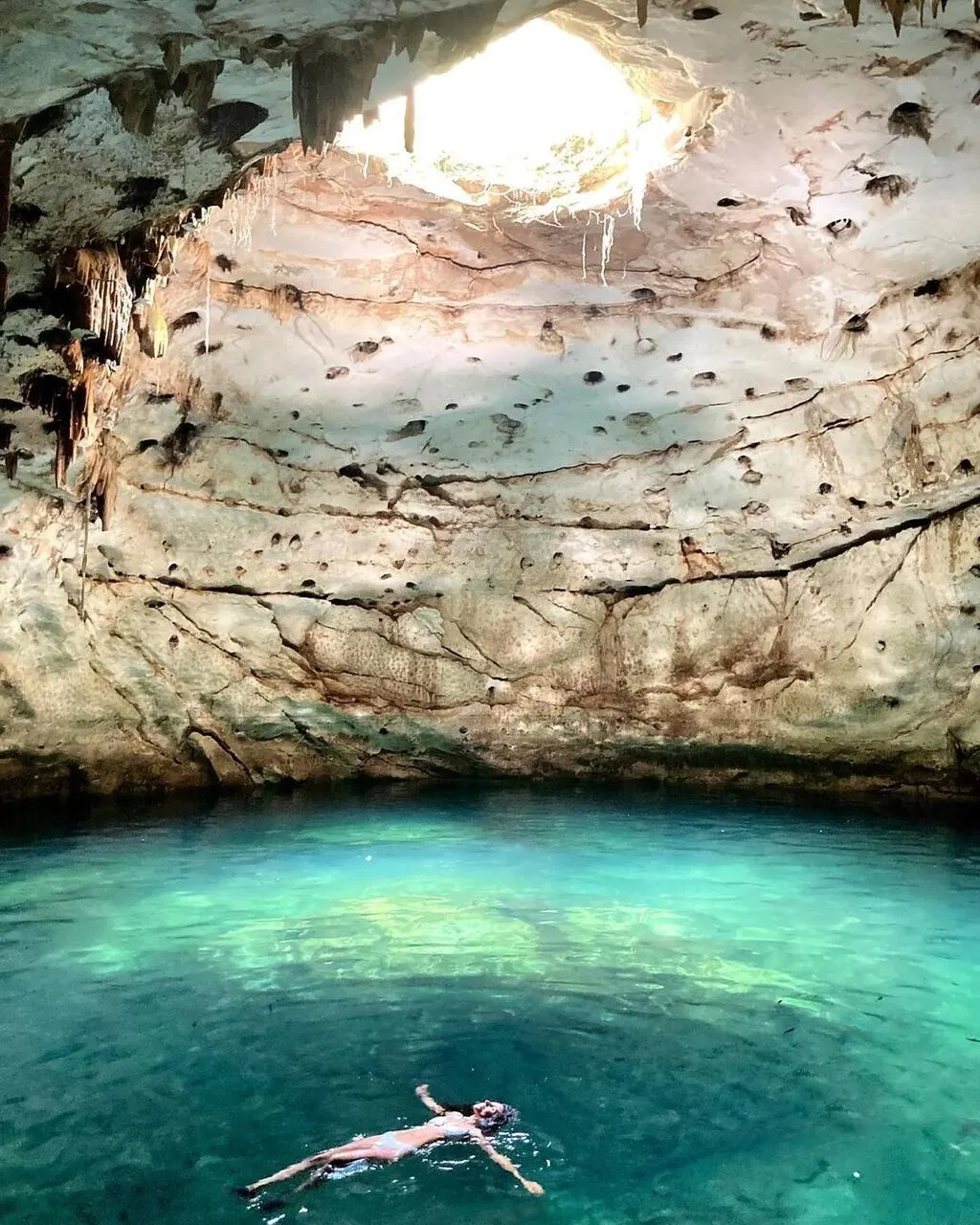
Tickets and current prices
Cenote Hubiku sells cenote entry as well as packages that can include the buffet restaurant and other parts of the complex.
Recent public listings have commonly placed basic cenote entry in the region of MXN 100 to 150 per person, with food packages and optional extras costing more. Treat that as a planning range rather than a guaranteed 2026 price.
Before visiting, confirm:
- The current cenote-only admission
- Whether the life jacket is included
- Locker and towel charges
- The price of the buffet package
- Child pricing
- Whether card payment is working
- Whether advance booking is needed for your date
You can check the venue’s official booking page.
Bring Mexican pesos even if you expect to pay by card. Cash is useful for lockers, drinks, tips and small purchases, and payment systems outside Valladolid can be inconsistent.
Opening hours and the best time to visit
Cenote Hubiku is generally published as open daily from 9:00 AM to 5:00 PM.
Go near 9:00 AM if your priority is a quieter swim. Large tour groups often reach the complex later in the morning or around lunchtime.
Go nearer midday if your priority is seeing sunlight enter through the ceiling. The trade-off is that this is also when the cenote may be busier.
Weekdays outside Mexican school holidays, Easter week and long weekends are usually easier than peak holiday dates.
A useful approach is:
- 9:00 AM to 10:30 AM: Better for quieter swimming
- Late morning to early afternoon: Better chance of stronger overhead light
- After 3:00 PM: Sometimes calmer, but leaves less margin before closing
Do not arrive close to closing time expecting a full visit. You need time to buy tickets, change, shower, descend the stairs, swim and return to the surface.
GuideChichén Itzá Opening Hours and Tickets: 2026 Prices, Last Entry and TipsCurrent Chichén Itzá opening hours, 2026 ticket prices, last-entry time, parking costs, Sunday rules, night-show tickets, and practical advice for an easier visit.Open
How long should you spend at Hubiku?
Allow around 1.5 to 2 hours for a straightforward cenote visit.
Allow 2.5 to 3 hours if you also want lunch, the tequila tasting area, the reconstructed Maya village and time to change without rushing.
A simple visit might look like this:
- Tickets and changing: 20 minutes
- Descent and photographs: 15 minutes
- Swimming: 45 to 60 minutes
- Showering and changing: 20 minutes
- Restaurant or other areas: 45 to 75 minutes
Hubiku does not normally need half a day unless you are eating slowly, traveling with a group or treating it as your main activity.
Facilities at Cenote Hubiku
Hubiku has more visitor infrastructure than many cenotes around Valladolid.
Facilities generally include:
- Large parking area
- Toilets
- Showers
- Changing areas
- Life jackets
- Lockers
- Towel rental
- Gift and handicraft shop
- Buffet restaurant
- Tequila attraction and tasting area
- Reconstructed Maya village area
That makes it easier for families and tour groups, but it also explains why the venue can feel more organized and commercial than a small village cenote.
Keep valuables in a locker rather than leaving phones, wallets or car keys with clothing beside the water.
The buffet restaurant
The on-site restaurant serves a buffet with regional dishes, meat, salads, fruit, bread and desserts.
Its main advantage is convenience. You can swim, shower and eat without driving into Temozón or returning immediately to Valladolid.
Treat it as a practical tour-stop buffet rather than the main culinary reason to visit. Travelers particularly interested in local food may prefer to eat longaniza, smoked meat or another regional lunch in Temozón.
The buffet can still be useful when:
- Traveling with children
- Visiting as part of a long day
- Continuing toward Ek Balam or Valladolid
- Managing different dietary preferences within a group
- Avoiding another stop after swimming
Ask about vegetarian options and food allergies before paying for the combined package.
 View into the Hubiku cavern from the entrance passage
The Maya village area
The complex includes a reconstructed village area with traditional-style houses, cultivation displays and handmade tortillas.
It gives visitors a simple visual introduction to regional building forms and rural life, but it should not be confused with visiting a living Maya community or a detailed cultural museum.
Spend a little time here if it is included in your ticket, particularly with children. It is not a reason to make a separate journey to Hubiku.
For a broader view of contemporary inland Yucatán, combine the cenote with Temozón, Valladolid, Uayma or another nearby town rather than treating the visitor display as the complete cultural experience.
 Swimming in the deep water at Cenote Hubiku
The tequila museum and tasting
Hubiku also has a small tequila attraction associated with Don Tadeo products. Visitors may be offered tastings, including sweeter or flavored drinks.
This is a commercial tasting stop rather than a major museum. Tequila comes from western Mexico rather than Yucatán, so it should be treated as an optional addition to the visit rather than a regional heritage experience.
Do not feel obliged to buy a bottle. Check the final price, bottle size and airline baggage rules before purchasing alcohol to carry home.
Drivers should skip the tasting.
How to get to Cenote Hubiku
Cenote Hubiku is near Temozón on the road north from Valladolid toward Tizimín and the Ek Balam area.
The listed address is:
Carretera Valladolid–Tizimín, kilometre 1.5, Temozón, Yucatán, 97740
Use the current map pin rather than relying only on written directions. The final approach leaves the main road and enters the visitor complex.
From Valladolid
Allow roughly 25 to 35 minutes by car, depending on your starting point and road conditions.
A rental car is the simplest option. A taxi also works, but arrange the return before the driver leaves. Do not assume another taxi or app-based ride will be waiting at the entrance.
Ask the driver to quote for:
- One-way transport
- Waiting during the visit
- Return pickup at a fixed time
- A combined Hubiku and Ek Balam day
Public transport toward Temozón may get you part of the way, but the final access and return make Hubiku awkward without a car. It is not one of the easiest Valladolid cenotes to visit independently by bus.
Read our Valladolid travel guide for help choosing a base and planning nearby day trips.
GuideBest Day Tours from Valladolid: Ruins, Cenotes, Wildlife, and Small TownsCompare the most useful day trips from Valladolid, including Chichén Itzá, Ek Balam, cenotes, Río Lagartos, Las Coloradas, Izamal, and smaller Yucatán towns.Open
From Mérida
Hubiku is roughly a 2-hour to 2.5-hour drive from central Mérida, depending on the route, traffic and roadworks.
It is too far to visit only for the cenote. Combine it with:
- Ek Balam
- Valladolid
- Temozón
- Uayma
- An overnight stay in Valladolid
A rental car or private driver is the practical choice. A group tour can work, but check how many additional stops are included and how long the complete day will be.
GuideCelestún from Mérida: Flamingos, Boat Tours & Beach GuideCelestún is a working fishing town on the far western edge of Yucatán, where a wide Gulf beach meets the Ría Celestún Biosphere Reserve, famous for its flamingo habitat. The destination is about 90–110 km west of Mérida and requires roughly 1.5–2 hours each way by car; a rental car, private driver, organized tour or public bus can be used, with the bus being the cheapest but less flexible. A full‑day visit from Mérida is typical, beginning with a morning boat tour of the mangrove channels and reserve, followed by a long seafood lunch under a palapa and optional beach time. Boat tours are priced per boat rather than per person, include life jackets and usually cover flamingo viewing areas, mangrove passages and occasional stops at freshwater springs; English‑speaking guides are not guaranteed, so confirm in advance. The best flamingo season is November to February, especially December to February, though sightings vary daily. Visitors should expect a wide, soft‑sand beach with calm but sometimes murky water, a relaxed malecón with palapa restaurants, and more locals on weekends and holidays. Bring cash for small vendors, arrive early for cooler weather and better boat‑tour timing, and respect wildlife distance as flamingos are sensitive to close approaches.Open
From Cancún, Playa del Carmen or Tulum
Tours from the Caribbean coast commonly combine Hubiku with Chichén Itzá, Ek Balam or Valladolid.
These trips can last 10 to 13 hours, sometimes longer once hotel pickups are included. Read the itinerary carefully before booking.
A coast-based tour makes sense if you want transport, lunch and several attractions handled in one booking.
It is not the best option if you dislike long van journeys, early hotel pickups or short timed stops. Staying one or two nights in Valladolid produces a calmer visit.
Do you need a tour?
You do not need a guide to visit Cenote Hubiku itself.
Visit independently if you have:
- A rental car
- A private driver
- A clear return arrangement from Valladolid
- An itinerary that includes Temozón or Ek Balam
Choose a tour if you:
- Are staying on the Riviera Maya
- Do not want to drive
- Want ruins, transport, lunch and swimming in one package
- Prefer a fixed itinerary
- Are comfortable with a longer day
A private driver gives you more control over arrival time and how long you spend swimming. It is often the better option for families or small groups trying to avoid the busiest tour-bus period.
Our getting around Yucatán guide explains when rental cars, taxis, tours and private drivers make sense.
Is Cenote Hubiku good for families?
Hubiku can work well for families because it has parking, changing areas, toilets, life jackets, food and staff on site.
It is most suitable for children who:
- Can manage a long staircase
- Are comfortable wearing a life jacket
- Follow instructions around deep water
- Can cope with cool water and a dark cavern
Parents should know that:
- The water is deep
- There is no shallow beach entrance
- Surfaces may be wet and slippery
- The descent involves roughly 115 steps
- Tour groups can make the cavern noisy
- Close supervision is still necessary
This is not an easy stroller stop. Leave the stroller in the car and use a suitable child carrier only if you can move safely on the stairs.
Accessibility
Hubiku is not a strong choice for travelers who cannot manage stairs.
Access to the water involves a substantial stone staircase, and the official state tourism listing does not classify the experience as fully inclusive.
Travelers with limited mobility should contact the venue directly before visiting rather than assuming assistance, ramps or alternative access will be available.
For a mixed-mobility group, one person may enjoy the cenote while others use the restaurant and surface facilities, but confirm what can be accessed without descending.
What to bring
Bring:
- Swimsuit
- Towel
- Dry clothes
- Water shoes or sandals with good grip
- Waterproof pouch or dry bag
- Mexican pesos
- Refillable water bottle
- Light cover-up
- Small bag for wet clothing
Avoid bringing unnecessary valuables.
Apply sunscreen and insect repellent after swimming rather than before. Shower thoroughly when instructed so oils and chemicals do not enter the groundwater.
What to combine with Cenote Hubiku
Ek Balam
Ek Balam is the most natural major combination.
Visit the ruins early, before the strongest heat, then drive to Hubiku for swimming and lunch. This creates a balanced day without returning and crossing Valladolid between stops.
Read our complete Ek Balam guide before planning the visit.
GuideEk Balam Guide: Climbing the Acropolis and Swimming Cenote XcanchéA complete guide to visiting Ek Balam in Yucatán: climb the Acropolis for jungle views, see the preserved stucco carvings, and cool off in Cenote Xcanché. Includes entrance fees, transport from Valladolid, and practical tips.Open
Temozón
Temozón is known for smoked meats, longaniza, carpentry and furniture workshops.
Stop for lunch in town instead of using the Hubiku buffet if local food is a priority. A short drive through the centre also gives the day more regional context.
GuideTemozón: Smoked Meats, Wood Shops & Ek Balam BaseTemozón is a small town a short drive north of Valladolid in the Yucatán, known for its smoked pork sausages and longaniza displayed along the main street and for a concentration of woodworking and furniture showrooms, with the Ek Balam archaeological zone and the community‑run cenotes X’canché and Hubiku only minutes away. The town itself is free to visit and the shops generally operate from 9 am to 6 pm, though hours can vary. Ek Balam is open daily 8 am–5 pm (last entry around 4 pm) and charges foreign adults about $561 MXN (INAH $100 plus a $461 state fee) and Mexican nationals about $227 MXN, with free entry for many locals on Sundays. Cenote X’canché costs roughly $170 MXN and Hubiku about $100 MXN for swimming only, with a separate buffet charge if desired. Cash in Mexican pesos is required; cards are rarely accepted at the small shops. A typical visit lasts four to six hours for the meat and furniture strip plus a cenote, or a full day if Ek Balam is added. Visitors can expect to order smoked meats by weight, eat them on‑site with tortillas and salsas, browse custom cedar and hardwood furniture, explore the climbable Maya ruins with jungle views, and then cool off in either the semi‑open X’canché (reached by a 1.5 km path) or the closed‑cavern Hubiku with its buffet. The town centre is flat but sidewalks are uneven, and the cenotes have stairs. Recommended transport is a car or frequent taxis/colectivos from Valladolid (12–14 km, 15–20 min); Ek Balam is another 14 km beyond Temozón. Bring small‑bill cash, swimwear, water shoes, sun protection and a reusable bottle; ask for mixed meat platters, confirm price per kilo, keep two receipts for Ek Balam, rinse before swimming and avoid non‑biodegradable sunscreen.Open
Valladolid
Return to Valladolid for an evening walk, dinner and an overnight stay.
Hubiku works particularly well when Valladolid is your base. You can visit the cenote without turning the day into a long return excursion from Mérida or the Caribbean coast.
GuideValladolid Travel Guide: What to Do, Where to Stay and How to Plan Your TripValladolid is a small colonial town in eastern Yucatán, roughly halfway between Mérida and Cancún and within an hour’s drive of Chichén Itzá and Ek Balam. The guide suggests staying two nights for most itineraries, with three nights better for families or those who want to visit several cenotes or make day trips to Río Lagartos, Las Coloradas or Cobá. Getting there is easy by rental car, ADO bus, Tren Maya or private driver; the bus station is central, while the train station lies outside the historic centre and requires a taxi or shuttle. Within the town the historic centre, Calzada de los Frailes and the main square are all walkable, but a car, taxi, colectivo, bicycle or scooter is needed for most cenotes and ruins. Typical activities include a morning walk around the main square, visiting Iglesia de San Servacio and the municipal palace, strolling the colourful Calzada de los Frailes, and touring the Convent of San Bernardino de Siena. Cenote Zací, just outside the centre, offers a convenient swim; the local market provides cheap breakfast and snacks. Visitors should plan to start early at ruins and cenotes to avoid the heat, bring cash in small bills, wear grip sandals for cenote water, and respect church dress codes. In the hotter months (April‑May) a hotel with a pool is advisable, and the most comfortable weather is from November to March.Open
Uayma
Uayma has one of the most distinctive colonial churches in the region. It can be added to a private-driver or rental-car route, though opening access to the church interior can be irregular.
Cenote X’Canché
Cenote X’Canché is beside the Ek Balam archaeological area and offers a more rustic, community-based experience.
Choose X’Canché if you want the simplest ruins-and-cenote combination. Choose Hubiku if you prefer larger changing facilities, easier parking, an underground cavern and food on site.
Read our Cenote X’Canché guide before choosing between them.
GuideCenote Xcanché Guide: Swim Near Ek Balam from ValladolidCenote Xcanché is a semi‑open limestone pool set in the forest near the Ek Balam archaeological zone, north of Valladolid in the municipality of Temozón. The cenote is about a 30‑minute drive from Valladolid, 2.25–2.75 hours from Mérida and 2–2.5 hours from Cancún; visitors usually reach it by rental car, taxi, private driver or an organized tour, and the walk from the Ek Balam entrance to the water is roughly 1.5 km, often done on foot, bike or a local tricycle‑style transport. Entry to the cenote costs a few hundred pesos; the exact amount varies with season and any extra activities such as zip‑line, rappel or biking, and cash in pesos is required because cards are not reliably accepted. The site is open only during daylight hours, with no specific closing time given, so arriving late after the ruins is discouraged. A typical visit lasts 1.5 to 2 hours, longer if adventure options are added. Visitors can expect a rustic setting with wooden stairs, platforms, changing areas, bathrooms, life jackets and basic food or drinks. The water may appear dark blue, green or almost black depending on light. Bring swimwear, a towel, water, a hat, sandals or water shoes with grip, and a dry bag for wet clothes. Life jackets are advisable for children and less confident swimmers, and sunscreen, oils or insect repellent should not be worn in the water. The cenote is best visited after touring Ek Balam in the early morning, then swimming around late morning or midday, followed by lunch in Valladolid. Weekdays are quieter; the path can be slippery in the rainy season and the stairs may be challenging for those with limited mobility.Open
Suggested Ek Balam and Hubiku itinerary
A comfortable day from Valladolid:
- 7:30 AM: Leave Valladolid
- 8:15 AM: Arrive at Ek Balam
- 8:30 AM to 10:30 AM: Explore the archaeological site
- 11:00 AM: Drive toward Hubiku
- 11:30 AM to 1:00 PM: Swim at Cenote Hubiku
- 1:00 PM to 2:00 PM: Lunch at Hubiku or in Temozón
- 2:30 PM: Stop briefly in Temozón or Uayma
- 4:00 PM: Return to Valladolid
- Evening: Walk the centre and have dinner
This plan leaves breathing room. Do not add Chichén Itzá to the same day unless you are comfortable spending most of the day rushing between major sites.
Hubiku compared with other Valladolid cenotes
Choose Hubiku for a large cavern, swimming, facilities and an Ek Balam route.
Choose Suytun if the famous stone platform and light-beam photograph matter more than swimming space.
Choose Oxmán if you want an open cenote, hacienda atmosphere and a more relaxed half-day near Valladolid.
Choose X’Canché if you want a community-run cenote directly beside Ek Balam.
Choose Zací if you do not have a car and want the easiest cenote from central Valladolid.
Our best cenotes near Valladolid guide compares the main options by transport, crowds, swimming and photography.
Common mistakes to avoid
Do not arrive at midday expecting solitude. This is a recognised tour-group stop.
Do not build your entire day around seeing one perfect shaft of light. Clouds, season and timing affect the appearance.
Do not rely only on old entrance prices. Confirm current packages before driving from Mérida or the coast.
Do not assume Hubiku has shallow water for children. The pool is deep.
Do not leave phones, wallets or car keys unattended beside the water.
Do not try to combine Chichén Itzá, Ek Balam, Hubiku and Valladolid centre in one comfortable day. It may fit on paper, but it is too much for most travelers.
Do not drink during the tequila tasting if you are driving.
Planning help
Cenote Hubiku is easy to add when you already have transport to Ek Balam or Temozón. It is less convenient as a standalone public-transport trip from Valladolid.
For quick questions about timing, crowds or nearby combinations, use the free Yucatán Guide WhatsApp assistant.
For the next step, use the Plan hub to compare itineraries, transport and practical resources already available.
Frequently asked questions
Is Cenote Hubiku open every day?
The venue is generally published as open every day from 9:00 AM to 5:00 PM. Hours may change for maintenance, weather, holidays or private operations, so confirm before traveling.
How far is Cenote Hubiku from Valladolid?
Allow approximately 25 to 35 minutes by car from central Valladolid.
How deep is Cenote Hubiku?
Published venue information gives a depth of approximately 27 metres. Visitors should treat it as deep water and use a life jacket when needed.
Can you swim at Cenote Hubiku?
Yes. Hubiku has a large developed swimming area inside the cavern.
Are life jackets required?
Life jackets are available on site. Rules and ticket inclusions can change, so follow current staff instructions.
Is Cenote Hubiku suitable for children?
It can be suitable for supervised children who can manage the stairs and wear a life jacket. It is not a shallow swimming pool, and parents need to remain close.
Is Cenote Hubiku wheelchair accessible?
The cenote itself requires descending approximately 115 steps and is not a practical wheelchair-accessible swimming stop.
Can you visit Hubiku without a tour?
Yes. A rental car or private driver makes an independent visit straightforward. A taxi from Valladolid can also work if the return is arranged in advance.
Is there food at Cenote Hubiku?
Yes. There is an on-site buffet restaurant. Cenote-and-meal packages may be available.
Is Hubiku better than X’Canché?
Hubiku has a larger underground cavern and more developed facilities. X’Canché is more rustic, community-based and directly connected to an Ek Balam visit. The better choice depends on whether you value convenience or a smaller-scale experience.
Final advice
Visit Hubiku early for quieter swimming or nearer midday for stronger overhead light. Bring pesos, expect stairs and do not treat the cenote as shallow water.
The strongest route is Ek Balam in the morning, Hubiku for a swim, and lunch in either the complex or Temozón. From Valladolid, this makes an easy full day. From Mérida or the Caribbean coast, it only makes sense as part of a larger route.
Image credits
Hubiku gallery images: Yucatán Travel, Government of Yucatán.