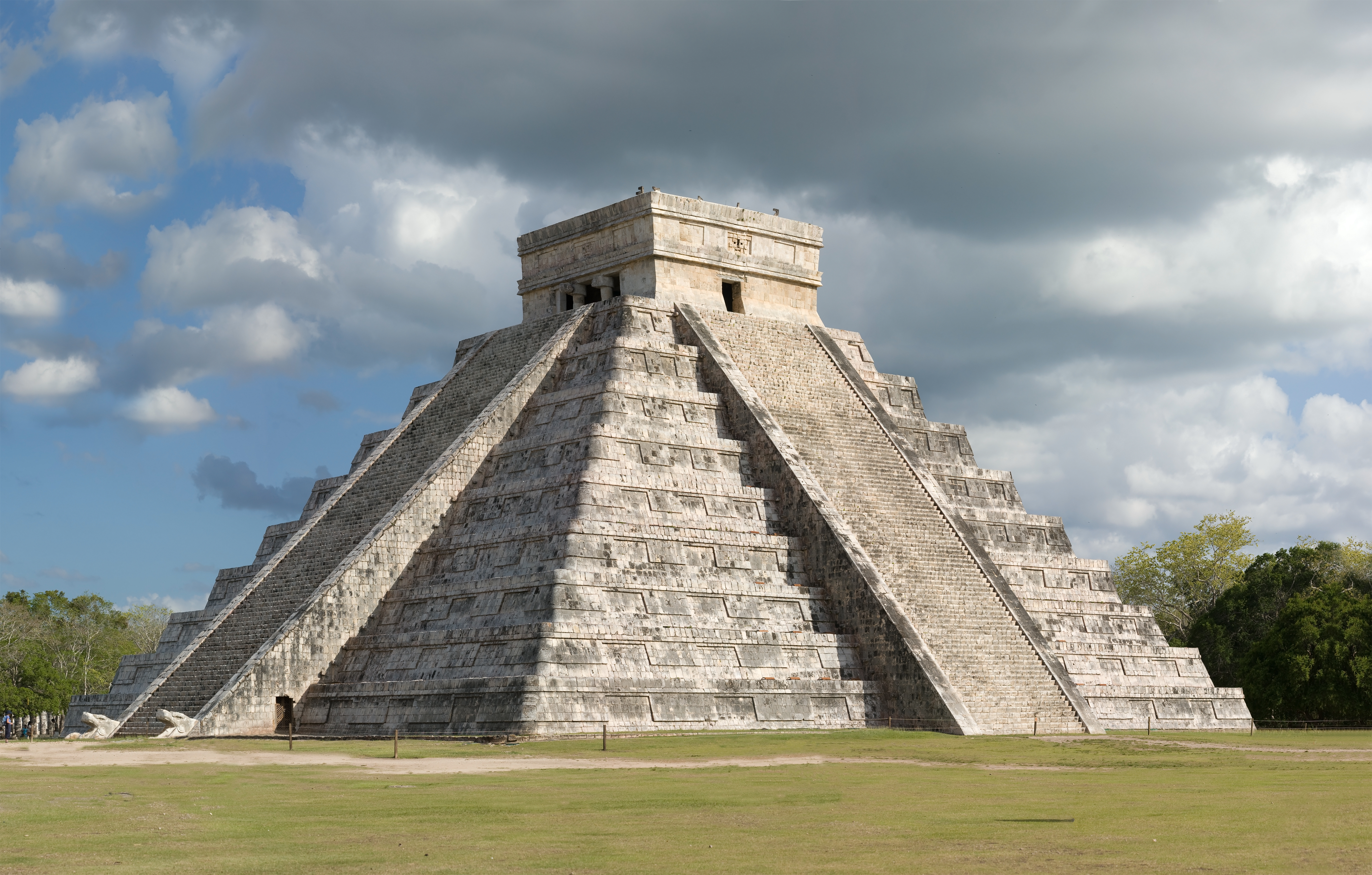
Most visitors arrive at Chichén Itzá with one building in mind and leave impressed by another. The Temple of the Warriors is the classic example. It stands east of El Castillo across the Great Plaza, a broad stepped platform crowned by a colonnaded hall and guarded by rows of carved stone warriors. From a distance it reads as scenery beside the famous pyramid. Up close, it is one of the most ambitious buildings in the ancient Maya world: a structure designed to hold crowds of people under one roof while wrapping them in imagery of eagles, jaguars, feathered serpents and armed men.
This guide is for travellers who want more than a photograph. It explains what the Temple of the Warriors was, why its style looks so different from earlier Puuc cities like Uxmal, what the chac-mool figure at its summit means, and how the Group of the Thousand Columns around it worked as one enormous public space. It also covers the practical side: when to see it, how much time to allow, what you can and cannot do at the monument today, and where to base yourself for an unhurried visit.
Quick answer
The Temple of the Warriors is a large stepped pyramid at Chichén Itzá in Yucatán, Mexico, built during the Early Postclassic period, roughly between the tenth and twelfth centuries. Its platform measures close to forty metres on each side, and its upper sanctuary was reached by a broad western stairway flanked by feathered-serpent balustrades. In front of the sanctuary stand carved square columns depicting warriors, and at its entrance rests a reclining chac-mool figure. The temple anchors the Group of the Thousand Columns, a vast complex of colonnades and platforms that once supported wide timber-and-thatch roofs.
Three things matter for planning:
- You view the temple from ground level. Climbing has been prohibited at Chichén Itzá for nearly two decades, and barriers keep visitors off the structure itself. The carvings on the lower columns are still easy to study at close range.
- It sits on the main circuit. Every route through Chichén Itzá passes the temple, so no extra walking or ticket is needed.
- Time pressure is the main enemy. Tour groups often allocate twenty minutes here, which is enough for a look but not for reading the column reliefs. Building in even thirty extra minutes changes the experience.
 The Temple of the Warriors at Chichén Itzá, seen across its front rows of carved warrior columns
Where the temple stands
Chichén Itzá occupies flat limestone terrain in the municipality of Tinum, a short drive from the village of Pisté and about an hour and a half east of Mérida by road. Within the archaeological zone, the Temple of the Warriors forms the eastern edge of the Great Plaza, the ceremonial heart of the city. El Castillo rises at the plaza's north end. The Great Ball Court stretches away to the northwest, and the Tzompantli, the platform of skulls, lies between the court and the temple.
Stand near the temple's southwest corner and you can take in most of this civic scheme in one turn of the head. That positioning was deliberate. The builders arranged these monuments as an integrated programme rather than scattering them across the city, and the Temple of the Warriors faces the open plaza the way a theatre faces its audience. Public ceremony, elite display and mass gatherings all had a stage here.
The temple also belongs to the eastern half of the site that Alfred Maudslay, working at Chichén Itzá in 1889, simply called the East Group on his map. His name never stuck with visitors, but his photographs record something important: when modern archaeology arrived, much of this quarter lay in ruins, its columns toppled and its walls lost under scrub. What you see today is the product of both ancient ambition and twentieth-century reconstruction.
What kind of building it is
The Temple of the Warriors is a four-sided stepped platform supporting a rectangular temple, but describing it that way undersells how unusual it is. Earlier Yucatec Maya cities built pyramidal temples for small priesthoods: compact sanctuaries above steep stairs, rooms sized for a handful of worshippers. The Temple of the Warriors works differently. Its summit sanctuary opens through serpent columns onto a forecourt lined with carved pillars, and the building connects physically to surrounding colonnaded halls, creating covered spaces that could hold hundreds of people at once.
The main stairway climbs the west face, flanked by balustrades shaped as feathered serpents whose heads rest on the ground at the base, mouths open, tails rising to support the temple lintels above. At the foot of the stair, standard-bearer figures once held positions where banners could be planted, framing processions as they climbed. The sanctuary itself was roofed with timber beams, and inside stood the cult images and braziers around which ceremonies turned.
Because the roofs were wood and thatch, they vanished long ago. What survives is the stone armature: platforms, columns, doorjambs and sculpture. Reading the building therefore takes a little imagination. Picture the forest of pillars not as a ruin but as the skeleton of an immense hall, its ceiling overhead, its painted plaster glowing in daylight, its carved columns standing like an honour guard of warriors frozen mid-procession.
That combination, pyramid plus pillared gallery plus mass audience, has no real parallel in the older Maya south. It points toward the question every visitor eventually asks here: why does this Maya city look so Toltec?
The Maya–Toltec question
The Temple of the Warriors is the centrepiece of what archaeologists call the Toltec style at Chichén Itzá, and it shares its design vocabulary with Pyramid B at Tula, the capital of the Toltecs in central Mexico, some eight hundred kilometres to the west. The parallels are specific and numerous: a stepped pyramid supporting a colonnaded summit hall, serpent columns framing the doorway, a chac-mool reclining at the entrance, rows of warrior pillars below, and decorative programmes built around eagle and jaguar warriors. For more than a century these similarities have driven one of Mesoamerican archaeology's great debates.
The older explanation told a story of conquest: Toltec armies led by a ruler remembered as Kukulcán, the feathered serpent, seized Yucatán and rebuilt Chichén Itzá in their own image. Modern scholarship is more cautious. No inscription at Chichén Itzá announces an invasion. The city's art mixes central Mexican forms with deeply local Maya traditions of vaulted architecture, calendar ritual and dynastic imagery. Many researchers now describe the result as a shared international style, carried by trade, pilgrimage, alliance and the movement of warriors and craftsmen rather than by a single documented conquest. Others still see strong evidence of central Mexican influence arriving with people, not just ideas.
For a visitor, the honest summary is this: the Temple of the Warriors shows Chichén Itzá plugged into a political world that reached far beyond Yucatán, and nobody can yet say exactly how that connection worked. Guides who present the conquest story as settled fact are oversimplifying. The building's fascination partly lies in that open question.
What is not open to doubt is the ideology the building expresses. Its reliefs celebrate organised military orders, sacrifice and the feathered serpent as sources of legitimate power. Whatever brought this package to Yucatán, Chichén Itzá's rulers invested in it massively, and the Temple of the Warriors was its principal monument.
Reading the carved columns
The most rewarding work at the temple happens at ground level, along the rows of square pillars that once supported the roof beams in front of the sanctuary. Each column carries a bas-relief figure of a warrior, and the repetition is the point: rank upon rank of armed men, each slightly different in dress and equipment.
Look for the details that differentiate them. Some figures wear feathered headdresses and ankle ornaments associated with the eagle orders; others wear jaguar pelts knotted at the waist, tails hanging behind. Shields appear at the forearm, atlatl throwing sticks and spears in the hands. At the base of many columns crouches a small bound figure, generally interpreted as a captive, placed literally beneath the feet of the warrior above. The programme reads like a muster roll of Chichén Itzá's military societies, and scholars have long argued that the columns represent members of the eagle and jaguar orders gathered for ceremony.
Between the warrior pillars, other panels carry images of the man-bird-serpent, the composite form of Kukulcán, along with priests, offerings and processions. The carving was once covered in stucco and paint, so the effect in ancient times was far more vivid than the grey limestone visible today. Traces of pigment have been recorded since the earliest scientific documentation of the building.
Give the columns slow attention. Direct midday sun flattens low relief, so morning and late afternoon light show the carving best. Walk the rows rather than studying a single pillar, because the meaning sits in the repetition, the way identical formats carry slightly different bodies, costumes and weapons down the line. Photographers should resist the urge to shoot only the temple's facade from the plaza; the individual columns reward closer frames.
 Chac rain-god masks stacked on the facade of the Temple of the Warriors at Chichén Itzá
The temple's upper facade carries a different sculptural language: stacked masks of the long-nosed rain god Chac, arranged in tiers beside the central doorway, echoing the facade traditions of the earlier Puuc cities while combining them with the militarised imagery below. The mixture is a good reminder that Chichén Itzá inherited Yucatán's Maya past even as it displayed its new, wider connections.
The chac-mool at the summit
At the entrance to the upper sanctuary lies the temple's most famous single object: a reclining stone figure known as a chac-mool. The figure rests on its back, knees bent, head turned sharply to one side, elbows propped so that the torso lifts slightly, and a shallow basin held on the belly. The pose is alert rather than relaxed, more messenger than sleeper.
Chac-mools appear at Chichén Itzá and at Tula and in other Early Postclassic contexts across Mesoamerica, which is one of the strongest threads tying those cities together. Interpretations vary: the figures are often described as intermediaries between people and gods, messengers or attendants who received offerings placed on the basin. Offerings could include food, incense, pulque or, in some ceremonial contexts, sacrificial material. What no responsible guide will claim is a single agreed meaning; the safest reading is that these figures marked the exact point where human gifts entered divine service.
The name itself is modern. Chac-mool was coined in the nineteenth century by the explorer Augustus Le Plongeon, who excavated a similar figure at Chichén Itzá and attached to it a story about a mythical ruler. The word is not an ancient Maya term, and Le Plongeon's historical theories have long been discarded, but the label stuck to the sculpture type worldwide. When you hear the name used at the site, treat it as museum shorthand rather than the figure's original identity.
The chac-mool at the Temple of the Warriors has had an eventful modern history. Figures from this building were moved during the twentieth-century restorations, and examples associated with Chichén Itzá now sit in museums as well as on the monument. The reclining figure visible at the sanctuary entrance today may not be the original carving that stood there, and whether you are looking at an ancient stone or a careful reproduction is exactly the kind of detail worth asking a licensed guide about. From the visitor area below the barrier you can see the silhouette clearly against the sanctuary doorway; bring a zoom lens if the figure matters to your visit.
 Reclining chac-mool figure before the upper sanctuary of the Temple of the Warriors at Chichén Itzá
The hidden temple inside
The building holds a secret that most hurried visitors never hear about: inside the Temple of the Warriors stands an earlier, smaller temple, preserved like a shell around a seed. When Earl Morris directed excavations here for the Carnegie Institution of Washington in the 1920s, his team uncovered this older structure beneath the later pyramid and left it intact within the final building. Archaeologists call it the Temple of the Chac Mool, after another reclining figure found in its doorway.
The inner temple matters for two reasons. First, it shows that the great warrior hall was itself a second thought, an enlargement of an existing sacred building, raised over its predecessor rather than erasing it. Second, its walls carry painted murals, documented in detail by Ann Axtell Morris for the Carnegie Institution's 1931 publication on the temple, with Jean Charlot studying the sculptural reliefs of the same complex. The painted panels show processions of warriors and figures in settings that scholars have connected both to ceremony and to scenes of village and coastal life, rendered in a style related to the celebrated murals of the Temple of the Jaguars nearby.
Visitors cannot enter the inner temple. Its rooms are closed behind the later architecture, protected from humidity and crowds, and even the murals' existence is easy to miss unless you read before you go or walk with a knowledgeable guide. But knowing the older building is there changes how the exterior reads: every terrace you see wraps around an earlier sacred place, and the whole monumental front was designed to make that buried sanctity the foundation of a new political order.
How the temple was brought back
The Temple of the Warriors owes its present appearance to one of the great restoration projects of New World archaeology. Maudslay photographed the group in 1889 amid fallen columns and secondary growth. Excavation and consolidation began in earnest under the Carnegie Institution of Washington from the mid-1920s, with Earl Morris directing fieldwork into 1929 and the Mexican federal government supporting the work that followed. His team re-erected hundreds of fallen columns, rebuilt collapsed terraces, stabilised the serpent balustrades and reassembled the carved panels along the platform edges.
That intervention saved the monument and also shaped it. The straight lines and complete colonnades you photograph today are partly modern reconstruction standing on original footings, using recorded originals wherever possible. This was careful work for its era, and the published record, culminating in the Carnegie's three-volume 1931 monograph on the temple, remains a foundation for anyone studying the building seriously.
Understanding the history of the restoration helps set expectations. You are looking at a composite: original sculpture in reconstructed positions, original architecture consolidated with new masonry, and lost elements such as timber roofs and painted plaster simply absent. None of this diminishes the site. It explains why access rules are strict, why barriers protect the columns, and why climbing restrictions apply without exception across Chichén Itzá's structures.
The Group of the Thousand Columns
The Temple of the Warriors does not stand alone. It anchors the Group of the Thousand Columns, or Grupo de las Mil Columnas, a sprawling complex of colonnaded halls and platforms that extends south and east from the temple's flanks around an enormous open court. The name overstates the surviving count: a couple of hundred columns stand today across the group. But the exaggeration captures what the ancient visitor experienced, because the colonnades originally carried continuous roofs of timber and thatch, forming covered galleries on a scale matched by few buildings anywhere in the ancient Americas.
The complex has several parts worth distinguishing. Immediately in front of the temple's west face, the carved warrior pillars formed its principal portico. Behind and beside it, the North Colonnade runs along the north side of the great court in multiple rows of plain drum columns on a raised platform, with interior benches suggesting a place where people gathered, waited or traded under supervision. The Northeast Colonnade continues the enclosure eastward, its facade decorated with masks of the long-nosed rain god. Farther along stands the small Temple of the Sculpted Columns, whose richly carved pillars depict individual figures of apparent importance, ending the axis with a building that reads almost like an annex of the temple itself.
On the group's southern side rises the Mercado, the building conventionally labelled the market, which closes the plaza together with a low platform. Nearby, archaeologists identified a steam bath, a sweat house with heating chamber and drains, of the kind used for ritual purification across Mesoamerica. The exact functions of these structures are debated, but the overall picture is coherent: a vast engineered precinct where crowds, ceremonies, markets and elite display could all be accommodated under cover within sight of the temple.
Walk the group slowly and the urban design becomes visible. The colonnades guide movement between temple, court and market. Doorways frame views back to El Castillo and the ball court. The scale tells you that Chichén Itzá expected gatherings far larger than any single neighborhood could provide, one reason many scholars associate this quarter with the city's greatest public ceremonies, including those tied to Kukulcán himself.
 Stone columns near the Group of the Thousand Columns beside the Temple of the Warriors at Chichén Itzá
How to visit the Temple of the Warriors today
The temple sits on every visitor route through Chichén Itzá. From the main entrance area near Pisté, most people walk first to El Castillo; turning east across the Great Plaza brings you to the Temple of the Warriors within minutes, usually just after the ball court if you follow the circuit clockwise. There is no separate ticket or checkpoint for this part of the site.
Access rules are strict and uniformly enforced. Climbing the temple, or any structure at Chichén Itzá, has been prohibited for years, and barriers ring the terraces and stairways. You study the carved columns from the ground, close enough to see the figures clearly but not to touch them. Site staff move quickly when visitors cross ropes, and penalties for damaging monuments are serious under Mexican federal law. The rules protect fragile relief work that survived more than a thousand years; they also mean that planning your visit around what you can see from permitted positions is part of the experience rather than a limitation imposed only on you.
Entry conditions have tightened in recent years as visitation has grown: bags are checked at the gate, large packs may need to be left at storage, food is generally not admitted, and drone use is prohibited. Arrive with a small bag, water in a reusable bottle, sun protection and firm-soled shoes. The plaza around the temple offers little shade, and limestone reflects heat intensely from late morning onward.
Most travellers reach the site either on an organised excursion or independently by car, bus or private transfer. From Mérida, the drive runs roughly an hour and a half each way via well-maintained highways, which makes early arrival realistic with a rental car or driver. From Valladolid, the site lies only about forty-five minutes away, allowing some of the earliest entries in the zone. From Cancún and the Riviera Maya to the east, organised day trips remain the simplest option despite the longer road time.
If you want commentary while you walk, licensed guides operate at the entrances, and structured tours bundle transport, guiding and sometimes cenote swims or Valladolid stops into a single day. Compare what is actually included before booking: hours inside the archaeological zone vary enormously between products, and a tour that spends forty minutes on site cannot serve anyone hoping to read the column reliefs properly.
Compare Chichén Itzá tours on GetYourGuide · See Chichén Itzá options on Viator
How long to allow, and what to pair it with
Give the Temple of the Warriors and its surrounding colonnades at least thirty minutes if you want to do more than photograph the facade. That is enough time to walk the front rows of carved pillars slowly, look up at the serpent columns framing the sanctuary, find the chac-mool silhouette, and cross the court to see how the North Colonnade closes the space. Travellers with a particular interest in iconography or photography routinely spend closer to an hour here, especially in morning light.
The temple pairs naturally with the monuments that share its plaza. El Castillo explains the city's calendar symbolism; the Great Ball Court, a short walk northwest, shows ritual sport on the same monumental scale as the warrior hall; the Tzompantli between them carries the skull-rack imagery that connects warfare to sacrifice across the precinct. The Sacred Cenote lies farther north along a causeway, tying the ceremonial core to the water supply beneath everything. Seen in sequence, these buildings make Chichén Itzá legible as one designed capital rather than a loose scatter of ruins.
If your day allows more, Valladolid sits forty-five minutes or so back toward the coast and makes an easy lunch stop, and several cenotes around Pisté and Dzitnup offer cool swims after the heat of the plaza. Just be realistic about stacking stops: travellers who add two or three destinations after Chichén Itzá often arrive at each one exhausted. A focused day, ruins early, swim and town late, beats a rushed circuit every time.
Where to stay for an unhurried visit
Where you sleep determines what the Temple of the Warriors feels like. Staying in Pisté puts you minutes from the entrance and makes a dawn start easy; accommodation there is simple but practical. Valladolid offers more atmosphere: a colonial town with hotels in converted houses, restaurants around its main square, and a short drive to the site for early entry before tour buses from the coast arrive. Mérida works well as a base for a longer Yucatán trip that includes Chichén Itzá as one day among several, accepting a longer morning drive.
For most travellers who want the temple at its best, an overnight in or near Valladolid is the sweet spot. You can be at the gate near opening, see the Great Plaza while it is still quiet and cool, and reach the Temple of the Warriors before midday crowds gather around its columns.
Check current Valladolid-area hotel rates on Booking.com · Compare Valladolid stays on Trip.com
Common questions
Can you climb the Temple of the Warriors?
No. Climbing has been prohibited at all of Chichén Itzá's structures for years, including this temple, and barriers block the stairways. The carved columns and serpent balustrades are best appreciated from ground level anyway.
Is the chac-mool at the top the original?
Figures associated with the temple have been moved during twentieth-century restorations, and examples linked to Chichén Itzá now sit in museums. What stands at the sanctuary today is presented as a reclining chac-mool, but whether it is the ancient original or a replacement is worth confirming with a licensed guide on site.
Why does a Maya city have Toltec-style architecture?
That is one of Mesoamerican archaeology's longest-running debates. The temple shares specific designs with Tula, the Toltec capital, but no inscription records a conquest, and the building blends central Mexican forms with local Maya traditions. Most archaeologists now describe a complex mix of trade, alliance, migration and shared elite culture rather than a simple invasion story.
What are the carvings on the columns?
Each square pillar carries a bas-relief of a warrior with shield, weapons and order insignia such as eagle feathers or jaguar pelts, often standing over a small bound captive. The repetition suggests the military societies of Chichén Itzá assembled in stone.
How much time does the whole archaeological zone need?
Plan a minimum of three hours on site for the main circuit, and closer to four or five if you want to include the Sacred Cenote, the southern group and unhurried time at the Temple of the Warriors and ball court. Half-day visits cover El Castillo, the ball court and the warriors complex comfortably.
Is a guide necessary?
Not required, but genuinely useful here. The temple's meaning lives in details, the captive figures under the warriors' feet, the stacked rain-god masks, the buried older temple, that casual visitors walk past. A good guide also distinguishes established fact from popular legend, which matters at a site surrounded by mythology.
The verdict
The Temple of the Warriors repays exactly the effort that most itineraries deny it. Arrive early, walk the full rank of warrior columns before the plaza fills, look for the chac-mool against the sanctuary doorway, then step back until the colonnades of the Thousand Columns group resolve into one vast ceremonial machine. Do that, ideally from an overnight base in Valladolid or Pisté rather than a whistle-stop tour, and the building stops being El Castillo's understudy and becomes what it was designed to be: the great hall where Chichén Itzá showed the world its power.