
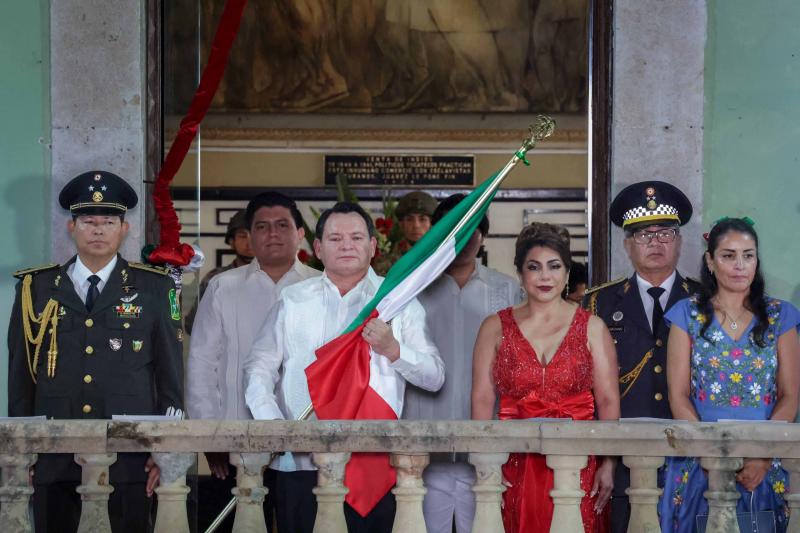
September is one of the more interesting months to be in Yucatán.
Mexican flags appear over balconies and shopfronts. Mérida's Plaza Grande turns green, white and red. Restaurants add patriotic dishes and drinks. Municipal plazas across the state prepare stages, food stalls and civic ceremonies.
Then, on the night of September 15, people gather for the Grito de Independencia.
For travelers, this is not simply a public holiday. The evening of September 15 and morning of September 16 offer a chance to see a civic celebration that local families actually attend, rather than an event created primarily for visitors.
Mérida hosts Yucatán's largest celebration, centered on the Palacio de Gobierno and Plaza Grande, but Valladolid, Izamal, Progreso and smaller towns normally hold their own versions.
There is also a particularly Yucatecan piece of history behind the date: on September 15, 1821, Yucatán itself formally declared its separation from Spain in Mérida.
This guide is designed to remain useful year after year. The section immediately below contains the confirmed information for 2026.
Mexican Independence Day in Yucatán 2026
Last checked: August 30, 2026.
In 2026, September 15 falls on a Tuesday and September 16 falls on a Wednesday.
The celebrations mark the 216th anniversary of the beginning of Mexico's independence movement.
GuideFestivals in Yucatán This Summer 2026: Confirmed Dates and Travel GuideA practical guide to Yucatán’s confirmed summer festivals in July and August 2026, including Feria Tunich, Progreso’s kite festival, El Cuyo, Tekit, Ticul, Tahmek and the Black Christ pilgrimage in Sisal.Open
What is confirmed in Mérida for 2026
The major piece of the 2026 programme already officially confirmed is the Desfile Cívico Militar on Wednesday, September 16.
| Event | Date | Time | Location |
|---|---|---|---|
| Grito de Independencia | Tuesday, September 15 | Main ceremony traditionally shortly before 11 pm; detailed 2026 programme still pending | Plaza Grande / Palacio de Gobierno |
| Fireworks and public celebration | Tuesday, September 15 | Traditionally immediately after the Grito | Plaza Grande |
| Desfile Cívico Militar | Wednesday, September 16 | 8 am confirmed | Remate de Paseo de Montejo to Parque de San Juan |
| Federal public holiday | Wednesday, September 16 | All day | Across Mexico |
The Yucatán state education authority, SEGEY, has officially confirmed that the September 16 parade begins at 8 am.
The route starts at the Remate de Paseo de Montejo, continues toward Mérida's historic center and finishes at Parque de San Juan.
Participating contingents include schools in secondary, upper-secondary and university education, with categories for marching bands, flag escorts and student contingents.
See the official 2026 SEGEY announcement.
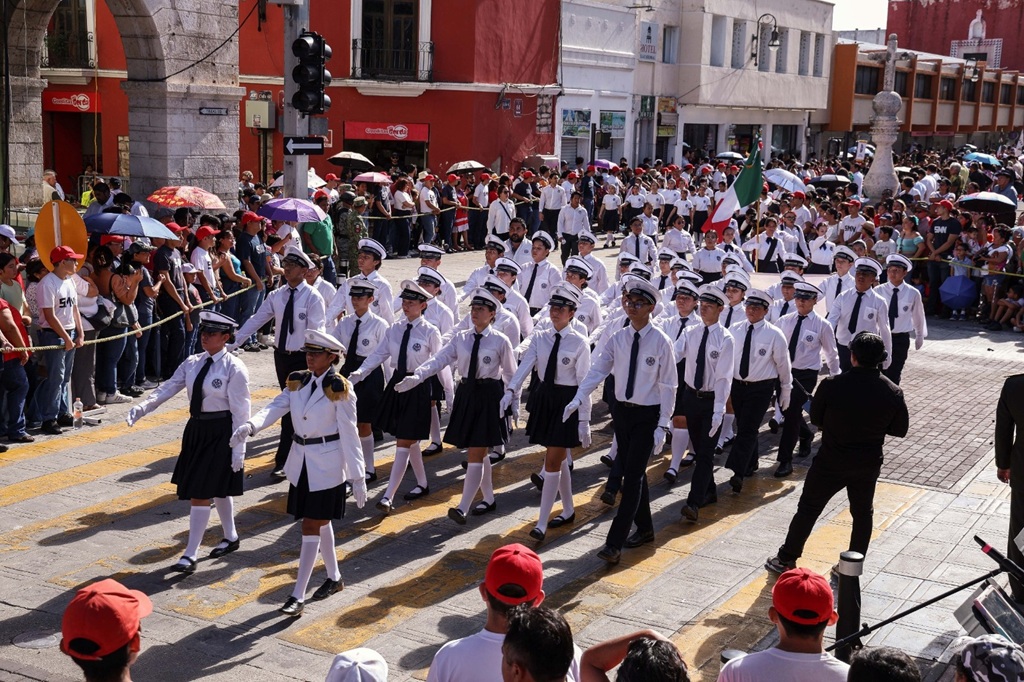 Civic parade through central Mérida during Mexico's Independence Day celebrations
Image: Secretaría de Educación del Gobierno del Estado de Yucatán.
What has not yet been announced for September 15
As of August 30, the Yucatán state government has not yet published the complete 2026 entertainment programme for the night of September 15.
That means there is not yet a confirmed 2026 headline artist or complete minute-by-minute programme that we would recommend planning around.
Do not rely on websites presenting estimated timings or an artist lineup as official unless the information can be traced back to the state or municipal government.
What is much more predictable is the structure of the evening.
Mérida's main state ceremony has traditionally taken place at the Palacio de Gobierno overlooking the Plaza Grande, with cultural performances earlier in the evening, the formal Grito shortly before 11 pm, fireworks and often a major free concert afterward.
In 2025, for example, activities began during the evening before Governor Joaquín Díaz Mena delivered the Grito from the Palacio de Gobierno. Fireworks followed, followed by a free concert by Edén Muñoz.
The exact 2026 entertainment programme should appear closer to September 15.
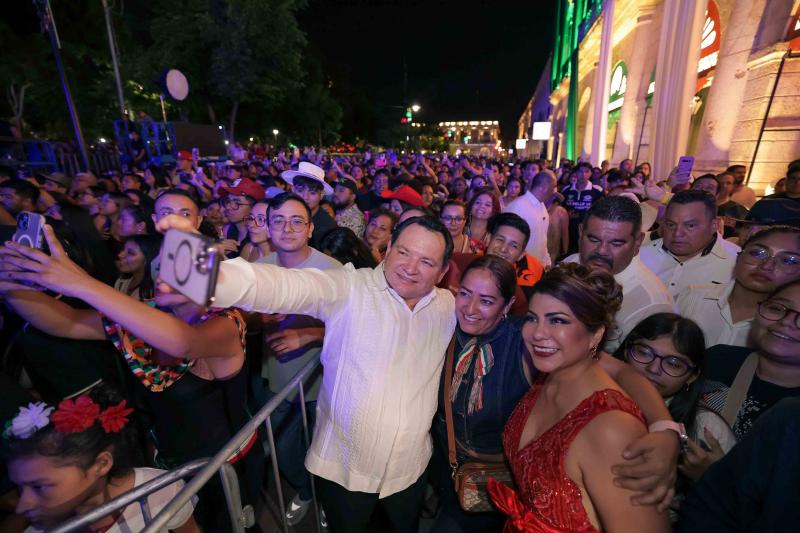 Crowds during the Independence Day celebration at the Palacio de Gobierno in Mérida
Image: Gobierno del Estado de Yucatán, 2025.
Mérida is already preparing for September 2026
Preparations began unusually early this year.
By August 20, patriotic decorations were already being installed around Mérida's Centro Histórico and Plaza Grande, including a large representation of the eagle and serpent from Mexico's national emblem.
Expect the center to become increasingly decorated through the first half of September.
For visitors already in Mérida, it is worth walking through the Plaza Grande during the days before the Grito. The atmosphere builds gradually rather than appearing only on the night of September 15.
September 15 or September 16: when is Mexican Independence Day?
This confuses a lot of first-time visitors.
Mexico's official Independence Day is September 16.
The major public celebration, however, takes place on the night of September 15.
The Grito commemorates the call associated with Miguel Hidalgo y Costilla in the town of Dolores in 1810, which helped begin the independence struggle.
Modern ceremonies recreate that moment on the evening before the official holiday.
So, from a traveler's perspective:
- September 15 at night: go out for the Grito, music, food and fireworks.
- September 16 in the morning: watch the civic-military parade.
- September 16 during the day: expect a quieter public holiday atmosphere and some closures.
If you only have time for one event, the night of September 15 is the larger public celebration.
If you are traveling with young children, dislike dense crowds or want something easier to photograph, the September 16 morning parade may suit you better.
Where the Grito happens in Mérida
The central event is held around the Plaza Grande, in front of the Palacio de Gobierno.
 Palacio de Gobierno facing Mérida's Plaza Grande
Image: Aadh05 via Wikimedia Commons, CC BY 4.0.
The ceremonial center is the balcony of the Palacio de Gobierno on the north side of the square.
The governor receives the national flag, appears on the balcony, recalls figures associated with Mexican independence, rings the ceremonial bell and leads the crowd through the traditional cries of "¡Viva México!"
The national and Yucatecan anthems are normally part of the ceremony.
In recent Mérida ceremonies, Yucatecan historical figures have also been included alongside the nationally recognized independence heroes.
The formal ceremony itself is relatively short.
The larger experience is the evening around it: thousands of people in the historic center, music, food, flags, families, street vendors and the anticipation leading up to the Grito.
What the night actually feels like
Do not expect a quiet historical reenactment.
The Plaza Grande becomes a large public gathering.
People arrive throughout the evening. Families find positions around the square. Stages and sound systems fill the center with music. Vendors work the surrounding streets. Mexican flags, face paint, tricolor hats and decorations appear everywhere.
As the Grito approaches, movement through the square becomes increasingly difficult.
The atmosphere then changes quite quickly.
The music stops or recedes for the civic ceremony. The crowd turns toward the Palacio de Gobierno. The governor appears on the balcony. The names and cries are answered by thousands of voices below.
The bell rings.
The Mexican flag is waved.
Then comes the response:
"¡Viva México!"
After the ceremony, the atmosphere shifts back toward a street celebration, usually with fireworks and live music.
It is loud, warm and crowded.
That is part of the experience.
It also means the main Grito is not necessarily the right event for every traveler.
What time should you arrive at Plaza Grande?
If seeing the ceremony matters to you, do not plan to arrive at 10:45 pm.
For the main Mérida celebration, arriving somewhere around 7–8 pm is a sensible target once the full programme is underway.
That gives you time to:
- get into the historic center before the largest crowds arrive
- understand which streets have been closed
- pass any event security controls
- eat before the Grito
- find a reasonable viewing position
- avoid trying to force your way through the Plaza Grande immediately before 11 pm
If you only want the general atmosphere and do not care about seeing the balcony clearly, you can arrive later.
The trade-off is density.
The closer it gets to the Grito, the less freely you can move around the central square.
The September 16 parade in Mérida
For many visitors, the parade is actually the easier event to experience.
In 2026 it starts at 8 am on Wednesday, September 16.
The confirmed route runs from the Remate de Paseo de Montejo to Parque de San Juan.
 Monumento a la Patria on Paseo de Montejo in Mérida
Image: Sharon Hahn Darlin via Wikimedia Commons, Creative Commons.
Expect school contingents, marching formations, flag escorts and civic and military participation.
The atmosphere is more formal than the previous night's celebration.
Where to watch
You do not necessarily need to stand at the starting point.
The route gives you several opportunities to find a viewing position between Paseo de Montejo and the center.
For photography, look for a section with:
- clear sightlines down the street
- some morning shade
- enough pavement space that you are not blocking pedestrian movement
- a background that gives the images a sense of Mérida
Go early if you want a front-row position.
September mornings warm up quickly.
Is the parade better for families?
Usually, yes.
The parade is still busy, but it avoids several of the difficult parts of the Grito: very late hours, fireworks, dense nighttime crowds and a large post-ceremony concert audience.
For families with smaller children, the September 16 parade is often the more manageable choice.
Bring water and sun protection.
A Yucatecan twist to Independence Day
There is an unusual historical coincidence behind September 15 in Yucatán.
Mexico's independence struggle began in 1810, but the process lasted more than a decade.
Yucatán followed a somewhat different path from regions where major insurgent armies fought prolonged campaigns.
On September 15, 1821, authorities gathered in Mérida's Casas Consistoriales and declared Yucatán's separation from Spain, while proposing the province's incorporation into the emerging Mexican nation.
The Government of Yucatán's historical record places the event in the council chambers of Mérida.
See Yucatán's official historical chronology.
That means September 15 carries a double historical resonance here.
It is the evening on which modern Mexico reenacts the Grito associated with Hidalgo, but it is also the date on which Yucatán formally proclaimed its own independence from Spanish rule in 1821.
 Historic view of Mérida's Palacio de Gobierno
Image: Wilhelm Schirp Laabs via Wikimedia Commons, public domain.
The political relationship between Yucatán and Mexico would remain complicated through the nineteenth century.
Yucatán later asserted autonomy during conflicts over federalism and centralism, including the period associated with the Republic of Yucatán.
You do not need that history to enjoy the celebrations, but it helps explain why Yucatecan identity sits comfortably beside the strong Mexican symbolism of September.
Where else to celebrate Independence Day in Yucatán
Mérida has the largest event, but it is not the only place to experience September 15.
One of the strengths of Independence Day is that almost every municipality has its own civic celebration.
If you are already staying outside Mérida, there is usually little reason to travel back to the capital solely for the Grito.
Valladolid
Valladolid is one of the most appealing alternatives for travelers staying in eastern Yucatán.
 Cathedral of San Servacio and central square in Valladolid
Image: Gage Skidmore via Wikimedia Commons, CC BY-SA 4.0.
The city has a compact central square, which makes municipal celebrations feel much more intimate than Mérida's.
Valladolid works particularly well if you are already spending the night there for Chichén Itzá, Ek Balam or nearby cenotes.
Do not make a late-night drive back to Mérida simply to attend the capital's event if you have been drinking or are already tired.
Staying locally is easier.
2026 note: a detailed Valladolid Independence Day programme was not yet publicly confirmed in the sources we checked on August 30. Check the municipal programme during September before planning around a specific concert or timetable.
GuideValladolid Travel Guide: What to Do, Where to Stay and How to Plan Your TripValladolid is a small colonial town in eastern Yucatán, roughly halfway between Mérida and Cancún and within an hour’s drive of Chichén Itzá and Ek Balam. The guide suggests staying two nights for most itineraries, with three nights better for families or those who want to visit several cenotes or make day trips to Río Lagartos, Las Coloradas or Cobá. Getting there is easy by rental car, ADO bus, Tren Maya or private driver; the bus station is central, while the train station lies outside the historic centre and requires a taxi or shuttle. Within the town the historic centre, Calzada de los Frailes and the main square are all walkable, but a car, taxi, colectivo, bicycle or scooter is needed for most cenotes and ruins. Typical activities include a morning walk around the main square, visiting Iglesia de San Servacio and the municipal palace, strolling the colourful Calzada de los Frailes, and touring the Convent of San Bernardino de Siena. Cenote Zací, just outside the centre, offers a convenient swim; the local market provides cheap breakfast and snacks. Visitors should plan to start early at ruins and cenotes to avoid the heat, bring cash in small bills, wear grip sandals for cenote water, and respect church dress codes. In the hotter months (April‑May) a hotel with a pool is advisable, and the most comfortable weather is from November to March.Open
Izamal
Izamal offers a smaller-town setting.
 Yellow streets and convent in Izamal, Yucatán
Image: CAHA0909 via Wikimedia Commons, CC BY-SA 4.0.
It makes sense if you are already staying overnight in town and want a local municipal celebration rather than a large concert-style event.
The practical advantage is scale.
You can usually walk from accommodation in the center rather than dealing with Mérida's road closures, parking and much larger crowd.
Again, check the municipal programme close to September 15 rather than assuming a particular artist or schedule.
GuideIzamal: The Yellow City GuideIzamal is a small colonial town painted yellow, located east of Mérida in central Yucatán, about one hour to one hour 15 minutes by road from Mérida Centro and roughly 1½ hours from Valladolid. It is most often visited as a half‑day or full‑day day trip from Mérida, using a rental car, private driver, or the cheapest option—a bus from Mérida’s Noreste/Oriente terminals; a Tren Maya connection exists but the station is not in the main plaza. The essential sights can be covered in 4–6 hours, or a full day if you include a leisurely lunch, extra photography time and a slower pace. Entry to the Convento de San Antonio de Padua is free (donations welcome) and the Kinich Kakmó pyramid can be climbed at no charge; the cost of the visit is therefore limited to transport, meals and any optional guide or carriage hire. Visitors should expect a walkable historic centre with a wide convent atrium, the climb of Kinich Kakmó (uneven stone steps, bring proper shoes and water), and the chance to wander yellow‑washed streets, small markets and craft shops. Early morning (before 10 am) or late afternoon (after 4 pm) offers softer light for photography and cooler temperatures; midday can be very hot and the stone of the pyramid becomes scorching. Dress modestly for the convent, bring a hat for the exposed atrium, and carry cash for meals—restaurants such as Kinich and Zamná serve traditional Yucatecan dishes, while smaller loncherías are cheaper but may not accept cards. Horse‑drawn carriages are available but should be used after checking the animal’s condition. The town’s layered Maya, colonial and modern character makes it a relaxed, family‑friendly alternative to larger archaeological sites.Open
Progreso
If you are staying on Yucatán's coast, Progreso is the logical place to look for local celebrations.
 Malecón in Progreso, Yucatán
Image: Jorge F. Victoria Puerto via Wikimedia Commons, Creative Commons.
Do not assume you need to return to Mérida.
The more important consideration is getting back to your accommodation safely after the event, particularly if taxis or app-based vehicles become busy.
If you are staying in Progreso, celebrate there.
If you are staying in Mérida and want the largest programme, remain in Mérida.
GuideProgreso Beach, Mexico: Malecón, Swimming, Food & Mérida Day TripsProgreso beach is a public Gulf‑side shoreline about 36 kilometres north of Mérida, reached by a straight highway or frequent Autoprogreso buses. The public beach has no entry fee and is best enjoyed in a 3–6‑hour window, though a full day is possible if side trips are added. By car the drive from the north side of Mérida takes 35–45 minutes and from the city centre 45–60 minutes; by bus the journey is 45–55 minutes. Parking is available on streets and in paid lots near the waterfront, while the bus terminal sits within walking distance of the Malecón. Facilities include restaurants, cafés, beach clubs, chair and umbrella rentals, restrooms, showers in some Blue‑Flag zones, convenience stores and pharmacies. Small vendors, chair rentals, taxis, tips and boat excursions usually require cash in pesos, although many restaurants accept cards. The Malecón is paved and partly ramped, making it more accessible than many Yucatán beaches. Visitors can expect a broad, sandy beach with shallow, calm water on most days, a lively promenade of eateries and vendors, and the world‑record‑long pier that can be viewed but not walked. Weekday mornings are quieter; Sundays, holidays and cruise‑ship days bring crowds. Bring swimwear, towel, sunscreen, a hat, sandals and a reusable water bottle, and be prepared for cash‑only payments at smaller stalls. For families, the nearby Museo del Meteorito offers a short indoor activity, and boat trips to El Corchito Ecological Reserve or Isla Columpios add mangrove and spring swimming if desired.Open
Smaller Yucatecan towns
Municipal Independence Day celebrations can be particularly enjoyable in smaller towns because they remain centered on local families.
The usual pattern is a gathering around the municipal palace, civic ceremony, music, food and dancing.
Visitors are generally able to attend public celebrations, but remember that these events exist primarily for the local community.
Be respectful around formal flag ceremonies and civic proceedings.
If you are visiting a village specifically for September 15, arrange transportation before the evening begins. Public transport between smaller towns becomes much less useful late at night.
A private driver can make sense for a small group, but book in advance and expect road access near the central plaza to be restricted.
What to eat during Fiestas Patrias
September brings plenty of national Mexican imagery to Yucatán, but local food does not disappear.
You may see nationally associated dishes alongside the food people eat every week in Mérida.
Around public events, the useful rule is simpler: follow the stalls with steady local demand and food being prepared fresh.
Depending on the event, you may come across tacos, tortas, esquites, elotes, sweets, marquesitas and other street snacks.
Elsewhere in the city, restaurants often run special mes patrio menus during September.
You do not need to spend the evening chasing one particular "official" Independence Day dish.
If you want a more serious Yucatecan meal before the Grito, eat earlier in the evening and then walk into the Plaza Grande afterward.
That is usually easier than trying to find a table in the immediate center at peak time.
Is September 16 a public holiday in Mexico?
Yes.
September 16 is an official federal holiday in Mexico.
It is one of the country's mandatory rest days.
Expect:
- government offices to close
- banks to close
- some businesses to operate reduced hours
- heavy activity around the parade route during the morning
- altered traffic patterns in central Mérida
- some restaurants and tourist businesses to remain open
September 15 itself is not the main statutory holiday, although individual organizations may close early or alter their schedules because of the evening celebrations.
If you need to visit a bank, government office or administrative service, do it before September 16.
Are archaeological sites open on September 16?
Do not assume that every attraction closes simply because it is a public holiday.
Major visitor attractions and archaeological sites often operate on holidays, but opening arrangements can change.
If September 16 is your planned day for Chichén Itzá, Uxmal or another archaeological site, check the relevant INAH information shortly before traveling.
The bigger logistical issue may be transport rather than the attraction itself.
Bus schedules, tour departures and traffic can differ on holidays.
If you have a fixed itinerary, confirm the operating schedule with your tour company or driver.
Getting around Mérida on September 15
Driving directly into the Plaza Grande area is usually the least convenient option.
Central streets can be closed and parking becomes difficult long before the ceremony.
If you are staying in Centro, walk.
If you are staying farther away, use a taxi, Uber, DiDi or public transport to get near the historic center and complete the last part on foot.
Do not insist that a driver take you to the Plaza Grande itself. Road closures may make that impossible.
Choose a practical drop-off point several blocks away.
GuideHow to Get Around Mérida in 2026: Airport, Buses, Taxis, Cars & Day TripsThe article explains how to move around Mérida, Yucatán, whether staying in the historic centre or making day trips to sites such as cenotes, ruins, beaches or other towns. From the airport (MID) to the city centre the options are an official airport taxi (ticket bought at the counter, set fare by zone, more expensive than city rides), the budget Va y Ven/IE‑TRAM bus (light luggage, nearby stop, walking or short taxi needed), Uber, DiDi or other rides‑share apps (subject to airport pickup rules), or a pre‑booked private transfer (higher price but convenient for families, large luggage or late arrivals). The ride to Centro normally takes 15–25 minutes in normal traffic. Within Mérida the cheapest city travel is the Va y Ven bus network, which uses newer vehicles, electronic payment and clear route names; it requires checking maps and speaking some Spanish. Taxis are plentiful, often run on agreed fares, so confirm the price before boarding. Uber, DiDi and inDrive work well for cross‑town trips, especially in heat or at night, but rideshare is not suitable for rural destinations. Walking is practical in the compact Centro historic area, though midday heat and narrow, one‑way streets can be challenging. For longer trips, ADO long‑distance buses connect Mérida to Cancún, Valladolid, Campeche and other major points, while the Tren Maya serves a few routes such as Mérida‑Valladolid or Mérida‑Cancún when schedules align. Rental cars, private drivers or guided tours become worthwhile for multiple cenotes, the Ruta Puuc, remote beaches or family groups with several day trips, as public buses and trains have limited flexibility for such itineraries.Open
Public transport
Special operating arrangements sometimes accompany major events, but these can change each year.
Check Va y Ven announcements and the official app close to September 15.
Do not build your night around the assumption that your usual bus will still be running at its normal frequency after midnight.
Parking
If you drive, park outside the immediate event zone.
The closer you try to get to the Plaza Grande, the more time you may spend sitting in traffic or discovering that your chosen street is closed.
Make sure any private parking garage you use will remain open late enough for you to retrieve the vehicle after the celebration.
What about road closures on September 16?
Expect restrictions along the parade route.
For 2026, the parade begins at the Remate de Paseo de Montejo and finishes at Parque de San Juan.
That affects a substantial corridor through central Mérida.
If you have an airport transfer, intercity bus or tour departure on the morning of September 16, leave additional time.
A hotel being only a few kilometers from the bus station does not mean the journey will take its usual amount of time when streets are closed.
If timing matters, ask your hotel, transfer company or driver which side of the parade route they need to reach you from.
Weather in Yucatán during Independence Day
September is hot, humid and firmly inside Yucatán's rainy season.
A dry afternoon does not guarantee a dry evening.
For the Grito, bring:
- lightweight clothing
- water
- a small umbrella
- shoes that are comfortable on wet pavement
- a waterproof way to protect your phone
- only the belongings you actually need
A large bag becomes irritating very quickly in a dense crowd.
September is also within Atlantic hurricane season. A tropical system does not need to hit Mérida directly to disrupt outdoor events.
If severe weather is forecast, check official announcements before traveling into the center.
Safety and crowds
Independence Day in Mérida is a major family event, but normal large-crowd precautions still apply.
Keep your phone and wallet secure.
Carry only essential cash and cards.
Choose a meeting point before entering the densest part of the crowd.
Mobile reception can become less reliable when thousands of people are concentrated in one place.
If you become separated from your group, "we'll WhatsApp each other" is not as useful as agreeing beforehand to meet at a specific landmark.
Do not use the central flagpole or the middle of the Plaza Grande as your meeting point. That area may be inaccessible once crowds and security controls are in place.
Choose somewhere on the edge of the event zone.
Is the Mérida Grito suitable for young children?
It depends on the child.
The event itself is family-oriented, but the environment includes:
- large crowds
- late hours
- loud amplified music
- fireworks
- waiting around
- heat and humidity
For an older child who enjoys public festivals, it can work well.
For a baby, toddler, noise-sensitive child or anyone who becomes anxious in compressed crowds, we would favor an earlier visit to the decorated center and the September 16 morning parade instead.
There is no prize for standing in the middle of the Plaza Grande at 11 pm.
You can experience Fiestas Patrias without choosing the most crowded possible version of it.
Accessibility
The center of Mérida is relatively flat, but Independence Day introduces temporary obstacles: barriers, large crowds, diversions, uneven colonial pavements and blocked street crossings.
Wheelchair users or travelers with limited mobility should avoid trying to move through the densest central section immediately before and after the Grito.
Arrive early and choose a position near the edge of the crowd.
For the parade, select a viewing point that allows you to remain in one place rather than repeatedly crossing the route.
If accessibility is a major concern, ask your accommodation for current road-closure information before leaving.
Is it worth changing your itinerary for Independence Day?
If you are already in Yucatán on September 15, yes: it is worth leaving some room in your schedule for the celebrations.
We would not necessarily rearrange an entire Yucatán trip solely to be in Mérida for the Grito.
The event is significant, but it is also short, late and extremely busy.
It works particularly well for travelers who:
- enjoy public cultural events
- are staying in Mérida Centro
- want to experience contemporary Mexican civic life
- enjoy street food and live music
- do not mind crowds
- can keep September 16 relatively relaxed
It is less suitable if you:
- strongly dislike large crowds
- have an early tour the following morning
- are traveling with a child who struggles with fireworks
- need an early night's sleep
- have mobility issues that make dense public events difficult
In those cases, enjoy the decorations during the day and watch the parade the following morning.
A good two-day Independence Day plan in Mérida
You do not need to over-plan this.
September 15
Keep the morning flexible.
Spend the hottest part of the afternoon somewhere cool, return to your hotel and rest.
Eat dinner early.
Around 7–8 pm, walk or take a ride toward Centro and approach the Plaza Grande on foot.
Spend the evening exploring the surrounding streets and watching the cultural programme.
Move toward your chosen viewing area before the main ceremony.
Watch the Grito shortly before 11 pm.
Stay for fireworks and the concert if the atmosphere suits you.
Leave when you have had enough rather than waiting for the entire crowd to depart at once.
September 16
Wake early enough for the 8 am parade if you want to see it.
Find a viewing position along the route between Paseo de Montejo and Parque de San Juan.
Afterward, have a late breakfast.
Keep the rest of the day relatively light.
A cenote or complicated road trip is possible, but this is not the day we would choose for an aggressively timed itinerary after being out late the previous night.
Should you combine Independence Day with a Yucatán trip?
September has advantages and disadvantages.
There are fewer international visitors than during the winter high season, and Independence Day gives the middle of the month a distinctly local atmosphere.
On the other hand, September can be wet, very humid and hot.
If your priorities are archaeological sites and cenotes, start early in the day.
If your priority is the September 15 celebration, do not exhaust yourself at Chichén Itzá, Uxmal or on a long road trip first.
A better rhythm is to keep September 15 itself centered around Mérida.
Save the longer excursions for another day.
Independence Day etiquette for visitors
You do not need to be Mexican to join a public celebration.
Visitors are welcome at the Grito and municipal events.
A few simple habits help:
Stand respectfully during the national anthem and formal flag ceremonies.
Do not push through families who have been waiting for a viewing position.
Avoid treating military, civic or flag ceremonies as a costume backdrop.
Join the "¡Viva México!" responses if you want to.
Buy food from local vendors.
Be patient with security controls and road closures.
Independence Day is festive, but it is also a serious national commemoration.
Mexican Independence Day is not Cinco de Mayo
This is worth clarifying.
Cinco de Mayo is not Mexico's Independence Day.
May 5 commemorates the Mexican victory over French forces at the Battle of Puebla in 1862.
Mexican Independence Day commemorates the beginning of the struggle against Spanish rule in 1810.
The national holiday is September 16, with the Grito celebrated on the night of September 15.
Within Mexico, September is considerably more important to the national civic calendar than Cinco de Mayo.
Quick answers
When is Mexican Independence Day in 2026?
Wednesday, September 16, 2026.
The principal public celebrations take place on Tuesday night, September 15.
Where is the Grito in Mérida?
The main state celebration takes place around the Plaza Grande and Palacio de Gobierno in Mérida's Centro Histórico.
What time is the Mérida Grito?
The ceremony traditionally takes place shortly before 11 pm on September 15.
The detailed official 2026 programme had not yet been published when this guide was updated on August 30.
What is confirmed for Mérida in 2026?
The September 16 Desfile Cívico Militar is officially confirmed for 8 am, beginning at the Remate de Paseo de Montejo and ending at Parque de San Juan.
Is the Mérida Grito free?
The main public celebration in Plaza Grande is traditionally free.
Does Mérida have fireworks?
Fireworks traditionally follow the formal Grito ceremony. Final 2026 event details should be checked once the state publishes the complete programme.
Is September 16 a day off in Mexico?
Yes. September 16 is a federal mandatory rest day.
Do towns outside Mérida celebrate?
Yes. Municipalities throughout Yucatán normally hold their own Grito ceremonies and local celebrations.
Should I celebrate in Mérida or a smaller town?
Choose Mérida for the largest crowds, major stage production and state ceremony.
Choose a smaller town if you prefer a more local-scale gathering and are already staying there.
There is little reason to make a late-night intercity journey solely to attend Mérida's event.
Planning your Independence Day visit
If you are staying in Mérida Centro, this is one of the easiest major events to experience independently. Walk to the historic center, arrive early and give yourself enough time to leave after the ceremony.
A tour is not necessary.
A rental car is actively inconvenient for the central Mérida event.
A private driver becomes more useful if you are staying outside Mérida or want to attend a celebration in another Yucatecan town without worrying about late-night transportation.
For quick itinerary questions, the Yucatán Guide WhatsApp assistant can help you work out whether the Grito fits naturally into the rest of your trip.
Travelers who want someone to check the whole itinerary can use Human Trip Support, while the Trip Plan & Booking Portal is better suited to custom routes, transfers, tours and day-by-day planning.
Families, larger groups and travelers who want transport and logistics handled around major events can also use the Managed Private Concierge service.
You do not need any of these services simply to attend the Grito.
The basic plan remains straightforward:
Stay near the center if possible, eat early, arrive before the heaviest crowds, watch the ceremony, and keep the following morning flexible enough to see the parade.
2026 official information and sources
The 2026 section of this guide was last checked on August 30, 2026.
Current confirmed information is based primarily on:
- SEGEY's official announcement for the September 16, 2026 Desfile Cívico Militar
- Government of Yucatán information on the 2025 Grito ceremony and its established format
- Government of Yucatán historical chronology for September
The headline entertainment programme for the night of September 15, 2026 had not yet been officially published at the time of this update.
Once you are within a few days of the event, check the Government of Yucatán and Mérida municipal channels again for final stage times, road closures, transport changes, security arrangements and any weather-related adjustments.

