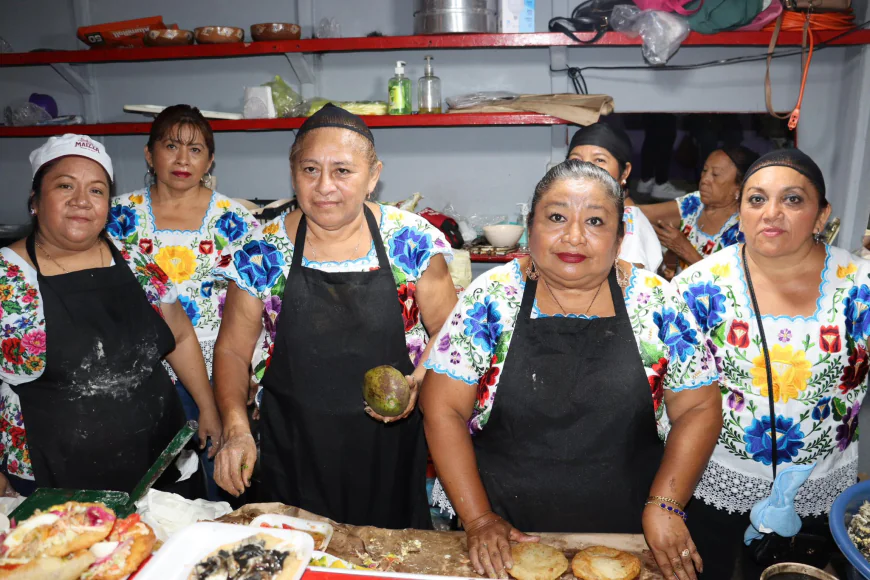
Yucatecan food is not simply a variation of the tacos, mole and chile-heavy cooking travelers may know from central Mexico.
The regional table is built around corn, turkey, pork, black beans, pumpkin seed, achiote, sour orange, habanero and recados: seasoning pastes that give many dishes their color and depth.
For a first trip, prioritize cochinita pibil, panuchos or salbutes, sopa de lima, papadzules, poc chuc and one evening marquesita. Add relleno negro, queso relleno and regional specialties once you understand the basic flavors.
 Cochinita pibil served with pickled red onion
Quick answer: what should you eat in Yucatán?
| Dish | What it is | Best time or place |
|---|---|---|
| Cochinita pibil | Achiote and sour-orange pork, traditionally cooked in a píib | Morning markets and specialist shops |
| Lechón al horno | Roast pork, often prized for crisp skin | Breakfast or early lunch |
| Panuchos and salbutes | Fried tortilla-based antojitos with meat and garnishes | Markets and casual evening eateries |
| Sopa de lima | Turkey or chicken broth with local citrus and fried tortilla | Sit-down lunch or dinner |
| Papadzules | Egg-filled tortillas with pumpkin-seed sauce | Traditional restaurants |
| Poc chuc | Thin charcoal-grilled pork with sour orange and onion | Maní and regional restaurants |
| Relleno negro | Turkey or chicken in a dark recado negro broth | Markets, fondas and traditional restaurants |
| Queso relleno | Queso de bola filled with seasoned meat and served with sauces | Sit-down regional meal |
| Huevos motuleños | Eggs, tortilla, beans, tomato sauce and garnishes | Breakfast, especially around Motul |
| Marquesitas | Crisp rolled wafer with queso de bola and optional sweet fillings | Parks and plazas after sunset |
What makes Yucatecan food different?
Yucatán’s cuisine developed from a long Maya food tradition and later layers of colonial and migrant influence.
The Maya foundations include corn, beans, squash, chile, pumpkin seed, turkey and earth-oven cooking. Spanish colonial rule introduced or expanded the use of pork, cattle, dairy, wheat and other ingredients. Lebanese migration later left a visible mark through foods such as kibis, which became thoroughly integrated into local snack culture.
Queso de bola, the Edam-style cheese used in queso relleno and marquesitas, reached Yucatán through trade and became a regional ingredient. It should not be explained as evidence of Dutch colonization or a large Dutch migrant tradition in Yucatán.
The result is a cuisine with its own internal logic rather than a simple list of outside influences.
The flavors to understand
Achiote and recado rojo
Achiote gives cochinita pibil and other dishes their earthy flavor and red-orange color. It is often combined with sour orange, garlic and spices as part of recado rojo.
Naranja agria
Sour orange brings acidity without tasting exactly like lime or sweet orange. It appears in marinades, pickled onion, grilled meat and fresh salsas.
Habanero
Habanero is central to Yucatecan cooking, but it is often served separately. The food itself does not have to be painfully hot.
Start with a small amount. A roasted habanero salsa can be much hotter than its portion size suggests.
Recado negro
Recado negro is made from heavily charred chile and spices. It gives relleno negro its dark color and smoky, savory character.
Black color does not automatically mean extreme heat. The flavor is deeper and more roasted than a fresh green or red salsa.
Pepita
Ground pumpkin seed appears in sikil pak, papadzules and other regional preparations. It gives sauces and dips an earthy, nutty quality.
The dishes to prioritize
Cochinita pibil
Cochinita pibil is pork seasoned with achiote, sour orange and spices, wrapped in banana leaf and slow-cooked.
Traditional versions are cooked in a píib, an earth oven. Many restaurants and shops use conventional ovens while following the same broad seasoning and wrapping method.
Cochinita is usually eaten in tacos or tortas with pickled red onion and habanero salsa. It is especially associated with Sunday mornings, although specialist shops may serve it on other days.
Go early. Good sellers can run out before lunch.
Lechón al horno
Lechón is roast pork with a lighter seasoning profile than cochinita. Crisp skin is often the most sought-after part.
Try cochinita and lechón side by side in tacos when a market counter serves both. They are related morning foods but taste and feel different.
Panuchos and salbutes
A panucho uses a tortilla opened and filled with black bean puree before frying. It is then topped with meat, pickled onion, avocado and other garnishes.
A salbute is a softer, puffed fried tortilla without the bean filling.
Panuchos are denser. Salbutes feel lighter in structure, although both are fried.
 Panuchos in Yucatán
Eat them soon after serving. The texture declines once the toppings sit on the tortilla.
Sopa de lima
Sopa de lima is a clear poultry broth, usually made with chicken or turkey, tomato, aromatics, local citrus and fried tortilla strips.
A good version is savory and bright rather than aggressively sour. It is useful after several heavy pork meals.
Coconut milk is not a standard defining ingredient and should not be presented as a normal coastal variation without a specific restaurant context.
 Sopa de lima with fried tortilla strips
Papadzules
Papadzules are corn tortillas filled with chopped boiled egg, covered in a pumpkin-seed sauce and finished with tomato sauce.
They are gentle, earthy and deeply regional. They are also one of the easier traditional dishes for vegetarians, although the kitchen should still confirm whether stock or lard is used.
Papadzules have pre-Hispanic ingredients and strong regional roots. Claims that they were specifically ceremonial or reserved for religious occasions should be treated cautiously unless tied to a reliable historical source.
Poc chuc
Poc chuc is thin pork cooked over charcoal or a hot grill, served with sour orange, onion, chiltomate, black beans and tortillas.
It is less saucy than cochinita and depends more on browning, smoke and acidity.
Maní is strongly associated with poc chuc and is one of the better places to build a food-led day trip. Use the Maní travel guide before driving there.
 Poc chuc with Yucatecan side dishes
Relleno negro
Relleno negro is a dark turkey or chicken dish seasoned with recado negro. It may include pork and a seasoned meat preparation called but, sometimes with boiled egg.
Order a full bowl or plate when you want to understand it. A relleno negro taco is an easier first taste.
Queso relleno
Queso relleno uses a hollowed section of queso de bola filled with seasoned minced meat. It is normally served with kol, a pale sauce often based on broth and masa, and tomato sauce.
It is not simply a cheese ball baked until golden. The sauces and meat filling are central to the dish.
Queso relleno is rich. It works better as a shared or occasional sit-down meal than as part of a large street-food crawl.
Huevos motuleños
Huevos motuleños combine tortilla, black beans, eggs and tomato sauce, commonly with peas, ham, queso de bola and fried plantain.
The dish is associated with Motul, where breakfast makes a useful half-day trip from Mérida. Versions vary, and not every plate includes the same garnishes.
Use the Motul guide if you plan to eat the dish in its home town.
Lomitos and longaniza de Valladolid
Eastern Yucatán has its own strong specialties.
Lomitos de Valladolid are pieces of pork in a tomato-based sauce. Longaniza de Valladolid is a smoky regional sausage usually served grilled or incorporated into other dishes.
These are particularly useful orders when staying in Valladolid and wanting something beyond cochinita.
Sikil pak
Sikil pak is a pumpkin-seed dip commonly made with roasted tomato, onion, herbs and seasoning.
It is served with tortilla chips or tortillas and works well as a starter. Recipes vary in texture and heat.
Kibis
Kibis are fried bulgur preparations associated with Lebanese migration to Yucatán. Street and market versions may contain meat or be served with pickled onion and chile.
Because bulgur is wheat, kibis are not gluten-free.
Tikin xic
Tikin xic is fish seasoned with achiote and sour orange, traditionally wrapped or grilled, and strongly associated with the coast.
It is a proper fish dish rather than a generic small street snack. Order it at a coastal restaurant or a place known for regional seafood.
Tamales and mucbipollo
Yucatecan tamales often use banana leaves, although styles vary.
During Hanal Pixán, families prepare mucbipollo or pib, a large tamal-like dish traditionally cooked underground. It is seasonal and tied to the observance, not an everyday restaurant order throughout the year.
Marquesitas
Marquesitas are thin wafers cooked on a pressing iron, filled and rolled while crisp.
The classic savory element is queso de bola. Sweet additions include cajeta, chocolate spread, jam or fruit.
Start with cheese alone or cheese plus one sweet filling. Heavily loaded versions can become expensive and difficult to eat.
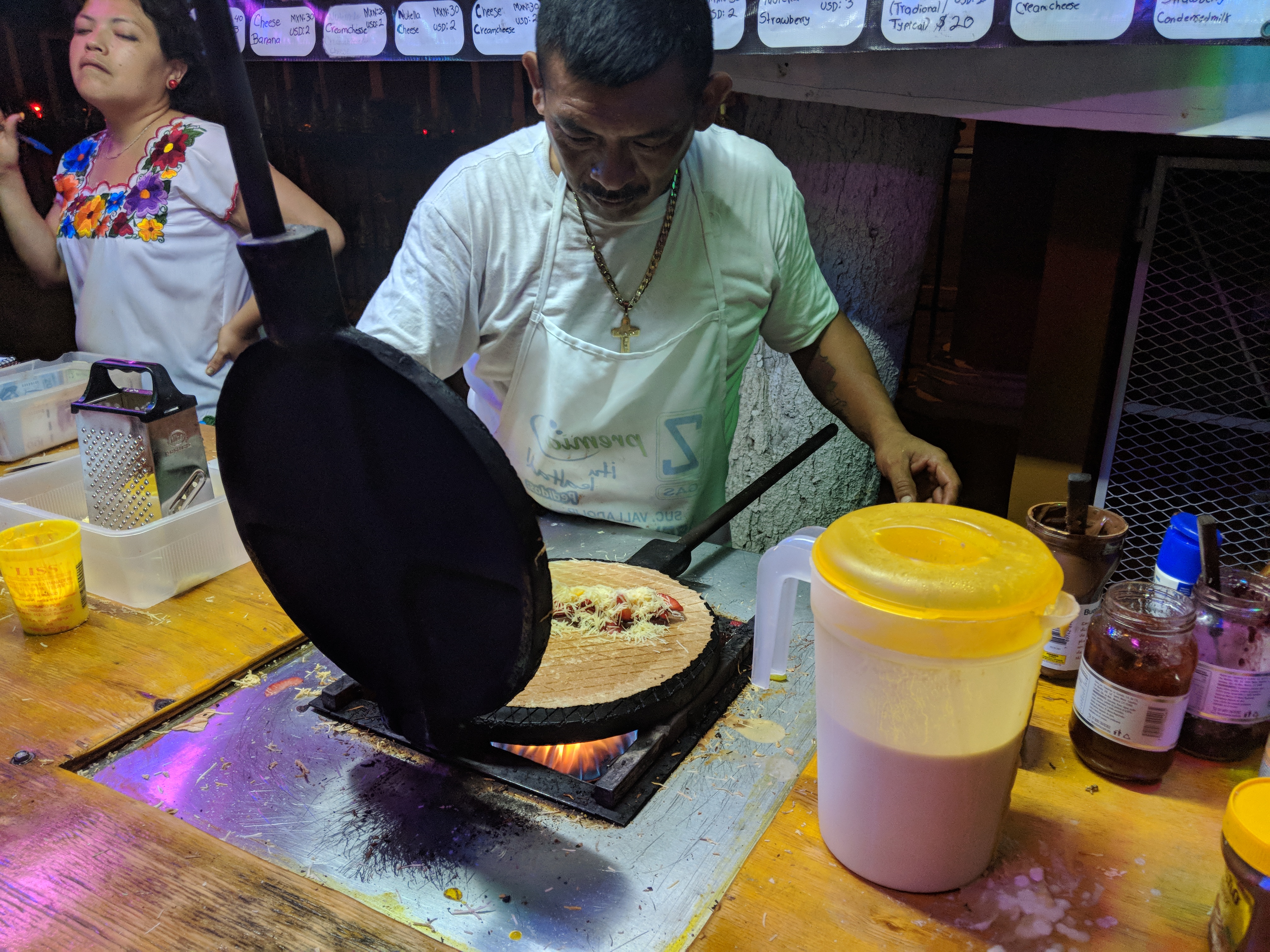 Traditional marquesitas
Where to eat Yucatecan food
Markets
Markets are useful for:
- Cochinita and lechón in the morning
- Tacos and tortas
- Panuchos and salbutes
- Juices and fruit
- Rotating lunch dishes
In Mérida, Mercado de Santiago and the Lucas de Gálvez–San Benito area are the main starting points. Read the Mérida markets guide before visiting.
Loncherías and cocinas económicas
These simple establishments may serve a small number of guisos or a daily menu.
Ask:
“¿Qué guisos tienen hoy?” — What dishes do you have today?
The day’s food may be more interesting than the permanent printed menu.
Traditional restaurants
A sit-down regional restaurant is the easiest place to order sopa de lima, papadzules, queso relleno, poc chuc and several other dishes in one meal.
This format works better for families, groups and travelers who need clear menus or dietary explanations.
Parks and plazas
Evening parks are the natural setting for marquesitas, elotes, esquites, churros and other snacks.
Do not expect the strongest cochinita or lechón after dark. Those are morning foods.
Use the Mérida street-food guide for timing and locations.
Coastal restaurants
The coast is better for:
- Tikin xic
- Ceviche
- Fried or grilled fish
- Octopus and shrimp dishes
- Seafood cocktails
Choose a busy restaurant with good turnover. Ask the price before ordering whole fish when it is sold by weight.
Where to eat by destination
Mérida
Mérida offers the widest range: markets, classic regional restaurants, modern kitchens and evening snacks.
Use separate meals for separate styles. A morning taco counter, a traditional lunch and a marquesita at night will teach you more than one enormous tasting menu.
GuideMérida Travel Guide: What to Do, Where to Stay and How to Plan Your TripMérida is the capital of the Mexican state of Yucatán, located in the northwest part of the peninsula and known as “La Ciudad Blanca” for its bright limestone architecture. The city is served by Mérida International Airport (MID), a 15‑25 minute drive to the historic centre, and by ADO bus terminals that connect to Cancún, Valladolid, Campeche and other destinations; rideshare services such as Uber and inDrive operate throughout town, while a car is only needed for longer day trips to sites like Uxmal or Celestún. The guide suggests an ideal stay of three to five nights in the city, with day trips ranging from 45 to 90 minutes. No specific entry fees are listed, but visitors should budget for accommodation, meals, transport and optional tours. The article notes that tap water is not potable, so purified water should be purchased, and that most restaurants expect a 10‑15 % tip. Travelers can expect a walkable historic centre, Sunday “bici‑ruta” streets closed to cars, lively plazas with marimba music, and a culinary scene that ranges from market breakfasts to fine‑dining in restored mansions. The climate varies: December‑March offers the mildest weather, April‑May is very hot, June‑October brings rain and humidity, and November is a transition period. Recommended packing includes breathable clothing, a wide‑brim hat, reef‑safe sunscreen (to be rinsed before entering cenotes), comfortable walking shoes and insect repellent. Tips include planning activities for early mornings and evenings to avoid midday heat, using shaded arcades in the centre, staying hydrated, and bringing a reusable water bottle with electrolytes. Modest dress is advised for churches and cultural venues, and a small fan or portable cooler can make the hot season more comfortable.Open
Valladolid
Valladolid is strong for lomitos, longaniza, escabeche oriental, cochinita and regional antojitos.
The city also makes a good base for market breakfasts and cenote-day lunches.
GuideValladolid Travel Guide: What to Do, Where to Stay and How to Plan Your TripValladolid is a small colonial town in eastern Yucatán, roughly halfway between Mérida and Cancún and within an hour’s drive of Chichén Itzá and Ek Balam. The guide suggests staying two nights for most itineraries, with three nights better for families or those who want to visit several cenotes or make day trips to Río Lagartos, Las Coloradas or Cobá. Getting there is easy by rental car, ADO bus, Tren Maya or private driver; the bus station is central, while the train station lies outside the historic centre and requires a taxi or shuttle. Within the town the historic centre, Calzada de los Frailes and the main square are all walkable, but a car, taxi, colectivo, bicycle or scooter is needed for most cenotes and ruins. Typical activities include a morning walk around the main square, visiting Iglesia de San Servacio and the municipal palace, strolling the colourful Calzada de los Frailes, and touring the Convent of San Bernardino de Siena. Cenote Zací, just outside the centre, offers a convenient swim; the local market provides cheap breakfast and snacks. Visitors should plan to start early at ruins and cenotes to avoid the heat, bring cash in small bills, wear grip sandals for cenote water, and respect church dress codes. In the hotter months (April‑May) a hotel with a pool is advisable, and the most comfortable weather is from November to March.Open
Maní
Go for poc chuc and combine lunch with the convent, town center or a wider Ruta de los Conventos day.
GuideManí Travel Guide: Pueblo Mágico of Convents and Maya HistoryA complete guide to Maní, one of Yucatán's seven Pueblo Mágicos. Discover the famous ex-convento of San Miguel Arcángel, visit the cenote Xcabachén, explore meliponarios, and taste the world's best Poc Chuc in this historic town where Maya traditions thrive.Open
Motul
Motul is most useful as a breakfast trip for huevos motuleños. Arrive early and continue toward another northern stop if traveling by car.
GuideMotul Pueblo Mágico Guide: Huevos Motuleños & Easy Mérida Day TripMotul is a newly designated Pueblo Mágico located northeast of Mérida in the former henequen region of Yucatán. It is most famous for huevos motuleños, a hearty Yucatecan breakfast, and for its ties to the political figures Felipe and Elvia Carrillo Puerto. A morning visit typically costs only the price of food, market purchases and any optional cenote entry; the article gives no fixed admission fees. The town centre is open all day, but the best time to go is early morning when the market is active and the streets are cooler. From Mérida the drive takes about 35–45 minutes, while a regional bus takes roughly one to one‑hour‑twenty minutes; a private driver or taxi is useful for reaching Cenote Sambulá or nearby coastal spots. The basic itinerary—breakfast at Mercado 20 de Noviembre, a walk around Parque Felipe Carrillo Puerto, a quick look at the Palacio Municipal and the Iglesia de San Juan Bautista—takes 2–3 hours; adding a swim at Cenote Sambulá or a coastal stop extends the day to 5–7 hours. Visitors should expect a working town with traffic, heat, uneven sidewalks and cash‑only stalls. Bring pesos for food, taxis and cenote entry, and ask for “huevos motuleños, por favor” to keep orders simple. Early arrival improves chances of a relaxed breakfast; the market and streets become busy later. If you plan to see the Carrillo Puerto museum or house, check opening hours locally as they can vary. For families, the cenote is suitable only if children are comfortable in water and adults can supervise closely. A car is not required for the town centre but makes side trips to the cenote, haciendas or the coast much easier.Open
Progreso and the coast
Choose seafood, tikin xic and a long lunch. The coast is not the place to force every inland pork specialty into one meal.
GuideProgreso Beach Guide: Malecón, Swimming, Food and Mérida Day TripsProgreso beach is a public Gulf‑side shoreline about 36 kilometres north of Mérida, reached by a straight highway or frequent Autoprogreso buses. The public beach has no entry fee and is best enjoyed in a 3–6‑hour window, though a full day is possible if side trips are added. By car the drive from the north side of Mérida takes 35–45 minutes and from the city centre 45–60 minutes; by bus the journey is 45–55 minutes. Parking is available on streets and in paid lots near the waterfront, while the bus terminal sits within walking distance of the Malecón. Facilities include restaurants, cafés, beach clubs, chair and umbrella rentals, restrooms, showers in some Blue‑Flag zones, convenience stores and pharmacies. Small vendors, chair rentals, taxis, tips and boat excursions usually require cash in pesos, although many restaurants accept cards. The Malecón is paved and partly ramped, making it more accessible than many Yucatán beaches. Visitors can expect a broad, sandy beach with shallow, calm water on most days, a lively promenade of eateries and vendors, and the world‑record‑long pier that can be viewed but not walked. Weekday mornings are quieter; Sundays, holidays and cruise‑ship days bring crowds. Bring swimwear, towel, sunscreen, a hat, sandals and a reusable water bottle, and be prepared for cash‑only payments at smaller stalls. For families, the nearby Museo del Meteorito offers a short indoor activity, and boat trips to El Corchito Ecological Reserve or Isla Columpios add mangrove and spring swimming if desired.Open
Meal timing
Timing affects what you will find.
- Early morning: cochinita, lechón, tacos de guisado, tortas and tamales
- Late morning to lunch: market food, panuchos, salbutes and daily guisos
- Main afternoon meal: regional restaurant dishes and family-style cooking
- Evening: marquesitas, corn snacks, churros and taquerías
Some morning sellers close when the food runs out. Go early when one particular dish matters.
Vegetarian, vegan and gluten-free notes
Yucatecan food uses plenty of corn, beans and pumpkin seed, but hidden animal products are common.
GuideBest Vegetarian & Vegan Restaurants in MéridaA practical guide to eating vegetarian and vegan in Mérida, from dedicated plant-based kitchens and cafés to markets, Yucatecan dishes, ordering language, and food tours.Open
Vegetarian
Possible choices include papadzules, sikil pak, cheese marquesitas, some tamales and meat-free antojitos.
Ask whether beans or sauces contain lard or meat stock.
Vegan
Request no cheese, cream, egg or mayonnaise. Confirm lard and broth.
Useful phrase:
“¿Lleva manteca o caldo de carne?” — Does it contain lard or meat stock?
Gluten-free
Corn tortillas are naturally gluten-free, but shared fryers and preparation surfaces create cross-contact.
Kibis and marquesitas contain wheat. Travelers with celiac disease should explain the requirement carefully and consider a restaurant with a controlled kitchen rather than a busy street stand.
Food-safety advice
Choose places with:
- Strong customer turnover
- Food served hot
- Covered garnishes
- Clean preparation surfaces
- Separate handling of raw and cooked ingredients
- Commercial purified ice
Rich food, habanero, heat and dehydration can cause problems even when hygiene is good. Start with moderate portions and drink water.
Bringing the flavors home
Useful ingredients include:
- Achiote paste or recado rojo
- Recado negro
- Dried oregano and regional spices
- Habanero
- Pumpkin seed
- Banana leaves
A home oven or slow cooker can produce good achiote pork, but it will not reproduce an underground píib exactly. Use banana leaf, sour orange or an appropriate citrus substitute and slow cooking. There is no need to add liquid smoke and describe the result as traditional.
Buy sealed recados from a reputable market or shop, check the ingredient list and pack liquids or pastes according to airline rules.
Common mistakes
Calling every regional dish “Maya.” Modern Yucatecan cooking reflects several historical periods.
Explaining queso de bola through Dutch colonization. Trade is the more accurate context.
Treating tikin xic as a small street snack. It is usually a proper coastal fish meal.
Looking for cochinita late at night. Go in the morning.
Assuming a vegetable-heavy dish is vegetarian. Ask about lard and stock.
Adding habanero before tasting it. Start with a few drops.
Final recommendation
For a first introduction, eat cochinita or lechón in the morning, panuchos or salbutes at a market, sopa de lima or papadzules at a traditional restaurant, poc chuc when the route allows, and a queso de bola marquesita after sunset.
That sequence shows the range of Yucatecan food without turning every meal into a checklist.
For the next step, browse Tours & Experiences, continue with the relevant destination guide, or use the seven-day Yucatán dish guide to plan what to try.